
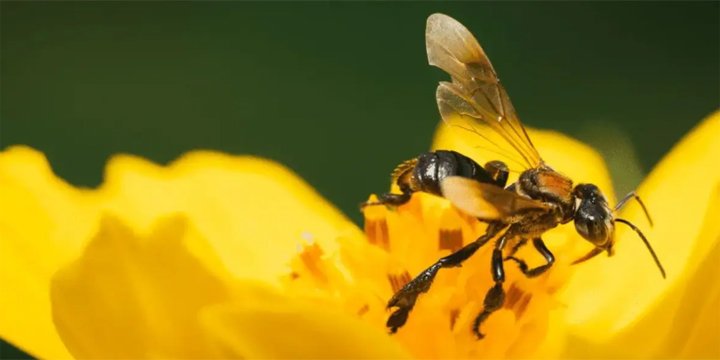
AMAZON’S STINGLESS BEE BECOMES FIRST INSECT TO GET LEGAL RIGHTS
Why in News
- Amazonian stingless bees have become the first insect species in the world to be granted legal rights.
- Two municipalities in Peru — Satipo and Nauta — passed an ordinance granting these rights.
- The move aims to strengthen conservation efforts for stingless bees, which are facing serious threats.
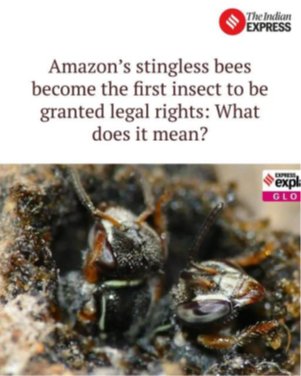
WHAT ARE STINGLESS BEES?
Basic Features
- Stingless bees are a group of bees that do not have stingers, or their stingers cannot cause pain.
- They are mainly found in tropical regions across the world.
- Out of around 500 known species, nearly half live in the Amazon rainforest.
- Peru alone has more than 170 species of stingless bees.
Ancient Species
- Stingless bees are considered the oldest bee species on Earth.
- They have existed for around 80 million years, since the time of the dinosaurs.
ECOLOGICAL IMPORTANCE
Role as Pollinators
- Stingless bees are key pollinators of tropical forests.
- In the Amazon, they pollinate more than 80% of plant species.
- They help pollinate important crops such as:
- Cacao
- Coffee
- Avocado
Importance for Forest Survival
- By supporting pollination, stingless bees help maintain:
- Forest regeneration
- Biodiversity
- Food chains
CULTURAL IMPORTANCE FOR INDIGENOUS PEOPLE
Indigenous Connections
- Stingless bees are deeply linked to the culture of:
- Asháninka people
- Kukama-Kukamiria people
4.2 Traditional Knowledge
- According to Apu Cesar Ramos, President of Eco Ashaninka of the Asháninka Communal Reserve:
- Stingless bees carry Indigenous traditional knowledge passed down for generations.
- They symbolise coexistence between humans and the rainforest.
MEDICINAL USE OF HONEY
- Asháninka communities use stingless bee honey as a traditional medicine.
- Studies show the honey has:
- Anti-inflammatory properties
- Anti-bacterial properties
- Anti-viral properties
Unique Nature of the Honey
- Stingless bee honey is different from commercial honey:
- It is not thick or gooey.
- It has high water content.
- The taste is sweet and sour
THREATS FACED BY STINGLESS BEES
Deforestation
- The biggest threat is deforestation caused by:
- Illegal logging
- Agricultural expansion
- Cattle grazing
- This has led to the loss of natural habitats.
Forest Fires
- The frequency and intensity of wildfires in the Amazon have increased.
- Fires destroy nesting sites and food sources.
Climate Change
- Rising temperatures have forced stingless bees to migrate to higher elevations.
- This separates them from communities that depend on them.
Declining Visibility
- Vásquez Espinoza, founder of Amazon Research Internacional, noted:
- Bees that were earlier found within 30 minutes of walking now take hours to locate.
- This shows a sharp decline in bee populations.
LEGAL RECOGNITION & MUNICIPAL ORDINANCE
Background Law (2024)
- In 2024, Peru passed a national law recognising stingless bees as native species.
- Under Peruvian law, native species must be protected.
Municipal Ordinance (2025)
- The new ordinance builds on the 2024 law.
- It grants legal rights to stingless bees.
RIGHTS GRANTED
The ordinance recognises the bees’ rights to:
- Exist and survive
- Maintain healthy populations
- Restore and protect their habitats
- Live in a pollution-free environment
INDIGENOUS RIGHTS & ENVIRONMENTAL JUSTICE
- The ordinance was developed in collaboration with Asháninka leaders and communities.
- It recognises that:
- Indigenous cultural and spiritual rights are inseparable from the well-being of stingless bees.
- Protecting bees also means protecting Indigenous identity and livelihoods.
FUTURE OUTLOOK
- Currently, the ordinance applies only to two municipalities.
- Efforts are underway to:
- Expand it to other regions
- Make it a national law across Peru
Note: Connect with Vajirao & Reddy Institute to keep yourself updated with latest UPSC Current Affairs in English.
Note: We upload Current Affairs Except Sunday.