

COPPER PRICES SURGE TO ALL TIME HIGH
Why in News
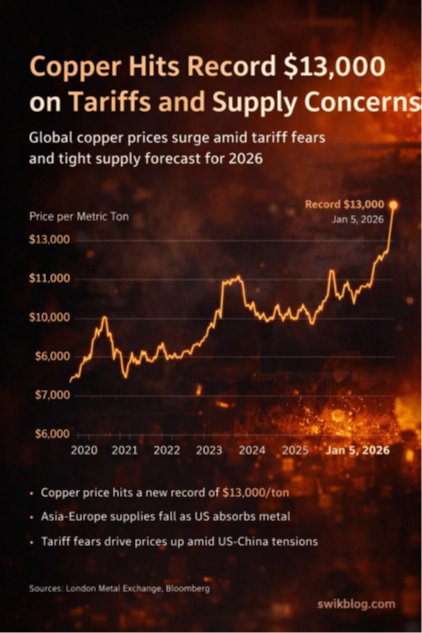
- Copper prices hit a fresh all-time high in December 2025.
- Benchmark prices crossed $12,000 per tonne on the London Metal Exchange (LME).
- Copper prices have surged over 35% in 2025, marking the biggest annual rise since 2009.
- The sharp rally has surprised markets despite moderate global economic growth.
IMPORTANCE OF COPPER IN THE ECONOMY
- Copper is a critical industrial metal.
- It is widely used in:
- Housing and construction
- Manufacturing
- Power grids and electricity transmission
- Clean energy technologies
- Artificial intelligence infrastructure
- Defence equipment
- Copper is often called a barometer of economic health:
- Rising prices indicate strong demand and growth.
- Falling prices signal economic slowdown.
KEY REASONS
Impact of Trump’s Tariffs
4.1 Tariff Announcement
- In August 2025, Donald Trump imposed a 50% tariff on:
- Semi-finished copper
- Derivative copper products
- These tariffs were announced ahead of implementation on August 1.
4.2 Stockpiling by US Buyers
- US buyers aggressively stockpiled copper to avoid future price hikes.
- Warehouses in the US saw a sharp rise in copper inventories.
- Fear that refined copper, currently exempt, may also face tariffs pushed prices higher.
Arbitrage Opportunities
- Copper trades on multiple exchanges, including:
- London Metal Exchange (LME)
- COMEX (US market)
- Prices in the US rose faster than in London, creating arbitrage opportunities.
- Traders bought copper in cheaper markets and sold in costlier US markets.
- This led to a mass movement of copper stocks to New York.
- According to reports, about 340,000 tonnes of copper are now stored in New York, up from 80,000 tonnes in January.
TIGHTENING GLOBAL COPPER SUPPLY
Disruptions at Major Mines
- Global supply was hit by accidents and natural disruptions at key copper mines:
- Indonesia:
- Mudslide at the Grasberg mine, the world’s second-largest copper mine.
- Force majeure declared; full production unlikely before 2027.
- Chile:
- A major rock blast halted operations at a large copper mine.
- Democratic Republic of Congo (DRC):
- Seismic activity caused severe underground flooding at a major mine.
- Indonesia:
Supply Impact
- These disruptions reduced global copper output.
- Supply tightened sharply at a time of rising global demand.
SURGE IN DEMAND
Artificial Intelligence and Data Centres
- Rapid expansion of artificial intelligence is driving copper demand.
- Data centres require large amounts of copper:
- Conventional data centre: 5,000–15,000 tonnes
- Hyperscale AI data centre: up to 50,000 tonnes
- Estimates are provided by the Copper Development Association.
Electric Vehicles (EVs)
- The shift to clean mobility is boosting copper consumption.
- Copper usage per vehicle:
- Conventional car: ~22.3 kg
- Electric vehicle: ~53.2 kg
- Data provided by the International Energy Agency (IEA).
Power Grids and Energy Transition
- Expansion of electricity grids and renewable energy systems requires large volumes of copper.
- Global energy transition policies are pushing long-term demand higher.
ROLE OF US DOLLAR & INTEREST RATES
- A weakening US dollar has supported copper prices.
- The dollar weakened due to expectations that the Federal Reserve may cut interest rates in 2026.
- Lower interest rates reduce the dollar’s strength.
- Since copper is priced in US dollars, a weaker dollar pushes prices higher.
DIVERGING FORECASTS ON COPPER PRICES
Bullish Views
- Citigroup:
- Forecasts copper prices could rise to $15,000 per tonne in a bullish scenario.
- Drivers include:
- Weak US dollar
- Interest-rate cuts
- Strong investor inflows
- JPMorgan:
-
-
- Expects the rally to extend into 2026.
- Cites severe supply disruptions as the key reason.
-
Sceptical Views
- Goldman Sachs:
- Expects copper prices to decline in 2026.
- Points to a modest global supply surplus next year.
- However, it believes long-term demand from:
- Power grids
- Electricity infrastructure will support prices beyond 2026.
OVERALL SIGNIFICANCE
- The copper rally reflects:
- Geopolitical trade disruptions
- Fragile global supply chains
- Structural rise in demand from AI and clean energy
- Copper is emerging as a strategic metal for the future economy.
- Price volatility may continue due to policy uncertainty and supply risks.
Note: Connect with Vajirao & Reddy Institute to keep yourself updated with latest UPSC Current Affairs in English.
Note: We upload Current Affairs Except Sunday.