
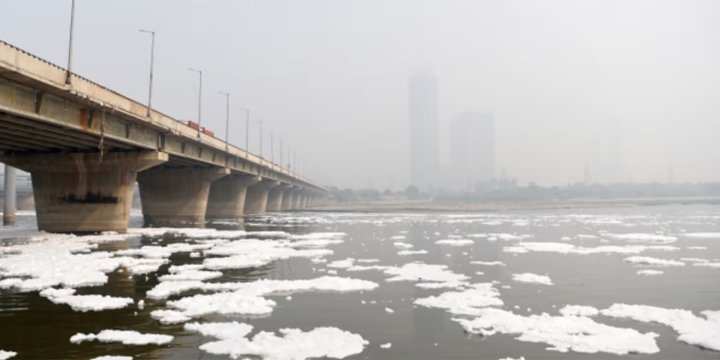
DELHI WATER CRISIS DUE TO AMMONIA SPIKE
Why in News?
- In January 2026, Delhi plunged into a massive drinking water crisis as six of its nine major Water Treatment Plants (WTPs) were forced to shut down or operate at minimal capacity.
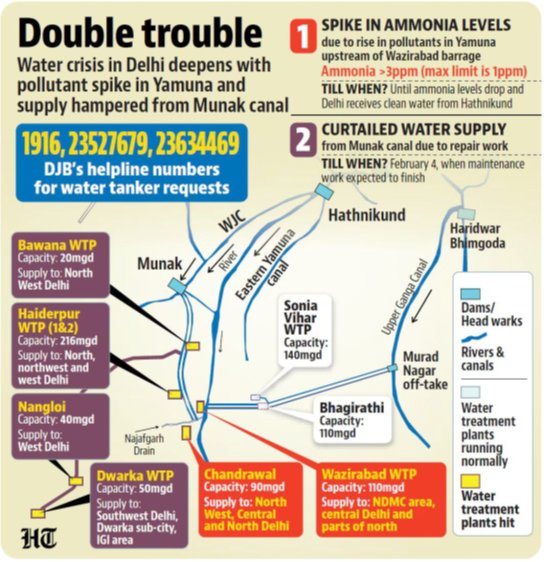
- The crisis, which disrupted supply to nearly 50% of the city, was caused by a “double blow”: record-breaking ammonia levels in the Yamuna River and the unscheduled closure of the Munak Canal for repairs.
IMMEDIATE CAUSES
- The Ammonia Spike:
- Ammonia concentrations in the Yamuna surged to 3 ppm, far exceeding the maximum treatable limit of 1 ppm for Delhi’s aging infrastructure.
- This forced the immediate shutdown of the Wazirabad and Chandrawal
- Munak Canal Closure: A critical raw water lifeline from Haryana, the Munak Canal, was closed for unscheduled maintenance on January 19, 2026.
- The Impact: Raw water supply was slashed by 50%
- Duration: Disruptions are expected to persist until February 4, 2026.
- Dilution Failure:
- Normally, ammonia is diluted by diverting fresh water from the Munak Canal into the Wazirabad pond.
- Since the canal itself was shut, no dilution was possible, leading to a total system collapse.
SCALE OF IMPACT SUPPLY SHORTFALL
- Volume: Against a normal daily demand of 1000 MGD (Million Gallons per Day), the city faced a shortfall of nearly 400-500 MGD.
- Geographic Spread: Severe shortages hit North, West, Central, and South-West Delhi.
- Lutyens’ Delhi: Even the New Delhi Municipal Council (NDMC) areas and VVIP zones experienced 45-50% supply cuts.
ABOUT NH3
- Chemical Nature:
- A colorless, pungent gas composed of nitrogen and hydrogen (NH₃).
- It is highly soluble in water, forming aqueous ammonia.
- Industrial Production: Manufactured via the Haber-Bosch process under high pressure and temperature.
- Applications:
- Agriculture: Approximately 90% of global ammonia is used in fertilizers (e.g., Ammonium Nitrate).
- Industry: Used as a refrigerant, in plastics, explosives, dyes, and pharmaceuticals.
- Environmental Hazard:
- It is highly toxic to aquatic life.
- In drinking water, it reacts with chlorine to form chloramines, reducing disinfection efficiency and altering the taste/smell of water.
CHRONIC POLLUTION & GOVERNANCE DEFICIT
- Seasonal Pattern:
- Ammonia spikes are a recurring winter phenomenon (15-22 times annually) due to reduced river flow and the concentration of industrial effluents from Haryana’s Panipat and Sonipat regions.
- Infrastructure Lag:
- Despite an announcement in the Delhi Budget 2022-23, a specialized Ammonia Treatment Plant at Wazirabad has not yet been commissioned, leaving the city vulnerable to predictable pollution events.
DELHI’S WATER DEPENDANCE MATRIX
| Source | Contribution | Status during Jan 2026 Crisis |
| Yamuna & Related Canals | 40.8% | Crippled due to high ammonia. |
| Ganga (via UP) | 26.5% | Operational; only source providing stable supply. |
| Bhakra Storage (via Haryana) | 23.1% | Reduced due to Munak Canal repairs. |
| Groundwater/Recycled | 9.6% | Insufficient to meet the massive deficit. |
GOVERNMENT & ADMINISTRATIVE RESPONSE
- Delhi Jal Board (DJB): Rationalized the remaining supply from Ganga-fed plants and deployed water tankers to parched colonies.
- Inter-State Coordination: The Delhi Government petitioned the Haryana Government to increase the release of water from the Hathini Kund Barrage to flush out the ammonia-laden water in the Yamuna.
- Judicial Oversight: The crisis has once again brought the Upper Yamuna River Board (UYRB) under the scanner for failing to ensure pollution-free raw water transit between states.
CONCLUSION
The 2026 water crisis highlights that Delhi’s water security is precariously balanced between trans-boundary river health and local infrastructure readiness. While the Ganga-fed plants provided a slim safety net, the delayed commissioning of the Wazirabad ammonia treatment facility remains a significant governance bottleneck in achieving a “Water-Plus” Delhi.
Note: Connect with Vajirao & Reddy Institute to keep yourself updated with latest UPSC Current Affairs in English.
Note: We upload Current Affairs Except Sunday.