
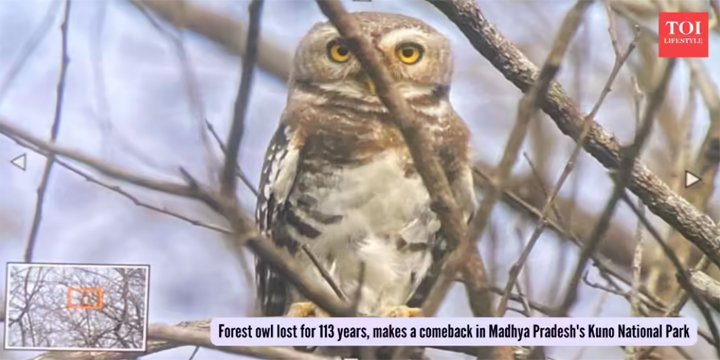
FOREST OWLET REDISCOVERED IN KUNO NATIONAL PARK AFTER 113 YEARS
Why in News?
- The Forest Owlet, a rare bird species endemic to central India, has been spotted in Kuno National Park in Madhya Pradesh after 113 years.
- The sighting is significant for biodiversity conservation and indicates improving ecosystem health in the region.
DISCOVERY IN KUNO NATIONAL PARK
- The rare bird was first spotted by Labh Yadav, a local tourism operator, in the Parond Beat area of Kuno National Park.
- After the sighting:
- Forest officials were informed
- The species was confirmed by Vivek Patel from the Wildlife Research and Conservation Society
- This marks the first recorded sighting of the Forest Owlet in Kuno National Park.
HISTORICAL BACKGROUND OF THE FOREST OWLET
- First discovered in 1872
- Last recorded sighting in 1884
- After that, the species was believed to be extinct
- However, in 1997, the bird was rediscovered in Nandurbar district of Maharashtra, surprising the scientific community.
DISTRIBUTION OF FOREST OWLET
- The species is endemic to central India.
- It has been observed in:
- Madhya Pradesh
- Maharashtra
- Gujarat
- Odisha
- Chhattisgarh
Important habitats include:
- Melghat Tiger Reserve (Maharashtra)
- Forest areas in Khandwa, Burhanpur and Betul districts of Madhya Pradesh
HABITAT OF FOREST OWLET
The species prefers:
- Tropical and Subtropical Moist Lowland Forests
- Dense Deciduous Forests
- Open Dry Deciduous Teak Forests
- Tropical Dry Forests
These habitats are mostly found in central Indian forest ecosystems.
UNIQUE FEATURES OF FOREST OWLET
- The Forest Owlet belongs to the owl family Strigidae.
- Important characteristics:
- Unspotted crown
- Full throat collar
- Heavily banded wings and tail
- Thickly feathered legs
- Unlike most owls, the Forest Owlet is diurnal, meaning it is active during the daytime.
- It usually hunts between 6 AM and 10 AM.
DIET OF FOREST OWLET
- The bird mainly feeds on:
- Rodents
- Reptiles such as lizards and skinks
- Insects
- This makes it an important part of the forest ecosystem and food chain.
CONSERVATION STATUS
- The Forest Owlet is a highly threatened species.
- Current status:
- IUCN Red List: Endangered
- CITES: Appendix I (highest level of protection against international trade)
- Global population estimate: around 250–999 adult birds.
- The biggest threat is habitat loss and forest fragmentation.
IMPORTANCE OF THE DISCOVERY
- The sighting in Kuno National Park is important because:
- It shows improvement in biodiversity conservation
- It indicates a healthy forest ecosystem
- It may be linked to broader conservation efforts such as the Cheetah Reintroduction Project
- Kuno National Park is already known for hosting cheetahs and diverse wildlife.
CONCLUSION
The rediscovery of the Forest Owlet in Kuno National Park after 113 years is a major milestone for wildlife conservation in India. It highlights the importance of protecting forest habitats and shows that effective conservation efforts can help rare species survive and recover.
Note: Connect with Vajirao & Reddy Institute to keep yourself updated with latest UPSC Current Affairs in English.
Note: We upload Current Affairs Except Sunday.