

INDIA EU FREE TRADE AGREEMENT
Announcement and overall significance of the deal
- On January 27, 2026, India and the European Union (EU) officially announced the conclusion of negotiations on a Free Trade Agreement (FTA).
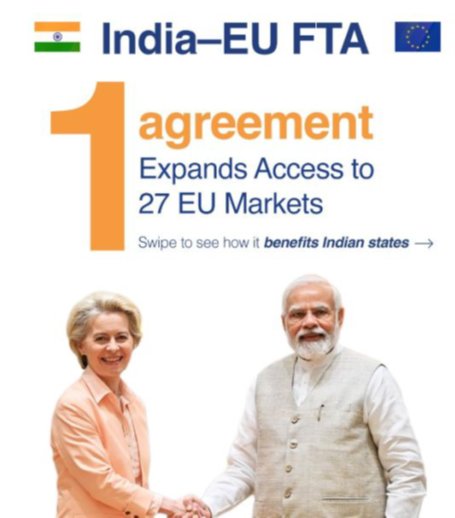
- The announcement was made at the 16th India–EU Summit by Prime Minister Narendra Modi and European Commission President Ursula von der Leyen.
- The agreement is being described as India’s largest and most ambitious FTA ever, both in terms of market access and trade coverage.
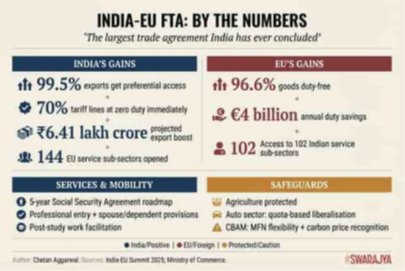
- Under the agreement, the EU will eliminate tariffs on 99.5% of Indian exports, with most duties falling to zero immediately once the agreement comes into force.
- India, in return, has offered tariff concessions on 5% of the traded value between the two economies.
WHY THIS MATTERS?
- The agreement links two of the world’s largest economic blocs, together representing nearly 1.8–2 billion people and a major share of global trade and investment.
- India, the world’s fourth-largest economy, and the European Union, the 2nd-largest economy, are now positioned as trusted global trade partners.
- Together, India and the EU:
- Account for around 25% of global GDP
- Represent nearly one-third of global trade
- According to the Ministry of Commerce & Industry, the agreement lays the foundation for:
- Inclusive growth
- Resilient and future-ready supply chains
- Stronger global economic stability at a time of fragmentation
FORMAL CONCLUSION & LEADERS INVOLVED
- The joint announcement on the conclusion of negotiations was signed by:
- India’s Commerce and Industry Minister Piyush Goyal
- EU Commissioner for Trade and Economic Security Maroš Šefčovič
- The signing took place in the presence of:
- Prime Minister Narendra Modi
- European Commission President Ursula von der Leyen
- President of the European Council António Costa
A TWO DECADES LONG NEGOTIATION PROCESS
- Negotiations for the India–EU FTA were first launched in 2007.
- Talks faced multiple pauses, setbacks, and disagreements, especially on sensitive issues such as:
- Agriculture
- Automobiles
- Intellectual property
- Services
- After a long gap, negotiations were revived in 2022, with both sides agreeing to exclude the most contentious issues to ensure progress.
- The conclusion in 2026 finally brings an end to a nearly 20-year-long negotiation process.
NEXT PROCEDURAL STEPS BEFORE IMPLEMENTATION
- According to the Ministry of Commerce and Industry:
- The agreement text will first be cleaned up and finalised over the next 10–15 days.
- This will be followed by a detailed legal scrubbing
- The final text will then be translated and sent to all 27 EU member states.
- Ratification will be required from the European Parliament before the FTA can come into force.
POLITICAL MESSAGING: MOTHER OF ALL DEALS
- Prime Minister Narendra Modi described the agreement as:
- “The largest Free Trade Agreement in India’s history.”
- He stated that the deal would:
- Improve access to the European market for Indian farmers and small industries
- Create new opportunities in manufacturing
- Strengthen cooperation in the services sector
- European Commission President Ursula von der Leyen called it:
- “The mother of all deals.”
- She described the agreement as:
-
- A “tale of two giants”, referring to the world’s second- and fourth-largest economies
- A strong message in favour of cooperation at a time of rising global trade fragmentation
SENSITIVE SECTORS PROTECTED BY BOTH SIDES
- Both India and the EU ensured that politically and economically sensitive sectors were protected.
India excluded:
- Strategic agricultural products
- Dairy sector
The EU retained tariffs on sensitive products such as:
- Beef
- Sugar
- Rice
- Chicken meat
- Milk powder
- Honey
- Bananas
- Soft wheat
- Garlic
- Ethanol
WHAT INDIA GAINS FROM THE FTA?
- India secured tariff reductions across 97% of tariff lines, covering 99.5% of trade value.
- 90.7% of India’s exports will enjoy zero-duty access from day one of implementation.


KEY LABOUR INTENSIVE SECTORS BENEFITING IMMEDIATELY
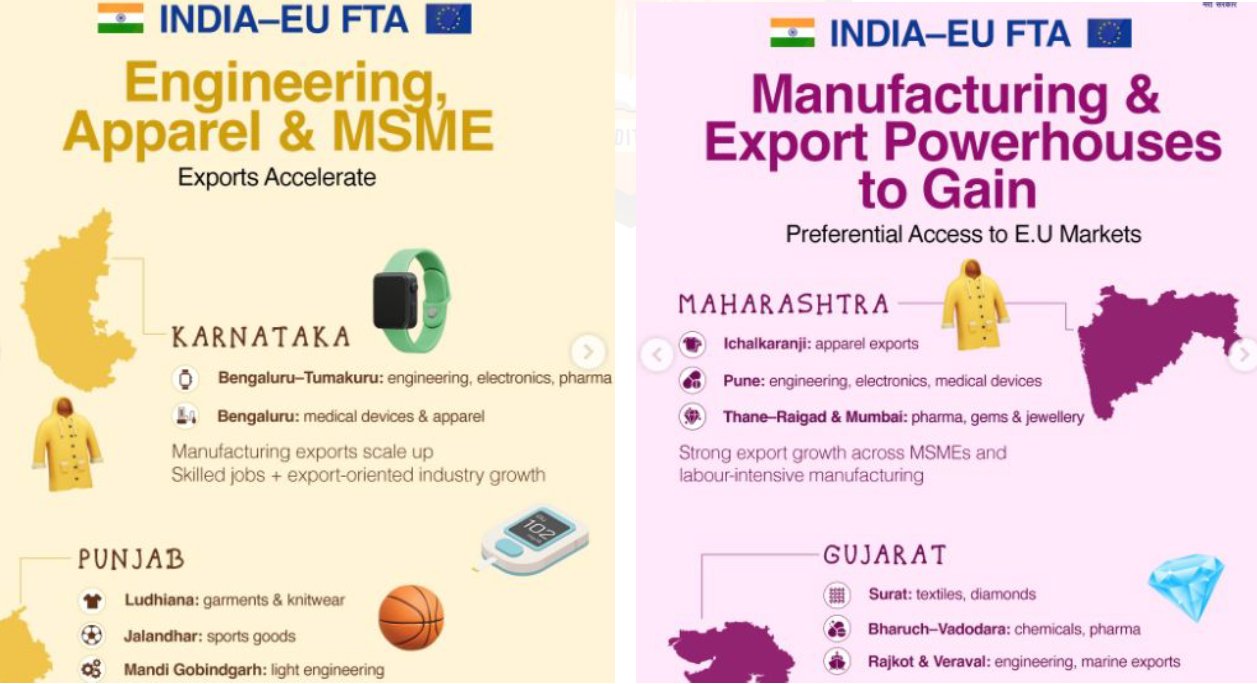
- Textiles and apparel
- Leather and footwear
- Marine products
- Tea, coffee, and spices
- Sports goods and toys
- Gems and jewellery
- 2.9% of exports will see duty elimination over 3–5 years, including:
- Certain marine products
- Processed food items
- Arms and ammunition
- 6% of exports will receive partial tariff reductions, including:
- Poultry products
- Preserved vegetables
- Bakery products
SECTOR WISE TARIFF ELIMINATION FOR INDIAN EXPORTS
- Duties will be eliminated entirely for major Indian export sectors such as:
- Marine products (up to 26% earlier)
- Chemicals (12.8%)
- Plastics and rubber (6.5%)
- Leather footwear (17%)
- Textiles and apparel (12%)
- Base metals (10%)
- Gems and jewellery (4%)
- Furniture and consumer goods (10.5%)
- Toys and sports goods (4.7%)
- According to the Ministry, these labour-intensive sectors account for ₹2.87 lakh crore (about USD 33 billion) of exports and are crucial for employment generation in India.
SERVICES MARKET ACCESS FOR INDIA
- The EU has made commitments across 144 services subsectors.
- These include:
- IT and IT-enabled services (IT/ITeS)
- Professional services
- Education services
- Business and consulting services
WHAT INDIA HAS CONCEDED TO EU?
- India has agreed to duty elimination or reduction on 92.1% of tariff lines, covering 97.5% of EU exports to India.
- 49.6% of tariff lines will see immediate duty elimination.
- 39.5% of tariff lines will see phased tariff elimination over 5, 7, or 10 years.
- Another 3% of products will receive phased tariff reductions.
KEY EU SECTORS GAINING ACCESS TO INDIA
- Machinery and electrical equipment
- Aircraft and spacecraft
- Optical, medical, and surgical equipment
- Plastics
- Precious stones and metals
- Chemicals
- Motor vehicles
- Iron and steel
- Pharmaceuticals
- Selected agricultural products
IMPACT ON INDIAN CONSUMERS & SUPPLY CHAINS
- Imports of high-technology European goods are expected to:
- Lower input costs for Indian manufacturers
- Benefit Indian consumers through lower prices
- Help Indian firms integrate into global supply chains
- Prices of products such as:
- Wine, spirits, beer, olive oil
- Chocolates, biscuits, breads
- Fruits, meat products, vegetable oils are expected to fall gradually.
MARKET ACCESS IN SERVICES FOR THE EU
- India has opened 102 services subsectors for the EU.
- These include:
- Professional and business services
- Telecommunications
- Maritime services
- Financial services
- Environmental services
RESOLUTION OF PROBLEMATIC SECTORS
Negotiations faced difficulties in sectors like automobiles and wine.
Automobiles:
- India agreed to allow European cars priced above ₹25 lakh to be imported at duties as low as 10%, compared to the current 110%.
- This concession is subject to quota limits.
- Cars are divided into three price buckets, with:
- Lower quotas for cheaper cars where Indian firms compete
- Higher quotas for premium vehicles
Wine:
- India agreed to reduce duties from 150% to 20–30%, depending on price.
- These concessions are also quota-based.
STRATEGIC & GEOPOLITICAL IMPORTANCE
- The FTA aligns with India’s goals under:
- Make in India
- Atma Nirbhar Bharat
- For the EU, the agreement offers:
-
- A strategic foothold in the world’s fastest-growing major economy
- Supply chain diversification and de-risking
- Leaders described the deal as a response to:
- Global economic uncertainty
- Rising protectionism
COOPERATION BEYOND TRADE
- India and the EU announced progress in research and innovation cooperation.
- Work is underway to associate India with Horizon Europe, the world’s largest public research and innovation programme.
- Artificial intelligence was identified as a priority area for collaboration.
- An agreement on mobility was signed to facilitate:
- Movement of students
- Researchers
- Skilled professionals
- This will strengthen people-to-people ties and academic exchanges.
TRADE, INVESTMENT & ECONOMIC SCALE
- The EU remains one of India’s largest trading partners.
- In 2024–25:
- Trade in goods stood at USD 136.54 billion
- Trade in services reached USD 83.1 billion
- The integration of two large and complementary economies is expected to create unprecedented trade and investment opportunities.
STRATEGIC IMPORTANCE FOR INDIA
- The India–EU FTA becomes India’s 22nd Free Trade Agreement.
- Along with recent FTAs with:
- UAE
- Australia
- UK
- EFTA
- It effectively opens the entire European market to Indian exporters and entrepreneurs.
- Since 2014, India has signed FTAs with Mauritius, UAE, Australia, Oman, the UK, EFTA, and announced a deal with New Zealand.
CONCLUSION
The India–EU Free Trade Agreement of January 2026 is a historic economic milestone that concludes two decades of negotiations.By opening markets, protecting sensitive sectors, and deepening cooperation in trade, services, technology, and research, the deal strengthens India’s global economic integration and positions both partners to face future global challenges through cooperation rather than isolation.
Note: Connect with Vajirao & Reddy Institute to keep yourself updated with latest UPSC Current Affairs in English.
Note: We upload Current Affairs Except Sunday.