
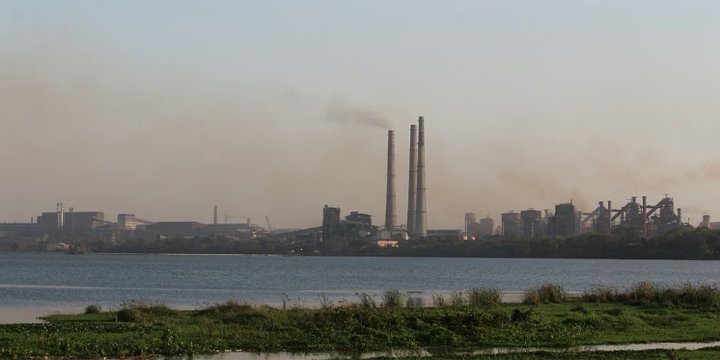
INDIA LACKS SO2 EMISSION STANDARDS FOR STEEL PLANTS
Why in News?
- A report by the Centre for Research on Energy and Clean Air (CREA) stated that India still lacks national standards for Sulphur Dioxide (SO₂) emissions from steel plant stacks.
- The report highlighted the case of the Bokaro Steel Plant (SAIL) in Jharkhand, which is significantly affecting child health and local air quality.
WHAT IS THE KEY ISSUE?
- India does not have specific national SO₂ emission standards for many steel production units, such as:
- Sinter Plants
- Mill Zones
- Refractory Material Plants
- These units are recognised sources of SO₂ emissions, but regulatory limits are absent.
- This regulatory gap can increase air pollution exposure for nearby populations.
HEALTH IMPACT OF BOKARO STEEL PLANT
- According to the Health Impact Assessment (HIA) conducted by CREA, the plant’s emissions caused significant health effects.
Impact on Children (Per Year)
- 270 Low Birthweight Births
- 280 Preterm Births
- 25 New Cases of Child Asthma
Impact on Adults
- Around 170 deaths annually linked to exposure to 5 and Nitrogen Dioxide (NO₂)
- About 290 asthma-related emergency hospital visits
ECONOMIC IMPACT
- Air pollution from the plant also causes economic losses.
- Around 123,000 workdays lost annually due to pollution-related illnesses
- Estimated economic burden of about US$80 million (₹640 crore) in 2023
- This reflects lost productivity and healthcare costs.
REASONS FOR HIGH IMPACT
- The report highlighted several issues:
- Heavy use of Coal and Coke in steel production
- Incomplete installation of Electrostatic Precipitators (ESPs)
- Continued use of Outdated Cyclone Dust Collectors
- Out of six sinter stack ducts, only two have modern pollution-control equipment.
STEEL SECTOR AS A MAJOR POLLUTER
- The Central Pollution Control Board (CPCB) classifies the steel industry as one of the 17 Highly Polluting Industries in India.
- Key facts:
- Current steel production capacity: ~200 million tonnes per year
- Planned capacity by 2030: 300 million tonnes
- India accounts for 57% of global coal-based steelmaking capacity under development
- This indicates rapid expansion with significant pollution risks.
WEAK MONITORING & TRANSPARENCY
- In 2014, CPCB mandated installation of Continuous Emission Monitoring Systems (CEMS) in highly polluting industries.
- However, problems remain:
- Incomplete implementation of CEMS
- Poor calibration and regulation
- Limited public access to emission data
- Lack of historical pollution records
- This reduces transparency and accountability.
ENVIRONMENTAL CONCERNS
- Experts warn that rapid expansion of steel production may lead to:
- Increased Air Pollutant Emissions
- Higher Greenhouse Gas Emissions
- Greater Environmental Degradation
- Without stricter regulations, India risks following a “Pollute Now, Clean Later” industrial model.
IMPORTANCE OF STRONGER REGULATION
Experts recommend:
- Setting National SO₂ Emission Standards for Steel Plants
- Strengthening Pollution Monitoring Systems
- Increasing Data Transparency
- Promoting Cleaner Steel Production Technologies
This is essential to protect Public Health and Environment.
CONCLUSION
The CREA report on Bokaro Steel Plant highlights a broader national issue — weak pollution standards in India’s steel sector. As India expands steel production, it is crucial to introduce strict emission standards, transparent monitoring, and cleaner technologies to prevent long-term health, environmental and economic damage.
Note: Connect with Vajirao & Reddy Institute to keep yourself updated with latest UPSC Current Affairs in English.
Note: We upload Current Affairs Except Sunday.