
INDIA’S ENERGY SECURITY STRATEGY
Why in News?
In December 2025, the Ministry of Petroleum & Natural Gas (MoPNG) released its Year-End Review, detailing a multi-pronged strategy that has successfully balanced affordability, sustainability, and strategic autonomy. Amid global volatility, India achieved a landmark milestone in June 2025 by meeting 50% of its cumulative electric power capacity from non-fossil fuel sources—five years ahead of its 2030 Paris Agreement target.
KEY ACHIEVEMENTS
The government’s 2025 strategy focused on “de-carbonizing” the energy mix while expanding traditional infrastructure.
1. Clean Cooking & PMUY 2.0
- Saturation Goal: Pradhan Mantri Ujjwala Yojana reached 10.35 crore active connections.
- Consumption Surge: The targeted subsidy of 300 per cylinder (continued for FY 2025-26) boosted average refills to a record 4.85 per annum.
- Safety First: Conducted over 12.12 crore free safety inspections at consumer premises via a nationwide campaign.
2. Gas-Based Economy: “One Nation, One Gas Grid”
- Network Expansion: The operational gas pipeline network grew to 25,429 km (with 10,459 km more under execution).
- Unified Tariff: Implementation of the Unified Pipeline Tariff regime now covers 90% of the grid, eliminating the “distance-based” cost disadvantage for distant states.
- City Gas: Domestic PNG connections reached 1.57 crore, and CNG stations crossed the 8,400 mark.
3. Biofuels & Green Aviation
- Ethanol Blending: Reached 19.24% (on track for 20% by 2026).
- CBG Mandate: Compulsory Compressed Bio-Gas (CBG) blending in CNG/PNG started in FY 2025-26.
- Sustainable Aviation Fuel (SAF): Established a roadmap for 1-5% SAF blending in ATF beginning in 2027.
STRATEGIC PETROLEUM RESERVES (PHASE 2)
India’s energy “insurance policy” relies on underground salt caverns and rock storage.
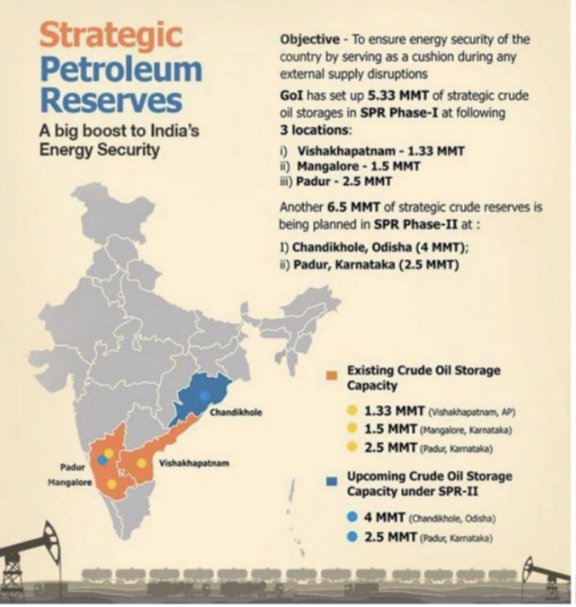
- Current Capacity: 5.33 MMT (sustaining ~9.5 days of requirement).
- SPR Phase II: Advancement of new commercial-cum-strategic facilities:
- Chandikhol (Odisha): 4 MMT capacity.
- Padur (Karnataka) Expansion: 2.5 MMT capacity.
- The Gap: Total storage (including OMCs) currently sustains 77 days, still 13 days short of the IEA-mandated 90-day supply.
CHALLENGES
Despite the shift toward renewables, structural vulnerabilities persist:
- The Import Challenge: Crude oil import dependence climbed to 89% in FY2025 as domestic production dipped to 28.7 MT.
- Geopolitical “Sanction Friction”: India’s reliance on Russian oil (~36% share) triggered punitive measures from the U.S. and EU in 2025, forcing a “re-evaluation” of strategic trust.
- Critical Mineral Bottleneck: India remains 100% dependent on imports for 10 key minerals (Lithium, Cobalt, Nickel) essential for the EV and battery storage transition.
- Concentration Risk: Over 60% of India’s solar and wind projects are located in just three states (Gujarat, Rajasthan, Tamil Nadu), increasing vulnerability to regional weather shocks or hybrid threats.
TRANSITIONING THE POWER SECTOR
| Source | Capacity (Nov 2025) | % of Total |
| Total Non-Fossil Fuel | 262.74 GW | 51.5% |
| Solar Power | 132.85 GW | Dominant Driver |
| Wind Power | 53.99 GW | Steady Growth |
| Thermal (Coal/Gas) | 246.90 GW | Still Base Load |
WAY FORWARD: 2026 ROADMAP
- Mission Anveshan: Deepening exploration in frontier basins like the Andaman Islands and Krishna-Godavari.
- Battery Mandate: Integrating a 4-hour battery storage requirement in all new renewable tenders to ensure grid stability.
- Global Alliances: Championing the One Sun One World One Grid (OSOWOG) to enable cross-border clean energy trade.
- Nuclear Integration: Fast-tracking Small Modular Reactors (SMRs) with international partners (USA, France) to replace aging thermal plants.
CONCLUSION
India’s 2025 energy performance marks a transition from fossil-dependency to strategic diversification. While “Green Growth” is the destination, the short-term focus remains on securing affordable crude and expanding the gas grid to shield the common citizen from global price volatility.
Note: Connect with Vajirao & Reddy Institute to keep yourself updated with latest UPSC Current Affairs in English.
Note: We upload Current Affairs Except Sunday.