
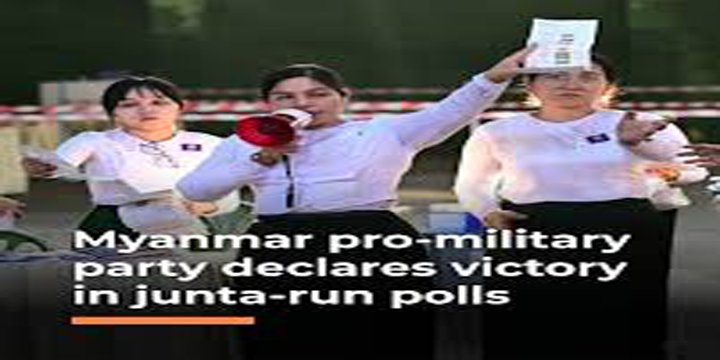
MYANMAR’S PRO MILITARY PARTY (USDP) SECURES VICTORY IN JUNTA RUN POLLS
What happened in Myanmar?
- On January 26, 2026, Myanmar’s dominant pro-military party, the Union Solidarity and Development Party (USDP), declared victory in the country’s junta-run elections.
- The announcement came a day after the third and final phase of voting, which concluded on Sunday.
- A senior USDP official stated that the party had already secured a majority and was in a position to form a new government.
- Official election results are expected to be released later this week.
WHO DECLARED THE VICTORY & WHAT WAS SAID?
- A senior official of the USDP, speaking anonymously, told media agencies:
- “We won a majority already.”
- “We are in the position to form a new government.”
- “As we won in the election, we will move forward.”
- The official said they were not authorised to release preliminary results, but confirmed the party’s confidence in victory.
BACKGROUND: MYANMAR’S MILITARY TAKEOVER
- Myanmar has been under military rule since February 2021, when the armed forces staged a coup d’état.
- The coup overthrew the democratically elected government led by Aung San Suu Kyi.
- Since the coup:
- Suu Kyi has remained detained
- Her party, the National League for Democracy (NLD), has been dissolved
- The military justified the takeover by alleging election fraud in the 2020 elections, which the NLD had won by a landslide.
NATURE OF USDP
- The Union Solidarity and Development Party (USDP) is widely viewed as a civilian proxy of the Myanmar military.
- Analysts describe the party as closely aligned with the armed forces, rather than an independent civilian political force.
- The military previously governed Myanmar directly and later used the USDP as a political vehicle during earlier periods of controlled democracy.
WHY ARE THE ELECTIONS CONTROVERSIAL?
- Democracy watchdogs and analysts have strongly criticised the polls, calling them:
- A rebranding of military rule
- A process designed to give the junta civilian legitimacy
- Critics argue that:
- The ballot was stacked in favour of military allies
- Major opposition forces were barred from contesting
ABSENCE OF KEY POLITICAL PARTIES
- According to the Asian Network for Free Elections, parties that had won around 90% of seats in the 2020 election were not allowed to participate this time.
- This effectively excluded:
- Pro-democracy parties
- Former ruling forces with popular support
- As a result, voters were left with limited political choices, heavily tilted towards the military-backed establishment.
VOTING NOT HELD ACROSS THE COUNTRY
- Voting did not take place in large parts of Myanmar.
- These areas are controlled by:
- Rebel groups
- Armed resistance factions
- The ongoing civil war, triggered by the 2021 coup, made polling impossible in these regions.
- This has raised serious questions about the national mandate of the election.
SECURITY ENVIRONMENT DURING THE POLLS
- In areas controlled by the junta:
- Political dissent has been systematically suppressed
- New laws criminalise:
- Protests
- Criticism of the election
- Punishments can include up to 10 years in prison.
- According to the Assistance Association for Political Prisoners (AAPP):
- More than 22,000 people are currently imprisoned in junta jails.
ROLE OF JUNTA CHIEF
- On Sunday, junta leader Min Aung Hlaing was seen touring polling stations in civilian clothing in Mandalay.
- He did not rule out becoming president under the new political arrangement.
- Under Myanmar’s system:
- The president is chosen by a majority of Members of Parliament
- Parliament is expected to convene in March 2026
MILITARY STRATEGY BEHIND THE ELECTION
- Analysts say the military has carefully stage-managed the election.
- The objective was to:
- Retain real power
- Create a veneer of civilian governance
- Five years after the coup, the election is seen as an attempt to:
- Normalise military rule
- Reduce international pressure
INTERNATIONAL REACTION & CONCERNS
- The response of the international community is seen as crucial.
- UN Special Rapporteur Tom Andres warned that:
- The election outcome inside Myanmar was never in doubt
- What mattered most was international acceptance or rejection
- He stated that recognising the election would:
- Legitimize a fraudulent political exercise
- Set back prospects for resolving Myanmar’s crisis
BROADER IMPLICATIONS
- The elections do not resolve:
- The civil war
- Political repression
- The legitimacy crisis
- Instead, they may:
- Entrench military control
- Further isolate Myanmar internationally
- Prolong internal conflict
Note: Connect with Vajirao & Reddy Institute to keep yourself updated with latest UPSC Current Affairs in English.
Note: We upload Current Affairs Except Sunday.