
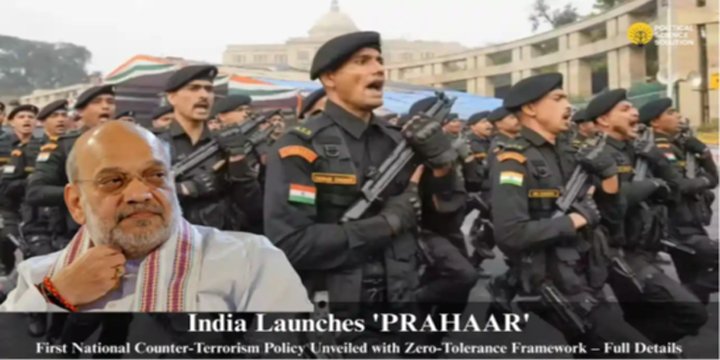
PRAHAAR: INDIA’S FIRST COUNTER TERRORISM POLICY
Why in News?
- The Ministry of Home Affairs (MHA) launched India’s first comprehensive National Counter-Terrorism Policy and Strategy called “PRAHAAR”.
- It marks a shift from a reactive approach (after attack) to a proactive, intelligence-driven approach (preventing attacks before they happen).
WHAT IS PRAHAAR?
PRAHAAR is an acronym. Each letter represents a pillar of the strategy:
- P – Prevention of terror attacks
- R – Response (swift and proportionate action)
- A – Aggregating capacities (whole-of-government approach)
- H – Human rights and Rule of Law
- A – Attenuating radicalisation
- A – Aligning international efforts
- R – Recovery and resilience
It follows a Whole-of-Government and Whole-of-Society approach.
KEY PILLARS OF PRAHAAR
1. Prevention
India will adopt a proactive and intelligence-led system.
Important mechanisms
- Multi Agency Centre (MAC)
- Joint Task Force on Intelligence (JTFI)
Focus areas:
- Prevent misuse of Internet and Social Media
- Break Over-Ground Worker (OGW) networks
- Stop Terror Funding
- Use Advanced Border Technologies
- Protect Critical Infrastructure (Power, Railways, Aviation, Ports, Defence, Space, Atomic Energy)
2. Response
- Local Police as first responders
- Support from State Counter-Terror Forces and CAPFs
- National Security Guard (NSG) for major attacks
- National Investigation Agency (NIA) for investigation and prosecution
Goal: Swift action and strong legal deterrence.
3. Aggregating Capacities
Focus on:
- Modern weapons and technology
- Standardised Anti-Terror Structure
- Advanced training by BPR&D, CAPFs, and NSG
Aim: Better Inter-Agency Coordination and uniform capacity across states.
4. HUMAN RIGHTS & RULE OF LAW
The strategy balances National Security with Fundamental Rights.
Legal framework includes:
- Unlawful Activities (Prevention) Act (UAPA), 1967
- Bharatiya Nyaya Sanhita, 2023
- Bharatiya Nagarik Suraksha Sanhita, 2023
- Bharatiya Sakshya Adhiniyam, 2023
- Prevention of Money Laundering Act (PMLA), 2002
- Arms Act, 1959
Ensures:
- Judicial Oversight
- Due Process
- Right to Appeal
5. ATTENUATING RADICALISATION
A Soft-Power Approach to address root causes.
Focus on
- Role of Community Leaders and NGOs
- De-radicalisation Framework
- Rehabilitation of vulnerable youth
- Action against hardcore elements
- Prevent Prison Radicalisation
- Promote Socio-Economic Empowerment
6. ALIGNING INTERNATIONAL EFFORTS
Terrorism is Transnational in nature.
India will use:
- Mutual Legal Assistance Treaties (MLATs)
- Extradition Treaties
- Joint Working Groups (JWGs)
- Cooperation at United Nations (UN)
Goal: Deny Safe Havens to terrorists.
7. RECOVERY & RESILIENCE
Adopts a Whole-of-Society Approach.
- Strong Public-Private Partnership
- Rapid restoration after attack
- Build long-term Community Resilience
EMERGING TERROR THREATS
- State-Sponsored Cross-Border Terrorism
- Influence of ISIS and Al-Qaeda
- Drone-Based Attacks (Punjab, J&K)
- Criminal-Terror Nexus
- Misuse of Social Media and Dark Web
- Cryptocurrency Financing
- Cyber Attacks on critical systems
- CBRNED Threats (Chemical, Biological, Radiological, Nuclear, Explosive, Digital)
IMPLEMENTATION CHALLENGES
1. Federal Issues
- “Police” and “Public Order” are State List subjects.
- Possible Centre-State Coordination issues.
2. Capacity Gaps
- Local police may lack advanced cyber training.
- Financial constraints for states.
3. Subjectivity in De-radicalisation
- Measuring radicalisation is psychological and complex.
- Risk of profiling or misuse.
4. Legal Concerns
- Low conviction rates under strict laws.
- Long Pre-Trial Detentions.
5. Inter-Agency Silos
- Need for seamless Real-Time Intelligence Sharing.
6. Measures to Strengthen PRAHAAR
- Improve Intelligence Sharing Mechanisms
- Upgrade State ATS and Counter-Terror Units
- Use AI, Big Data and Machine Learning
- Track Crypto-Based Terror Funding
- Amend IT Rules to control extremist content
- Create Specialised Federal Prosecutors
- Fast-track International Digital Evidence Sharing
Note: Connect with Vajirao & Reddy Institute to keep yourself updated with latest UPSC Current Affairs in English.
Note: We upload Current Affairs Except Sunday.