
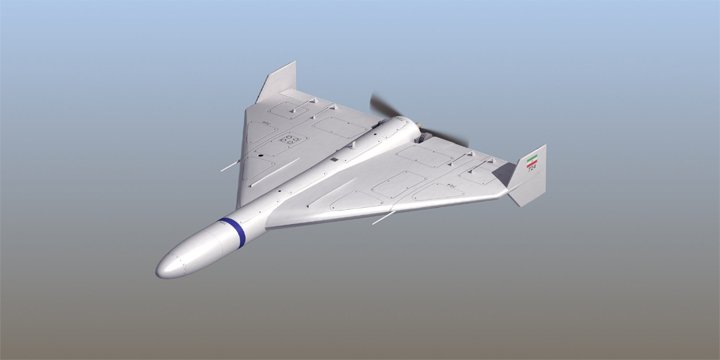
SHAHED 136 DRONE ATTACKS
Why in News?
- During the ongoing West Asia conflict, Iran has repeatedly used Shahed-136 drones to attack military targets linked to United States bases in the Gulf region.
- Reports suggest these attacks have damaged radar and communication infrastructure in several countries hosting US military facilities.
- The conflict highlights a new warfare pattern where low-cost drones challenge expensive air defence systems.
WHAT IS SHAHED 136 DRONES?
- The Shahed-136 is an Iranian loitering munition (suicide drone).
- Key characteristics:
- Designed to hover in the air before striking a target
- Operates as a one-way attack drone
- Carries an explosive payload
- Because of its low cost and simple design, it can be deployed in large numbers.
IRAN’S STRATEGY: PROJECTILE SATURATION
- Iran is using a strategy known as projectile saturation.
- This means launching large numbers of drones and missiles simultaneously to overwhelm enemy air defence systems.
- Instead of relying on precision weapons, the strategy focuses on:
- Mass deployment
- Continuous attacks
- Exhausting enemy interception systems.
COST COMPARISON
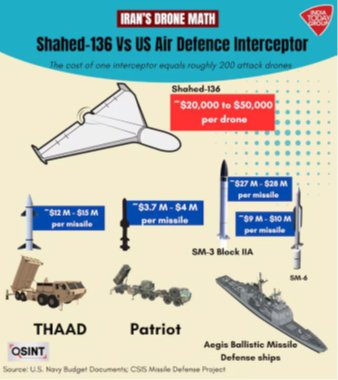
- One major reason for the effectiveness of this strategy is the huge cost difference between attack drones and interception missiles.
- Cost of Shahed-136 Drone
- USD 20,000 – USD 50,000
- About ₹18 lakh – ₹46 lakh
| Defence System | Approx Cost per Interceptor |
| Patriot Missile System | USD 3.7 – 4 million (₹34–37 crore) |
| THAAD Interceptor | USD 12 – 15 million (₹110–137 crore) |
| SM-6 Missile | USD 9 – 10 million (₹82–92 crore) |
| SM-3 Missile | USD 27 – 28 million (₹247–256 crore) |
This means one interceptor missile may cost as much as dozens or even hundreds of drones.
IMPACT ON US AIR DEFENCE SYSTEMS
- Iran’s drone attacks are putting pressure on advanced US missile defence systems, including:
- Patriot Air Defence System
- THAAD (Terminal High Altitude Area Defence)
- Aegis Ballistic Missile Defence System
- These systems rely on high-cost interceptor missiles, which are limited in number.
- If attacks continue at the same pace, there is concern that interceptor stocks could be exhausted faster than Iran runs out of drones.
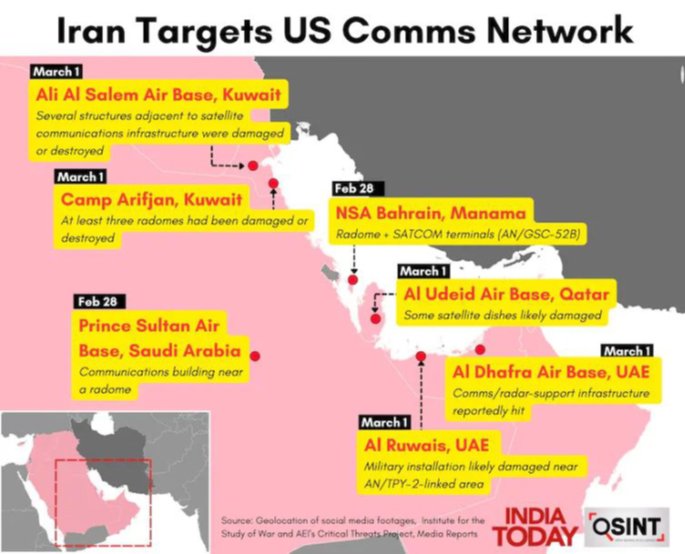
TARGETED INFRASTRUCTURE
- Reports suggest Iranian strikes targeted communication and radar infrastructure at US-linked military bases in several Gulf countries.
- Possible affected locations include:
- Ali Al Salem Air Base – Kuwait
- Camp Arifjan – Kuwait
- Manama facilities – Bahrain
- Prince Sultan Air Base – Saudi Arabia
- Al Udeid Air Base – Qatar
- Al Dhafra Air Base – United Arab Emirates
- Al Ruwais military installation – UAE
Damage reportedly included:
- Radar domes (Radomes)
- Satellite communication terminals
- Communication buildings
These facilities are part of the regional air defence coordination network.
IMPORTANCE OF RADAR COMMUNICATION SYSTEMS
- These installations form the communication backbone of US military operations in the Gulf.
- They support:
- Missile detection systems
- Satellite communication
- Air defence coordination
- Early warning networks
- Damage to these systems can disrupt regional defence coordination.
ABOUT THE THAAD MISSILE DEFENCE SYSTEM
- The Terminal High Altitude Area Defence (THAAD) system is one of the most advanced missile defence platforms developed by the United States.
- Main Purpose
- Designed to intercept short, medium and intermediate-range ballistic missiles during the final stage of flight.
KEY FEATURES OF THAAD
- Uses “Hit-to-Kill” technology (destroys targets through direct collision)
- Can intercept missiles inside and outside the Earth’s atmosphere
- Engagement range: 150–200 km
- Part of the broader Ballistic Missile Defence System (BMDS).
COMPONENTS OF A THAAD BATTERY
A typical THAAD battery includes:
- Interceptor missiles
- Truck-mounted launchers
- AN/TPY-2 radar system
- Fire control and communication unit
- Logistics and support equipment
Personnel strength: around 90 personnel.
A battery usually contains:
- 6 launchers
- 48 interceptors
- Each launcher carries 8 missiles.
CONCLUSION
The increasing use of Shahed-136 drones by Iran shows a shift in modern warfare toward low-cost, mass-produced weapons that can challenge expensive defence systems. By launching large numbers of drones, Iran is attempting to overwhelm and economically strain advanced US air defence systems, highlighting a growing asymmetry between inexpensive attack technologies and costly missile interception systems.