
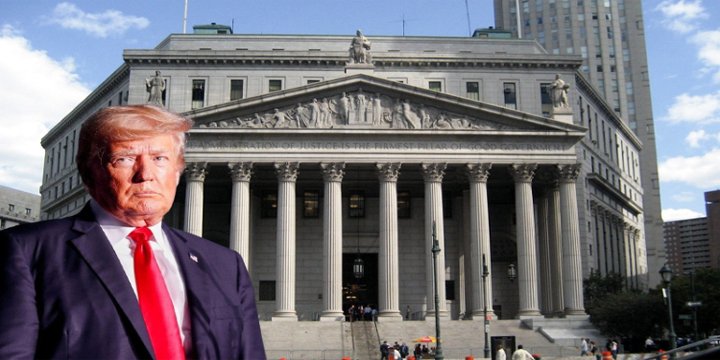
US SUPREME COURT ON TRUMP TARIFFS
What Happened?
- The S. Supreme Court gave a 6–3 judgment and struck down President Donald Trump’s emergency tariffs.
- These tariffs were imposed under the International Emergency Economic Powers Act (IEEPA), 1977.
- The Court said the President cannot use emergency powers to impose broad trade tariffs without approval from Congress.
- However, after this setback, Trump imposed a 15% global import surcharge for 150 days under Section 122 of the Trade Act, 1974.
This has major implications for:
- S. Constitutional System
- Global Trade
- India–U.S. Trade Relations
MAIN CONSTITUTIONAL ISSUE
Who has the power to impose tariffs?
- The S. Constitution gives power to levy taxes and tariffs to Congress.
- Trump used IEEPA (emergency law) without Congressional approval.
- The Court ruled this was executive overreach.
This case highlights Separation of Powers:
- Congress makes tax and trade laws.
- The President cannot replace Congress in trade matters.
The judgment strengthened Judicial Review and limited Executive Authority.
ABOUT IEEPA
- Passed under President Jimmy Carter.
- Mainly used to:
- Freeze foreign assets
- Impose sanctions
- It does not clearly mention tariffs.
Trump became the first President to use IEEPA to impose wide trade tariffs.
TRUMP’S TARIFF STRATEGY
Tariffs were used as:
- A Revenue-Generating Tool
- A Pressure Mechanism
- A way to Renegotiate Trade Deals
Countries targeted:
- China
- Canada
- Mexico
- India
- Brazil
“Liberation Day” Tariffs (April 2025)
- Announced Reciprocal Tariffs.
- Justified under National Emergency due to trade deficit.
- Linked to Fentanyl Trafficking and Migration
ECONOMIC IMPACT
- Around $175 billion collected under IEEPA tariffs.
- Record customs duty collection in 2025.
- Possible refund liability after Court ruling.
- Increased market uncertainty and volatility.
If the verdict was fully implemented, average tariff could fall from 15% to around 8%.
LEGAL CHALLENGES
Tariffs were challenged by:
- Small Importing Businesses
- 12 U.S. States
- Other affected groups
Court clearly stated: Emergency powers cannot substitute legislative trade authority.
NEW DEVELOPMENT: 15% GLOBAL TARIFF SURCHARGE
- After the IEEPA setback, the administration invoked Section 122 – Trade Act, 1974.
Key Features of Section 122:
- Allows temporary surcharge up to 15%
- Valid for 150 days
- Used to address Balance of Payments issues
Trump imposed a 15% ad valorem surcharge on global imports (earlier 10%). It applies to all countries including India.
COMPARISON OF TARIFF RATES
- Under IEEPA: Around 22%
- After Court Verdict (without surcharge): Around 8%
- New Surcharge: 15%
India benefits compared to earlier high tariffs. But India loses opportunity for much lower 8% tariff.
GOODS EXEMPTED FROM 15% SURCHARGE
Exempted sectors:
- Strategic and Technology Goods
- Critical Minerals and Metals
- Energy Products
- Aerospace Products
- Electronics
- Pharmaceuticals
- Vehicles and Auto Components
- Certain Agricultural Products
This shows U.S. Supply Chain Dependence.
IMPACT ON INDIA
Positive
- Tariff reduced from 18–22% to 15%.
- Relief in sectors like:
- Aircraft Parts
- Auto Components
Negative
- Expected tariff reduction to 8% did not happen.
- Pressure on:
- Engineering Goods
- Textiles
- Chemicals
India’s Commerce Ministry is assessing impact.
IMPACT ON INDIA USA TRADE DEAL
- India and the U.S. are negotiating an Interim Trade Agreement.
- New tariff situation changes dynamics:
- S. signalled India will continue paying tariffs.
- S. may demand greater market access.
- Tariffs used as negotiation leverage.
Key issues:
- Market Access
- Rules of Origin
- Supply Chain Diversification
OTHER TARIFF TOOLS AVAILABLE
Section 301 – Trade Act, 1974
- Used against Unfair Trade Practices
- Investigation-based
- Earlier used against India (Digital Services Tax, 2020)
Section 232 – Trade Expansion Act, 1962
- Tariffs on National Security Grounds
- Sector-specific (Steel, Aluminium, Automobiles) India still faces
Section 232 tariffs on:
- Steel
- Aluminium
- Automobiles
- Copper Products
KEY CHALLENGES
- Frequent policy changes cause Unpredictability.
- Temporary tariffs affect Long-Term Contracts.
- Rise of Economic Nationalism.
- Tension between Executive and Judiciary.
- Instability in Global Supply Chains.
WAY FORWARD
For India
- Speed up India–U.S. Trade Agreement.
- Diversify exports (EU, ASEAN, Africa).
- Strengthen Domestic Manufacturing.
- Follow WTO-Consistent Trade Diplomacy.
For Global Trade
- Promote Rule-Based Trade System.
- Reduce Unilateral Tariff Actions.
- Strengthen WTO Reforms.
Note: Connect with Vajirao & Reddy Institute to keep yourself updated with latest UPSC Current Affairs in English.
Note: We upload Current Affairs Except Sunday.