
Warming up to climate change: How do we know humans are causing global warming?
Context- 2023 might have set the record as the warmest year in the 174-year observational history, and possibly the warmest in the last 125,000 years. The year was marked by deadly heat waves, destructive floods, droughts, and unprecedented low ice levels in the Arctic and Antarctic.
These instances are just a few of the impacts of climate change. Despite the unanimous agreement among scientists about the reality of climate change, numerous misconceptions and a great deal of uncertainty still surround the topic.
Are humans causing global warming?
- Throughout its 4.5 billion-year history, Earth has experienced numerous cold and warm phases. These have been influenced by various natural factors such as fluctuations in solar energy and ocean circulation, which distributes heat globally. For example, significant changes in Atlantic circulation around 12,000 years ago transformed the Northern Hemisphere into a cold region.
- Volcanic activity can also drastically change Earth’s climate. Eruptions emit gases and dust into the atmosphere, reflecting sunlight and causing temporary cooling. Conversely, a significant global warming event 56 million years ago was sparked by a volcanic eruption that released large quantities of CO2, causing global temperatures to rise by up to five degrees Celsius.
- However, these natural factors cannot account for the current rapid global warming. While they continue to influence the climate, their impact is too small or too slow to explain the swift warming observed in recent decades.
- The primary driver of the rising global temperature is the increase in greenhouse gas concentrations in the atmosphere. Greenhouse gases like CO2, methane (CH4), and water vapor trap the Sun’s energy in the Earth’s system, leading to warming.
- Human activities, such as burning fossil fuels, have significantly increased greenhouse gas emissions since the industrial revolution.
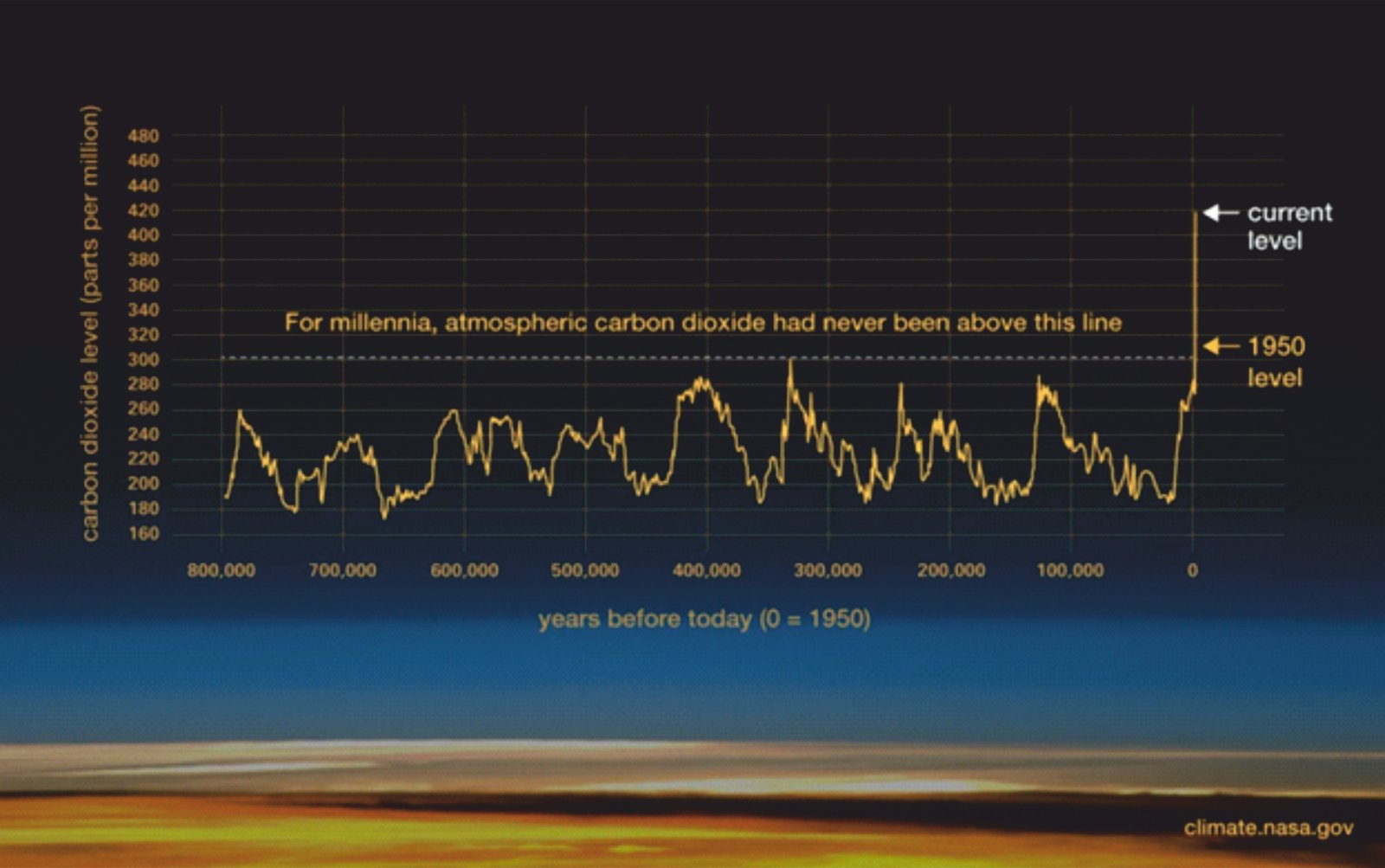
- For instance, CO2 levels in the Earth’s atmosphere have surged dramatically over the past 150 years, from approximately 280 parts per million (ppm) in the pre-industrial era to over 410 ppm today. Furthermore, data from ancient ice cores reveal that CO2 is now at its highest levels in over 800,000 years, resulting in rapid global warming, especially since the 1950s.
- The UN’s Intergovernmental Panel on Climate Change stated in a 2014 report that human influence on the climate system is evident and increasing, with impacts observed worldwide. The IPCC is 95 percent certain that humans are the primary cause of current global warming.
- Numerous studies over the years have corroborated the role of human activities in exacerbating global warming. A 2014 study found that the probability of the current warming happening without human-induced greenhouse gas emissions is less than 1 in 100,000.

(Credits- US Global Change Research Program)
How do we know that the Earth is warming?
- Temperature records, some dating back to the late 1880s, provide one method of tracking global warming. Nowadays, scientists employ satellites to monitor Earth’s surface temperature, and the collected data indicates a warming trend. Since 1880, the average global temperature has risen by at least 1.1 degrees Celsius, as reported by NASA.
- Indirect methods also confirm Earth’s rising temperature. A 1998 study that examined natural indicators such as tree rings and ice cores revealed that temperatures remained relatively stable for centuries before sharply increasing.
- The impacts of rising temperatures offer further evidence. The oceans are heating up, snow and ice cover in the Northern Hemisphere is diminishing, the Greenland ice sheet is receding, and sea levels are rising.
Conclusion- The evidence for global warming is compelling and multifaceted, ranging from temperature measurements dating back to the 1880s to modern satellite monitoring. Both direct and indirect methods, including the study of natural indicators like tree rings and ice cores, confirm the trend of rising temperatures. The impacts of this warming are evident in the increasing ocean temperatures, decreasing snow and ice cover, shrinking Greenland ice sheet, and rising sea levels.
As such, it is crucial to address these human-induced factors to mitigate the effects of global warming and safeguard our planet for future generations.