
Warming up to climate change: What is the 1.5 degree Celsius threshold, and what happens when we breach it?
Context- Disappearing sea ice, thawing glaciers, rapidly rising sea levels, extensive wildfires, and prolonged, severe heat waves are just a few of the global repercussions of climate change that we are witnessing today. Despite the unanimous consensus among scientists about the reality of climate change, numerous misconceptions and a great deal of uncertainty still surround the topic.
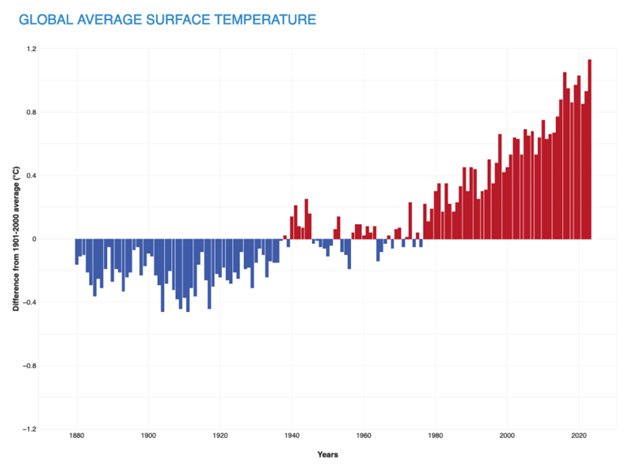
What is the 1.5 degree Celsius limit?
- In 2015, the Paris Agreement was signed by 195 countries to address climate change. The agreement aims to limit global warming to well below 2 degrees Celsius, and ideally to 1.5 degrees Celsius, above pre-industrial levels by 2100.
- Pre-industrial levels, while not specified in the agreement, are generally considered by scientists to be the global temperatures between 1850 and 1900.
- This period is used as it has reliable, near-global measurements, despite some global warming already occurring due to the Industrial Revolution which began in the early 1700s. This baseline is essential for tracking current temperature increases.
Why 1.5 degree Celsius?
- The Paris Agreement’s 1.5 degree Celsius limit is based on a report indicating that even a 1.5 degree Celsius rise in global temperatures could pose significant risks to certain regions and ecosystems.
- This limit serves as a “defence line” to prevent the severe impacts of climate change that could occur with a 2 degree Celsius increase.
- Sergey Paltsev, deputy director of MIT’s Joint Program on the Science and Policy of Global Change, emphasizes that the 1.5 degree Celsius target is not a magic number, but an agreed aspirational goal.
- He clarifies that science does not predict a catastrophe at a 1.51 degree Celsius increase, nor does a 1.49 degree Celsius increase mean all climate change impacts will be avoided. The key point is that lower temperature increase targets correspond to lower climate impact risks.
What happens when we breach the threshold?
- Exceeding the 1.5 degree Celsius limit could result in more frequent, intense, and/or heavy rainfall in many areas, as well as an increase in the intensity or frequency of droughts in certain regions, as stated by the Intergovernmental Panel on Climate Change (IPCC).
- Furthermore, rising global temperatures would heat up the oceans, leading to an increase in the number of powerful hurricanes, which could potentially intensify rapidly as they near coastlines. Wildfires would also become more severe and last longer.
- The melting of sea ice would accelerate, contributing to rising sea levels. Many of these effects have already begun to manifest in recent years, and they are expected to worsen once the threshold is crossed.
How close are we to breaching the threshold?
- The World Meteorological Organisation’s 2023 State of Global Climate report stated that there’s a 66% probability that the 1.5 degree Celsius warming limit will be exceeded in at least one year between 2023 and 2027.
- This would be the first time this limit is surpassed for an entire calendar year. Furthermore, 2023 has been declared the hottest year on record, with temperatures 1.48 degrees Celsius above pre-industrial levels.
But haven’t we already breached the 1.5 degree Celsius limit?
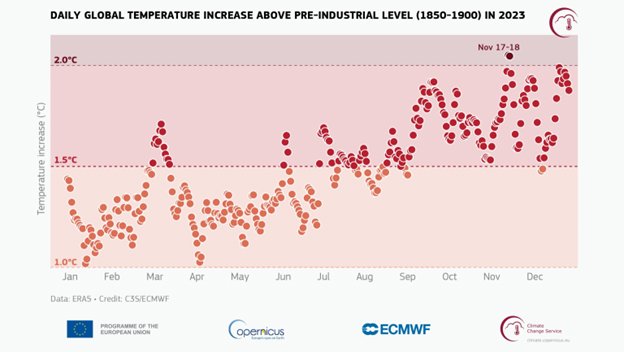
- Recent data from Europe’s Copernicus Climate Change Service (C3S) reveals that approximately 50% of days were over 1.5 degrees Celsius warmer than pre-industrial levels, and for the first time, two days in November exceeded 2 degrees Celsius.
- However, this doesn’t imply that the 1.5 and 2 degree Celsius limits have been breached. These thresholds pertain to long-term warming, meaning that the average global temperatures over a span of 20-30 years should not surpass 1.5 or 2 degrees Celsius.
Conclusion- The threat of global warming and climate change is real and imminent. The Paris Agreement’s target of limiting global warming to 1.5 degrees Celsius above pre-industrial levels is not just an arbitrary number, but a crucial threshold to mitigate the severe impacts of climate change. Recent data indicates that we are inching closer to this threshold, with 2023 being the hottest year on record. However, these measurements are based on short-term data, and the true test lies in long-term warming trends over 20-30 years.
As we continue to witness the effects of climate change, it becomes increasingly important to understand these targets and work collectively towards achieving them. The future of our planet depends on our actions today.