

Centre vs Delhi Govt on control over services: timeline of a dispute
Context- A five-judge Constitution Bench of the Supreme Court is hearing a dispute between the Delhi government and the Centre over the control of services. Almost five years ago, another Constitution Bench had ruled in favour of the Aam Aadmi Party-led state government in a similar tussle.
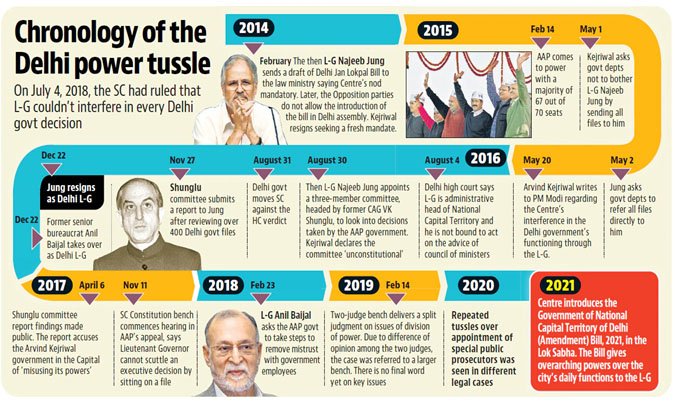
(Credits- Hindustan Times)
The present case
A Bench headed by Chief Justice of India (CJI) D Y Chandrachud, and also comprising Justices M R Shah, Krishna Murari, Hima Kohli, and P S Narasimha, is hearing the dispute between the Centre and the Delhi government over matters pertaining to control over the transfers and the overall functioning of administrative services in the National Capital Territory (NCT) of Delhi.
The reference
- The Centre on April 27, 2022 sought a reference to a larger Bench, arguing that it needed the power to make transfers and postings of officers in Delhi on account of it being the national capital and the “face of nation”.
- The court agreed that the limited question relating to the scope of the legislative and executive powers of the Centre and NCT of Delhi, with respect to the term “services”, would need an authoritative pronouncement by a Constitution Bench in terms of Article 145(3) of the Constitution.
- Article 145(3) deals with the setting up of a Constitution Bench comprising at least five judges “for the purpose of deciding any case involving a substantial question of law as to the interpretation” of the Constitution.
The 2018 verdict
- In 2018, a five-judge Bench comprising then CJI Dipak Misra and Justices Sikri, Bhushan, A M Khanwilkar, and (now CJI) Chandrachud interpreted Article 239AA of the Constitution which contains special provisions for the national capital.
- The court laid down broad parameters for the governance of Delhi; it held that although Delhi cannot be given the status of a state, the powers of the LG can be curtailed as he has no “independent decision-making power” and has to act on the aid and advice of the elected government.
- The court also restricted the jurisdiction of the LG to matters involving land, police, and public order, while holding that for all other matters, he will have to act on the aid and advice of the council of ministers.
Article 239AA
- Article 239 AA was inserted in the Constitution by the 69th Amendment Act, 1991, and conferred Special Status upon Delhi following the recommendations of the S Balakrishnan Committee
- According to this provision, the NCT of Delhi will have an Administrator and a Legislative Assembly. Subject to the provisions of the Constitution, the Legislative Assembly, “shall have the power to make laws for the whole or any part of the NCT with respect to any of the matters in the State List or Concurrent List in so far as any such matter is applicable to Union territories” except on the subjects of police, public order, and land.
Source- Indian Express
NEWS- Centre vs Delhi Govt on control over services: timeline of a dispute
Syllabus- Prelims; GS-2; Federalism