

FCRA LICENCE OF RAJIV GANDHI FOUNDATION & RAJIV GANDHI CHARITABLE TRUST CANCELLED
The Ministry of Home Affairs has cancelled the Foreign Contribution Regulation Act (FCRA) license of the Rajiv Gandhi Foundation (RGF) and Rajiv Gandhi Charitable Trust (RGCT) for alleged violations of the law.
Investigations for money laundering are also going alongside on these organisations.
In 2020, the central government had set up an inter-ministerial committee to “coordinate Investigations” into the funding of three trusts linked to the Nehru-Gandhi family — the RGF, RGCT and the Indira Gandhi Memorial Trust. (All are headed by Sonia Gandhi)
THE LAW (FCRA)

THE 2010 & 2020 PROVISIONS
- Prohibition to accept foreign contribution
- Under the Act, certain persons are prohibited to accept any foreign contribution.
- These include: election candidates, editor or publisher of a newspaper, judges, government servants, members of any legislature, and political parties, among others.
- In 2017 the MHA, through the Finance Bill route, paved the way for political parties to receive funds from the Indian subsidiary of a foreign company or a foreign company in which an Indian holds 50% or more shares.
- The 2020 amendment added public servants (as defined under the Indian Penal Code) to this list.
- Transfer of foreign contribution
- Under the Act, foreign contribution cannot be transferred to any other person unless such person is also registered to accept foreign contribution, or has obtained prior permission under the Act to obtain foreign contribution.
- The 2020 amendment prohibited the transfer of foreign contribution to any other person.
- Aadhaar for registration
- 2020 amendment mandated that any person seeking prior permission, registration or renewal of registration must provide the Aadhaar number.
- In case of a foreigner, they must provide a copy of the passport or the Overseas Citizen of India card for identification.
- However, in April 2022, Supreme Court read down this section and held that producing Indian Passport for the purpose of their identification would be enough. Now it is not mandatory for all office-bearers of NGOs to provide Aadhaar number.
- FCRA account
- Under the Act, a registered person must accept foreign contribution only in a single branch of a scheduled bank specified by them.
- However, they may open more accounts in other banks for utilisation of the contribution.
- 2020 amendment stipulated that foreign contribution must be received only in an account designated by the bank as “FCRA account” in such branch of the State Bank of India, New Delhi, as notified by the central government.
- No funds other than the foreign contribution should be received or deposited in this account.
- Renewal of license:
-
- Under the Act, every person who has been given a certificate of registration must renew the certificate within six months of expiration.
- The 2020 amendment provides that the government may conduct an inquiry before renewing the certificate.
- Use of foreign contribution for administrative purposes
- Under the Act, a person who receives foreign contribution must use it only for the purpose for which the contribution is received.
- Further, they must not use more than 50% of the contribution for meeting administrative expenses. 2020 amendment reduced this limit to 20%.
- Suspension of registration
- Under the Act, the government may suspend the registration of a person for a period not exceeding 180 days.
- 2020 amendment added that such suspension may be extended up to an additional 180 days.
XI JINPING GETS RE ELECTED AS CHINESE PRESIDENT
Chinese President Xi Jinping secured a record breaking third term as the General Secretary of the Communist Party of China (CCP).

ELECTIONS IN CHINA
- Elections in China occur under a single-party political system. This party is known as the Communist Party of China (CPC).
- The CPC is a cadre-based party and only the members take part in the election process to choose its leader or the President of China. The election is held during the Congress.
- Representatives are elected to the National People’s/Party Congress (NPC). With 2,300 representatives, it is the largest legislature in the world.
- The delegates are indirectly elected every five years to represent 35 electoral units –
- 31 provincial administrative regions in mainland China, and
- The Chinese military, as well as Hong Kong, Macao, and Taiwan.
- Every five years, the CCP convenes its national party congress to set major policies and select top leaders.
- During this time, members choose the Central Committee, which comprises around 380 members.
- The Central Committee also selects the Politburo, which has 25 members.
- In turn, the Politburo chooses the Politburo Standing Committee through secretive, backroom negotiations.
- The Standing Committee functions as the epicentre of the CCP’s power and leadership. Its membership has ranged from five to nine people. (7 generally)
- The Standing Committee elects a general secretary of the CPC who also becomes the President of China.

BESTU VARSH
Gujarati New Year or Bestu Varsh is being celebrated on October 26, 2022.
ABOUT BESTU VARSH:
- In Gujarat, the New Year which is popularly known as Bestu Varsh is celebrated as part of the five-day Diwali Celebrations.
- Ideally, Gujarati New Year falls on Pratipada of Shukla Paksha in the Kartik month; therefore, it is generally celebrated on Govardhan Puja during Diwali.
- People begin their New Year by visiting temples in the morning.
- Homes are decorated with Asopalav torans and marigold flowers, and attractive Rangoli at the entrance to welcome guests on the New Year.
NEANDERTHALS
Nobel laureate Svante Paabo and his team have recently published one of the biggest genetic studies yet of Neanderthals, providing clues about their community life and structure.

- Neanderthals are a hominin species that existed for at least 200,000 years throughout Europe and western Asia, and disappeared about 27,000 years ago.
- During this time, they witnessed some of the coldest climatic conditions ever known in these regions.

PHYSICAL FEATURES OF NEANDERTHALS
- Many of their physical features suggest that they were adapted for the cold, such as their barrel-shaped chests, shorter limbs, and larger brains, all of which suggest a body shape adapted for retaining heat.
- Their face was also distinctive. The central part of the face protruded forward and was dominated by a very big, wide nose.
- They excelled at hunting animals and making complex stone tools
- They were first discovered in 1856.
- Many Europeans and Asians have between 1 per cent and 4 per cent Neanderthal DNA while African people south of the Sahara have almost zero.
BLUE FLAG BEACHES
Two Indian beaches, Minicoy Thundi beach and Kadmat beach, located in Lakshadweep, have received the International eco-label ‘Blue Flag’.

ABOUT BLUE FLAG BEACH
Blue Flag beach is an Eco-tourism model to provide tourists/beach goers clean and hygienic bathing water, facilities/amenities, safe and healthy environment and sustainable development of the area. The Blue Flag programme was started in France in 1985 and in areas out of Europe in 2001.
WHO GIVES THIS CERTIFICATE?
Certification is accorded by Denmark based Foundation for Environment Education.
There are four broad parameters:
- Environmental Education and Information,
- Bathing Water Quality,
- Environment Management and
- Conservation and Safety and Services in the beaches.
LAKSHMI & GANESH ON RUPEE NOTES
Delhi Chief Minister Arvind Kejriwal recently appealed to the Union government to print images of Goddess Lakshmi and Lord Ganesh on new currency notes for the country’s “economic prosperity.

WHO ISSUES BANK NOTES IN INDIA?
- Section 22 of The Reserve Bank of India Act, 1934, gives RBI the “sole right” to issue banknotes in India.
- Section 25 states that “the design, form, and material of bank notes shall be such as may be approved by the Central Government after consideration of the recommendations made by the [RBI’s] Central Board”.
- The RBI’s Department of Currency Management has the responsibility of administering the core function of currency management. If the design of a currency note has to change, the Department works on the design and submits it to RBI, which recommends it to the central government. The government gives the final approval.
TYPES OF NOTES ISSUED SO FAR
- Ashoka Pillar Banknotes: The first banknote issued in independent India was the Re 1 note issued in 1949. It replaced the portrait of King George with the symbol of the Lion Capital of the Ashoka Pillar at Sarnath in the watermark window.
- Mahatma Gandhi (MG) Series, 1996
- Mahatma Gandhi series, 2005
- Mahatma Gandhi (New) Series, 2016
ASIAN INFRASTRUCTURE INVESTMENT BANK
Union Minister of Finance & Corporate Affairs Smt. Nirmala Sitharaman recently attended the 7th Annual Meeting of the Board of Governors of AIIB via video conference.
The theme of this year’s Annual Meeting was “Sustainable Infrastructure Toward a Connected World”.
ABOUT AIIB
- AIIB is a multilateral development bank that aims to improve economic and social outcomes in Asia.
- Formed In: 2016
- Headquarters: Beijing, China.
- Board of Governors: All powers of the Bank are vested in our Board of Governors, which is the highest decision-making body under our Articles of Agreement.
- Membership: AIIB has 105 members. China is the AIIB’s largest shareholder with a 26.5% voting share. India is the second-largest, with 7.5%, followed by Russia, which has a 5.97% voting share.
- India is a Founding Member of AIIB.
GM MUSTARD
The Genetic Engineering Appraisal Committee (GEAC) has yet again cleared the proposal for commercial cultivation of genetically modified (GM) mustard.

GEAC functions in the Ministry of Environment, Forest and Climate Change.
It is responsible for appraisal of activities involving large scale use of hazardous microorganisms and recombinants in research and industrial production from the environmental angle.
It is also responsible for appraisal of proposals relating to release of genetically engineered (GE) organisms and products into the environment including experimental field trials.
HISTORY OF GM MUSTARD:
Earlier, in 2017, the GEAC had cleared the proposal for commercial cultivation of GM mustard. However, the Union Environment Ministry vetoed it and suggested that the panel hold more studies on the GM crop.
GENETIC MODIFICATION/ENGINEERING

- Genetic engineering aims to transcend the genus barrier by introducing an alien gene in the seeds to get the desired effects.
- The alien gene could be from a plant, an animal or even a soil bacterium.
- E.g., Bt cotton has two alien genes from the soil bacterium Bacillus thuringiensis (Bt).
- It allows the crop to develop a protein toxic to the common pest pink bollworm.
- In Bt brinjal, a gene allows the plant to resist attacks of fruit and shoot borer.
Seeds produced using genetic engineering are called Genetically Modified Seeds.

ADVANTAGES OF GM CROPS
- Increase productivity and prevent crop loss: GM crops are resistance to insect damage, tolerant to herbicides, resistance to plant viruses which help farmers prevent crop loss and increases the crop productivity.
- Food security: With increase in population demand of food also increasing, to address this GM crops help foods to become more accessible and affordable for consumers.
- Enhanced nutritional quality: Many varieties of GM food crops have been developed, to enhance nutritional quality. Eg. Golden rice is a transgenic variety in rice, which is rich in vitamin A.
- Maintain soil fertility: GM crops have increased efficiency of mineral usage that reduces excess use of fertilizers and prevents loss of fertility of soil.
CHALLENGES WITH GM CROPS
- Bio-safety of human and animal health: Risk of toxicity, due to the nature of the product or the changes in the metabolism and the composition of the organisms resulting from gene transfer.
- Environmental concerns: Since a GMO is artificially created, its breeding with the other crops in the natural ecosystem can result in genetic contamination.GM technology could also allow the transfer of genes from one crop to another, creating super weeds which might be immune to common control methods.
- Economic concerns: Yields of GM crops have turned out to be false. For example, in India, with its Bt cotton experience, cotton yield has stagnated around 460 kgs per hectare in the recent past, despite most cotton being GM.
- Ecological concerns: GM crops could lead to erosion of biodiversity and pollute gene pools of endangered plant species.
WAY FORWARD:
- Awareness and information: Public awareness with reliable evidence-based information on GM crops such as keeping biosafety data out of the public domain needs to be increased to take informed decisions.
- Government roadmap: The government should come up with a fresh road map for ensuring food security without jeopardising the biodiversity and compromising with the safety of human health.
- Capacity building: There is need of capacity building in GM research agenda and development with science based consistent regulatory policy.
- Robust clinical trials: Clinical trials of GM crops need to be contingent on robust demonstration of safety and efficacy.
INDIAN & UK PMs INTERACT
Prime Minister Narendra Modi held a telephone conversation with new British Prime Minister Rishi Sunak.
During conversation, both the leaders have agreed on the importance of an early conclusion of a “comprehensive and balanced” trade agreement.

BILATERAL RELATIONS
- The bilateral relationship was upgraded to a Strategic partnership in 2004.
- During the May 2021 virtual summit between the PMs of both the countries, an ambitious ‘Roadmap 2030’ was adopted.
- This roadmap will pave a way to elevate bilateral ties to a ‘Comprehensive Strategic Partnership’.
- India was identified as a priority relationship for the UK in the 2021 Integrated Review and was invited by the UK as a guest to last year’s G7 meeting.
ECONOMIC SIGNIFICANCE
During the May 2021 virtual summit, India and UK launched an ‘Enhanced Trade Partnership’ (ETP). This was launched to unleash the trade potential between these two countries.
- Trade
- The total trade between India and the UK stood at $17.5 billion.
- UK is India’s 17th largest trading partner during the period of FY 2021-2022.
- In January 2022, India and the UK formally launched negotiations for an ambitious free trade agreement (FTA). (aims to increase the bilateral trade to $100 billion by 2030.)
- Investment
-
- Indian investment in UK: India invested in 99 projects and created 4,830 new jobs in the UK to retain the position of second-largest source of FDI after the US in 2020.
- UK’s investment in India: UK is the 6th largest inward investor in India after Mauritius, Singapore, USA, Netherlands, Japan. (cumulative equity investment of US $ 31.6 million for April 2000- December 2021 period. (6% of all FDI in India)
DEFENCE SIGNIFICANCE
- During the 2015 visit of PM Modi to UK, a new Defence and International Security Partnership (DISP) was pledged by leaders of both the countries.
- In October 2020, India and the UK reached the final stages of agreeing on a key defence logistics pact which will help in reciprocal use of airfields, bases, spares and supplies.
- After the pact, India can access ports and military bases from the Garrisons in the Gulf to Keeling Island in the South Indian Ocean and strategic military locations such as Busan and Okinawa.
CULTURAL SIGNIFICANCE
- 2017 was celebrated as the India-UK year of Culture to mark the 70th anniversary of Indian independence.
- Indian PM describes the connection between people of both the countries as a ‘living Bridge’.
- In August 2020, Britain announced its decision to mint a coin to commemorate Mahatma Gandhi.
- As per 2011 census approximately 5 million people of Indian origin are in the UK equating to almost 1.8 percent of the population and contributing 6% of the country’s GDP.
- The government of India awarded Pravasi Bhartiya Samman to British MP of Indian origin Priti Patel and British Member of the European Parliament (MEP) of Indian origin Neena Gill in 2017.
ONE NATION ONE POLICE UNIFORM
Prime Minister Narendra Modi recently mooted the idea of ‘One Nation, One Police Uniform’ at Home Ministry’s Chintan Shivir attended by Home Ministers of states.
His suggestion “One Nation, One Uniform” is in line with his broader attempt to introduce a uniform set of policies across the country.
Currently, there is a ‘one nation, one ration’ card; ‘one nation, one mobility’ card; ‘one nation, one grid’, ‘one nation, one sign language’ & ‘One Nation One Fertilizer’.

LAW & ORDER IN INDIA
- The Indian Constitution puts police forces under the jurisdiction of state governments, and each of the 28 states have their own police force.
- Both ‘public order’ and the ‘police’ are placed in List II (State List) of the Seventh Schedule of the Constitution, which deals with the division of powers between the Union and States.
- While police personnel in India are often associated with the colour khaki, their uniforms do differ in varying degrees in different regions.
- Since state governments and even an individual force can decide the uniform their personnel wear, there are at times inconsistencies in their official attire. For example:
- The Kolkata Police wear white uniforms.
- Puducherry Police constables wear a bright red cap with their khaki uniforms.
- Delhi Traffic Police personnel wear white and blue uniforms.
PAKISTAN OCCUPIED KASHMIR (POK)
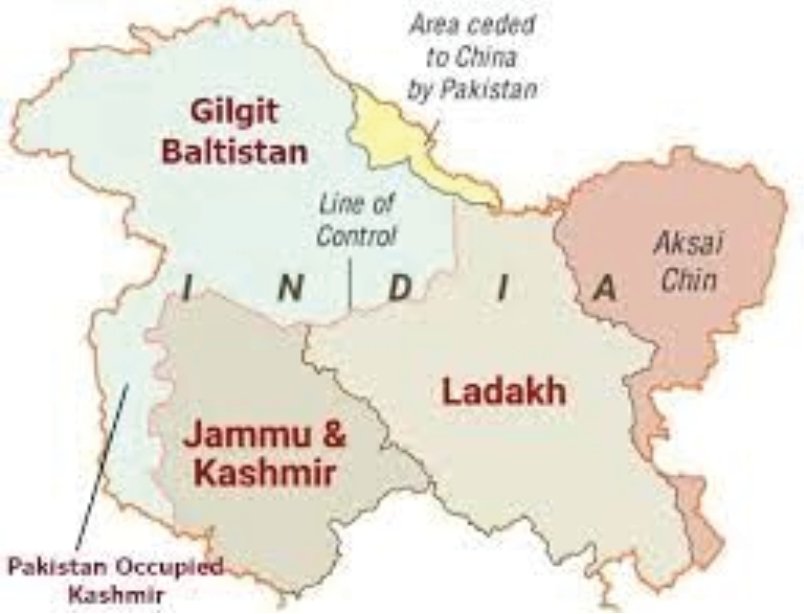
According to the Union defence minister Rajnath Singh the central government’s development journey in the Union territories of Jammu and Kashmir and Ladakh has only begun, and its northward journey will be complete after reaching Gilgit-Baltistan. (in POK)
ABOUT GILGIT BALTISTAN REGION
Gilgit-Baltistan (GB) was formerly known as the Northern Areas.
It is the northernmost territory administered by Pakistan, providing the country’s only territorial frontier, and thus a land route, with China, where it meets the Xinjiang Autonomous Region.
To G-B’s west is Afghanistan, to its south is Pakistan-occupied Kashmir, and to the east, the Union Territory of Jammu and Kashmir.
It is Indian territory, part of the former princely state of Jammu and Kashmir that acceded to India in full after Independence, and which has been under illegal Pakistani occupation.
THE STORY OF POK GETTING FORMED
- 1947: Two nation Theory divided India & Pakistan.
(https://en.m.wikipedia.org/wiki/Two-nation_theory)
- 1947-48: Indo Pak War. On October 22, 1947, with Hari Singh dithering on accession to India, Pashtun tribal militiamen along with Pakistani forces poured into the Kashmir Valley and marched towards Srinagar in accordance with a plan known as Operation Gulmarg. On the way, the lashkars engaged in massive plunder and looting in Baramulla.
Hari Singh signed the Instrument of Accession with India on October 26, 1947. The Indian Army then landed in the Kashmir Valley and began an operation to push back the Pakistani invaders.India secured 2/3rd of Kashmir & Pak secured 1/3rd of Kashmir. (Azad Kashmir). The matter was taken to the UN and it declared a ceasefire. The UN also asked to conduct a plebiscite when both nations agreed.

UDAN SCHEME
The Steel Authority of India Limited (SAIL) and the Airport Authority of India (AAI), recently signed an Operation and Management (O & M) agreement to facilitate commercial operations at Rourkela Airport under the RCS (Regional Connectivity Scheme) UDAN scheme.

ABOUT THE SCHEME
- UDAN (Ude Desh ka Aam Naagrik) is a regional airport development and “Regional Connectivity Scheme” (RCS) of the Union Government.
- The scheme UDAN envisages providing connectivity to unserved and underserved airports of the country through revival of existing air-strips and airports.
- Implementing Ministry: Ministry of Civil Aviation
- This is first-of-its-kind scheme globally to create economically viable flights on regional routes so that flying becomes affordable to the common man even in small towns.
- It is a key component of the National Civil Aviation Policy (NCAP) which was released by the Ministry of Civil Aviation (India) in 2016.
- The scheme is jointly funded by the central government and state governments.
COMPONENTS OF UDAN
- Airports: The first component is to develop new airports and enhance the existing regional airports to increase the number of operational airports for scheduled civilian flights.
- Flight routes: The second component is to add several hundred financially-viable, capped-airfare, new regional flight routes to connect more than 100 underserved and unserved airports in smaller towns by using “Viability Gap Funding” (VGF) where needed.
MONETARY POLICY COMMITTEE
The Reserve Bank of India (RBI) recently said that it would hold an additional Monetary Policy Committee (MPC) meeting on November 3, 2022.
This meeting has been called as the RBI has failed to maintain the consumer price index (CPI) inflation target within the 2-6 per cent band for three consecutive quarters, or nine straight months — January to September 2022.
This is the first time since the RBI adopted an inflation-targeting monetary policy regime in 2016 that an MPC meeting has been called under the provisions of Section 45ZN of the Act.
WHAT IS MONETARY POLICY COMMITTEE?
- The Monetary Policy Committee (MPC) is a committee constituted by the Central Government and led by the Governor of RBI.
- Monetary Policy Committee (MPC) was constituted as per Section 45ZB under the RBI Act of 1934 by the Central Government. The first meeting of MPC was conducted on 3rd October 2016 in Mumbai.
- Monetary Policy Committee was formed with the mission of fixing the benchmark policy interest rate (repo rate) to restrain inflation within the particular target level.
- The committee determines the policy interest rate required to achieve the inflation target.
- The MPC is required to meet at least four times in a year.
- The quorum for the meeting of the MPC is four members.
- Each member of the MPC has one vote, and in the event of an equality of votes, the Governor has a second or casting vote.
- Once every six months, the Reserve Bank is required to publish a document called the Monetary Policy Report to explain the sources of inflation and the forecasts of inflation for 6-18 months ahead.
COMPOSITION OF THE COMMITTEE
- The committee comprises of six members (including the Chairman) – three officials of the RBI and three external members nominated by the Government of India.
- Governor of RBI acts as the Chairperson (ex-officio) of the committee.
- Members nominated by the Government hold office for a period of four years from the date of appointment.
- None of the Central Government nominees are eligible to be re-appointed.
- The committee meets quarterly i.e. every three months.
- Decisions are taken by majority vote with each member having a vote.
- In case of a tie, the Chairman has a casting vote.
WHAT IS SECTION 45 ZN?
This section says that in case the RBI fails to meet the inflation target, it has to present a report to the government explaining the reasons for the failure.
In the report, the central bank will have to mention the remedial actions it proposes to take, and an estimated time within which the inflation target will be achieved following the timely implementation of the proposed remedial actions.
The report is required to be sent to the government within one month from the date on which the RBI failed to meet the inflation target.
IMT TRILAT
The first edition of India-Mozambique-Tanzania Trilateral Exercise (IMT TRILAT), a joint maritime exercise among the Indian, Mozambique and Tanzania navies commenced at Dar Es Salaam, Tanzania on 27 October 2022.
These exercises reflect India’s and the Indian Navy’s commitment to enhancing maritime security and cooperation with maritime neighbours in the Indian Ocean Region and promoting SAGAR, Security and Growth for All in the Region.
ABOUT THE EXERCISE
- Indian Navy is represented by the guided missile frigate, INS Tarkash, a Chetak helicopter and MARCOS (Special Forces).
- The exercise has three broad objectives:
- capability development to address common threats through training and sharing of best practices,
- enhancing interoperability, and
- Strengthening maritime cooperation.
RED MUD
CSIR- Advanced Materials and Processes Research Institute (AMPRI) has recently converted red mud into X-ray shielding tiles.
It has converted red mud into X-ray shielding tiles in a green and economically viable manner through a ceramic route by adding a certain weight percentage of high Z material and binder with it.
These tiles can be used to build radiation shielding structures in diagnostic X-rays, CT scanner rooms, Cath labs, bone mineral density, dental X-rays, etc., instead of the toxic lead sheet to protect the public from radiation hazards.
ABOUT RED MUD
- Red Mud is the waste generated in the Bayer process of alumina production from bauxite.
- It is also known as bauxite residue.
- Red Mud is defined as a “High Volume Low Effect Waste”.
- Nearly 1 to 1.5 tonnes of RM is being generated while producing one tonne of alumina from the bauxite ore through the Bayer process.
- It is considered to be toxic due to its extreme alkalinity and heavy element leaching.
- Annually about 175 million tonnes of red mud have been generated globally and stored in a specially designed clay-lined pond.
- Among that India is producing nearly 9 million tonnes of red mud every year.
NORTH EAST MONSOON
The India Meteorological Department (IMD) recently announced the onset of the northeast monsoon over South India.

ABOUT THE SEASON
- India receives rainfall during two seasons.
- About 75 per cent of the country’s annual rainfall is received from the Southwest monsoon between June and September.
- The Northeast monsoon, on the other hand, occurs during October to December, and is a comparatively small-scale monsoon, which is confined to the Southern peninsula.
- Also called the winter monsoon, the rainfall associated with the Northeast monsoon is important for Tamil Nadu, Puducherry, Karaikal, Yanam, coastal Andhra Pradesh, Kerala, north interior Karnataka, Mahe and Lakshadweep.
KALANAMAK RICE
Indian Agriculture Research Institute has successfully tested two new dwarf varieties in Uttar Pradesh that give double the yield of traditional variety of Kalanamak rice.
The traditional Kalanamak rice is protected under the Geographical Indication (GI) tag system.
It’s recorded in the GI application that Lord Buddha gifted Kala Namak paddy to the people of Sravasti so that they remembered him by its fragrance.
ABOUT KALANAMAK RICE
- Kalanamak is a traditional variety of paddy with black husk and strong fragrance.
- It is considered a gift from Lord Buddha to the people of Sravasti when he visited the region after enlightenment.
- Grown in 11 districts of the Terai region of north-eastern Uttar Pradesh and in Nepal, the traditional variety has been prone to ‘lodging’, a reason for its low yield.
- Its yield is barely two to 2.5 tonnes per hectare.
WHAT WAS THE NEED TO INNOVATE?
The traditional variety was suffering from Lodging. Hence the new variant has addressed the issue.
Lodging: Lodging is a condition in which the top of the plant becomes heavy because of grain formation, the stem becomes weak, and the plant falls on the ground.
ABOUT NEW VARIETIES
- Addressing the problem, the Indian Agriculture Research Institute (IARI) has successfully developed two dwarf varieties of Kalanamak rice.
- They have been named
- Pusa Narendra Kalanamak 1638 and
- Pusa Narendra Kalanamak 1652.
- The objective was to bring dwarfness into the variety and make the plant sturdy to prevent lodging. Attack of blight bacterial disease has also been addressed by inducting blight tolerant genes.
- The IARI says the new name is in recognition of its association with the Acharya Narendra Dev University of Agriculture and Technology in Ayodhya, for testing the two varieties.
- The yield of the new varieties is double that of the traditional variety. The IARI and the Uttar Pradesh Council of Agriculture are working together to make the seeds available to farmers at the earliest.
PERFORMANCE GRADING INDEX
The Ministry of Education has recently released the Performance Grading Index (PGI) for States and Union Territories for 2020-21.

ABOUT THE INDEX
- It is a unique index for evidence-based comprehensive analysis of school education systems across States and UTs.
- The prime objective of PGI is to promote evidence-based policy-making and highlight course correction to ensure quality education for all.
- As per the index, a total of seven States and Union Territories namely Kerala, Punjab, Chandigarh, Maharashtra, Gujarat, Rajasthan, and Andhra Pradesh have attained Level -2 grading in 2020-21.
- Gujarat, Rajasthan, and Andhra Pradesh are the new entrants with the highest achieved level.
- Union Territory Ladakh has made significant improvements in PGI from Level 8 to Level 4 in 2020-21.
- No state, however, has been able to attain the highest level of L1 so far.
GRADING
- PGI 2020-21 classified the States and UTs into ten grades of which the highest achievable Grade is Level 1 for the states scoring more than 950 points out of a total of 1000 points.
- The lowest grade is Level 10 which is for a score below 551.
- The PGI structure comprises 1000 points across 70 indicators grouped into 2 categories viz.,
- Outcomes,
- Governance Management (GM).
- These categories are further divided into 5 domains, viz.,
- Learning Outcomes (LO),
- Access (A),
- Infrastructure and Facilities (IF),
- Equity (E) and
- Governance Process (GP).
DISQUALIFICATION OF LEGISLATORS
Two Uttar Pradesh legislators were convicted on criminal charges in recent days, 1 has been
disqualified and his seat declared vacant by the State’s Legislative Assembly secretariat.
DISQUALIFICATION ACCORDING TO RPA
- Section 8 of the Representation of the People Act (RPA), 1951, contains provisions aimed at decriminalising electoral politics.
- There are two categories of criminal cases that attract disqualification upon conviction.
- In the first category are offences that entail disqualification for a period of six years upon any conviction.
- If the punishment is a fine, the six-year period will run from the date of conviction, but if there is a prison sentence, the disqualification will begin on the date of conviction, and will continue up to the completion of six years after the date of release from jail.
- All other criminal provisions form a separate category under which mere conviction will not entail disqualification. A sentence of at least two years in prison is needed to incur such disqualification.
- Major IPC offences are included under this head:
- making speeches that cause enmity between groups (Sec.153A) and doing so in a place of worship (Sec.505), bribery and personation during elections and other electoral offences, offences relating to rape and cruelty to women by husband and latter’s relatives.
- Besides, serious provisions of special laws such as the Protection of Civil Rights Act, Customs Act, Unlawful Activities (Prevention) Act etc are among the category of offences that entail disqualification regardless of the quantum of punishment.
- Laws for prevention of Sati, corruption, terrorism and insult to national flag and national anthem etc are also part of this group.
- In the first category are offences that entail disqualification for a period of six years upon any conviction.
LILY THOMAS V/S UOI
- Under Section 8(4) of the RPA, legislators could avoid immediate disqualification until 2013.
- The provision said that with respect to a Member of Parliament or a State legislator the disqualification will not take effect for three months.
- If within that period, the convicted legislator files an appeal or revision application, it will not take effect until the disposal of the appeal or application.
- In Lily Thomas vs. Union of India, the Supreme Court struck down clause (4) as unconstitutional, thus removing the protection enjoyed by lawmakers.
CAN THE DISQUALIFICATION BE REMOVED?
- The Supreme Court has the power to stay not only the sentence, but also the conviction of a person.
- In some rare cases, conviction has been stayed to enable the appellant to contest an election. However, the SC has made it clear that such a stay should be very rare and for special reasons.
- The RPA itself provides a remedy through the Election Commission.
- Under 11 of the Act, the EC may record reasons and either remove, or reduce the period of, a person’s disqualification.
- The EC exercised this power for Sikkim Chief Minister P.S. Tamang, who served a one-year sentence for corruption, and reduced his disqualification so as to contest a by-election and remain in office.
INTERNATIONAL DAY FOR BIOSPHERE RESERVES
November 3 will be the first ‘The International Day for Biosphere Reserves’, to be celebrated beginning 2022.
WHAT IS A BIOSPHERE RESERVE?
- Biosphere Reserve (BR) is an international designation by UNESCO for representative parts of natural and cultural landscapes extending over large area of terrestrial or coastal/marine ecosystems or a combination thereof.
- They are sites for testing interdisciplinary approaches to understanding and managing changes and interactions between social and ecological systems, including conflict prevention and management of biodiversity.
- Biosphere reserves are nominated by national governments and remain under the sovereign jurisdiction of the states where they are located.
WORLD NETWORK OF BIOSPHERE RESERVES (MAN & BIODIVERSITY (MAB) PROGRAM)
- The World Network of Biosphere Reserves (WNBR) was formed in 1971, as a backbone for biodiversity conservation, ecosystem restoration, and living in harmony with nature.
- The World Network of Biosphere Reserves of the MAB Programme consists of a dynamic and interactive network of sites of excellence.
- The World Network of Biosphere Reserves promotes North-South and South-South collaboration and represents a unique tool for international co-operation through sharing knowledge, exchanging experiences, building capacity and promoting best practices.
- There are now 738 properties in 134 countries, including 12 in India, four in Sri Lanka, and three in the Maldives.

EMISSIONS GAP REPORT
According to the Emissions Gap Report 2022, current pledges by countries for reducing greenhouse gas emissions would still leave the world warmer by 2.4-2.6 degrees celsius by the end of the century.
Emission gap- It is the difference between where greenhouse emissions are predicted to be in 2030 and where they should be to avert the worst impacts of climate change.
ABOUT THE REPORT
- The report was released by the United Nations Environment Programme (UNEP).
- It is managed by the UNEP Copenhagen Climate Centre.
- It serves as a “scientifically authoritative source of timely and policy-relevant information to key decision-makers,” guiding the UNFCCC process and implementing the Paris Agreement.
- The Paris Agreement, adopted by 196 countries in 2015 at COP 21, was aimed at limiting global warming and maintaining the average global temperature rise, ideally, to below 1.5°C.
THE FINDINGS
- The report found that the updated pledges by countries, also known as nationally determined contributions (NDC) under the Paris Agreement, only reduce the projected greenhouse emissions by 1 per cent by 2030.
- It is roughly equivalent to 0.5 gigatonnes of CO2.
- This is when a 45 per cent reduction is required for the world to limit global warming to 1.5°C above pre-industrial levels.
- The pre-industrial period is generally considered to be between 1850 and 1900.