
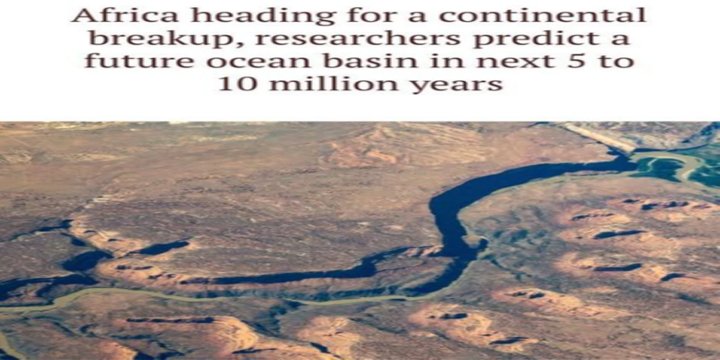
AFRICA HEADING FOR A CONTINENTAL BREAKUP
Why is this issue in the news?
- Researchers have stated that Africa is slowly breaking apart due to ongoing tectonic activity beneath the continent.
- Scientific studies suggest that Africa may split into two separate landmasses within the next 5 to 10 million years.
- This process could eventually lead to the formation of a new ocean basin.
- The findings are based on new analysis of magnetic data and long-term geological observations.
WHAT EXACTLY IS HAPPENING TO THE AFRICAN CONTINENT?
- Africa is undergoing a gradual but continuous geological separation.
- The crust beneath Africa is stretching, thinning, and tearing apart.
- Scientists compare this movement to “the zip on a jacket”, opening slowly from northeast to south.
- The process is accompanied by volcanic activity, earthquakes, and seismic movements.
When is the complete breakup expected?
- According to geological timelines, the continental split is expected to be completed in the next 5 to 10 million years.
- Scientists emphasise that this is an extremely slow process, not perceptible in human lifetimes.
What will Africa look like after the split?
- After the breakup, Africa will likely exist as two distinct landmasses.
Western African landmass
This larger portion is expected to include:
- Egypt
- Algeria
- Nigeria
- Ghana
- Namibia
Eastern African landmass
This smaller block will likely include:
- Somalia
- Kenya
- Tanzania
- Mozambique
- Large parts of Ethiopia
SCIENTIFIC BASIS: THE THEORY OF PLATE TECTONICS
- The explanation for this phenomenon lies in the Theory of Plate Tectonics.
- This theory states that:
- Earth’s continents sit on tectonic plates.
- These plates are constantly moving, though very slowly.
- Over millions of years, continents break apart and move, leading to:
- Formation of new oceans, and
- Creation of new crust through seafloor spreading.
Continents have never been fixed in Earth’s history.
EAST AFRICAN RIFT
- The most important region for this breakup is the East African Rift System.
- It is a massive tectonic fissure about 4,000 miles long.
- It stretches from Jordan, passing through East Africa, and reaches Mozambique.
- The rift is approximately 30–40 miles wide on average.
WHAT CHANGES ARE OCCURING IN EAST AFRICAN RIFT?
- The Earth’s crust in this region is weakening and pulling apart.
- Over geological time, the rift is expected to:
- Grow deeper, and
- Eventually be filled by ocean water.
- The rift is also expected to pass through major lakes such as:
- Lake Malawi
- Lake Turkana
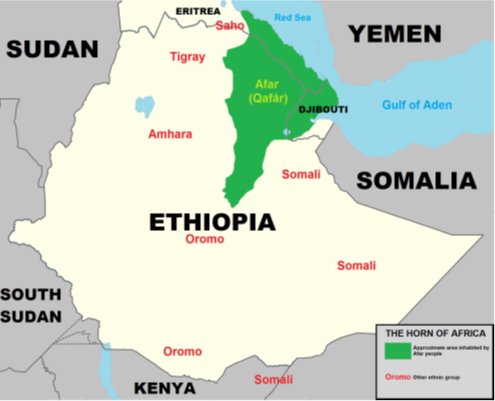
THE AFAR REGION
- Scientists have focused on the Afar region, which lies at the junction of:
- The Red Sea, and
- The Gulf of Aden.
Why Afar is special
- It hosts a triple junction, where three rift systems meet:
- Main Ethiopian Rift
- Red Sea Rift
- Gulf of Aden Rift
- A triple junction is considered a classic indicator of continental breakup.
- Scientists believe Afar shows the earliest visible stage of a new ocean formation.
ROLE OF MAGNETIC DATA
- Researchers re-analysed magnetic data collected in 1968 and 1969 using modern techniques.
- The data was gathered using airborne magnetic surveys.
Why magnetic data matters
- When magma cools, it records the Earth’s magnetic field direction.
- These magnetic patterns behave like:
- Barcodes, or
- Tree rings, preserving geological history.
WHAT DID THE MAGNETIC DATA REVEAL?
- The data showed evidence of ancient magnetic reversals, proving that:
- Seafloor spreading had already occurred between Africa and Arabia millions of years ago.
- This confirms that the region has been undergoing slow but steady rifting for tens of millions of years.
Evidence of steady rifting
- The Earth’s crust in the rift zone is stretching like soft material.
- Over time, this stretching leads to:
- Thinning of crust
- Eventual rupture
- Formation of a new ocean basin
SPEED OF THE CONTINENTAL BREAKUP
- According to Dr Emma Watts, a geochemist at Swansea University:
- The plates are currently separating at a rate of about 5 to 16 millimetres per year in the northern section.
- This confirms that while the process is active, it remains extremely slow.
Note: Connect with Vajirao & Reddy Institute to keep yourself updated with latest UPSC Current Affairs in English.
Note: We upload Current Affairs Except Sunday.