
ARAVALI RANGE: SC RULING, MINING REGULATION & SUSTAINABLE DEVELOPMENT
Why in News?
- In November–December 2025, the Supreme Court of India adopted a uniform and scientific definition of the Aravalli Hills and Ranges to regulate mining activities.
- Following the ruling, the Union Government announced a district-wise demarcation plan for mining regulation in the Aravalli Range.
- The decision triggered public protests, political reactions, and the #SaveAravalli campaign, with concerns that the new definition might weaken ecological protection.

ECOLOGICAL IMPORTANCE
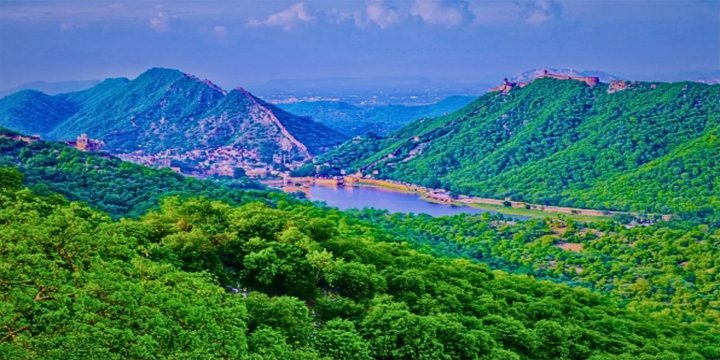
- The Aravalli Range is nearly 2 billion years old, making it India’s oldest mountain system.
- It stretches from Delhi through Haryana and Rajasthan to Gujarat, spanning about 800 km and 37 districts.
- The Aravallis act as a natural barrier against desertification, preventing the eastward spread of the Thar Desert.
- Guru Shikhar in Mount Abu is the highest peak at 1,722 metres.
- It acts as a natural barrier against the eastward spread of the Thar Desert.
- It is a major watershed, dividing drainage between the Arabian Sea and Bay of Bengal systems.
- The region supports dry deciduous forests, grasslands, wetlands, and rich wildlife, including tigers, leopards, and the Great Indian Bustard.
- It hosts UNESCO World Heritage Sites such as Chittorgarh and Kumbhalgarh forts.
- They play a critical role in groundwater recharge, climate regulation, and biodiversity conservation.
- The Supreme Court has repeatedly warned that uncontrolled mining in the Aravallis poses a serious threat to the nation’s ecology.

WHY A UNIFORM DEFINITION WAS NEEDED?
- For decades, only Rajasthan had a formally notified definition for regulating mining in the Aravallis.
- Rajasthan followed a 2002 State Committee Report based on Richard Murphy landform classification, defining hills as landforms rising 100 metres above local relief.
- Other States lacked a common definition, resulting in regulatory ambiguity, weak enforcement, and illegal mining.
- To address this, the Supreme Court directed adoption of a uniform, objective, and science-based definition applicable across all States.
COMMITTEE CONSTITUTED FOR THE DEFINITION
- A committee led by the Ministry of Environment, Forest and Climate Change (MoEF&CC) was constituted under Supreme Court directions.
- The committee included:
- Forest Secretaries from Delhi, Haryana, Rajasthan, and Gujarat
- Representatives of the Forest Survey of India,
- Central Empowered Committee (CEC), and
- Geological Survey of India (GSI).
- After extensive consultation, all States agreed to adopt the 100-metre above local relief criterion, with additional safeguards.
SC’S FINAL DECISION
- The Supreme Court accepted the committee’s recommendations in full.
- It adopted a uniform operational definition of the Aravalli Hills and Ranges.
- It imposed a temporary freeze on new mining leases.
- It directed preparation of a Management Plan for Sustainable Mining (MPSM) before any future mining expansion.
UNIFORM DEFINITIONS BY SC
A. Aravalli Hills
- Any landform in the Aravalli districts rising 100 metres or more above local relief is defined as an Aravalli Hill.
- Local relief is measured using the lowest contour line encircling the landform.
- Protection covers the entire hill system, including:
- The hill peak
- Supporting slopes
- Associated landforms, irrespective of gradient
B. Aravalli Ranges
- Two or more Aravalli Hills within 500 metres of each other constitute an Aravalli Range.
- The entire area between such hills, including slopes, valleys, and smaller hillocks, is included.
- All landforms within this 500-metre zone are excluded from mining, regardless of height.
These definitions are ecological safeguards, not merely technical criteria
WHY THIS DEFINITION STRENGTHENS PROTECTION?
- It ensures comprehensive protection of entire landforms, preventing piecemeal mining of slopes and foothills.
- It adopts a cluster-based approach, protecting ecological connectivity and wildlife corridors.
- It mandates mapping on Survey of India toposheets, making boundaries objective and enforceable.
- It closes loopholes that earlier allowed mining below 100 metres in ecologically sensitive zones.
SC DIRECTION ON MINING
- No new mining leases can be granted until a landscape-wide plan is finalised.
- Existing legal mines may continue only under strict compliance with environmental norms.
- Mining is absolutely prohibited in core and inviolate areas, except for narrowly defined strategic minerals.
- The Court rejected blanket bans, noting that they often encourage illegal mining, and instead adopted a calibrated regulatory approach.
MANAGEMENT PLAN FOR SUSTAINABLE MINING
- The Court directed MoEF&CC to prepare an MPSM through the Indian Council of Forestry Research and Education (ICFRE).
- The MPSM must:
- Treat the Aravallis as a continuous geological ridge from Gujarat to Delhi.
- Identify no-mining zones and regulated mining zones.
- Map ecologically sensitive areas and wildlife corridors.
- Assess cumulative environmental impacts and ecological carrying capacity.
- Include post-mining restoration and rehabilitation measures.
- Until the MPSM is finalised, the moratorium on new mining leases remains in force.
PROTECTION OF CORE/INVIOLATE AREAS
Mining is strictly prohibited in:
- Protected Areas, Tiger Reserves, and Wildlife Corridors
- Eco-Sensitive Zones and Eco-Sensitive Areas
- Wetlands and Ramsar sites (with 500 m buffer)
- CAMPA plantations and conservation investment areas
- Within 1 km of Protected Area boundaries
Limited exceptions apply only for:
- Atomic minerals
- Critical and strategic minerals
- Minerals listed in the Seventh Schedule of the MMDR Act, 1957
GOVERNMENT’S STAND
- The Union Government clarified that the framework does not dilute protection of the Aravallis.
- It emphasised that illegal mining, not legal mining, is the main threat.
- Enforcement will be strengthened using drones, satellite imagery, CCTV, weighbridges, and district task forces.
- Only 237 sq km out of 147,000 sq km of the Aravalli landscape is eligible for mining.
CRITICISMS & CONCERN
- Critics argue that the 100-metre threshold excludes large portions of the Aravalli landscape.
- The definition is seen as peak-centric, potentially overlooking ecological roles of lower hills and valleys.
- There are fears of groundwater depletion, desertification, and urban expansion, especially around Delhi-NCR.
- Effective protection depends on accurate mapping, strict enforcement, and timely preparation of the MPSM.
RESTORATION & LONG TERM CONSERVATION
- The Aravalli Green Wall Initiative aims at landscape-level ecological restoration.
- It proposes a 1,400 km long and 5 km wide green belt across Gujarat, Rajasthan, Haryana, and Delhi.
- The goal is to restore over 1.1 million hectares of degraded land by 2027.
- Traditional water systems such as johads and taankas are being promoted for watershed revival.
CONCLUSION
- The Supreme Court’s intervention has created a scientific, transparent, and enforceable framework for Aravalli protection.
- Contrary to alarmist claims, the ruling strengthens ecological safeguards, freezes new mining, and prioritises restoration
- The real test lies in implementation, enforcement, and landscape-level planning.
- The future of north-west India’s water security, climate resilience, and biodiversity depends on how effectively this framework is executed.
Note: Connect with Vajirao & Reddy Institute to keep yourself updated with latest UPSC Current Affairs in English.
Note: We upload Current Affairs Except Sunday.