
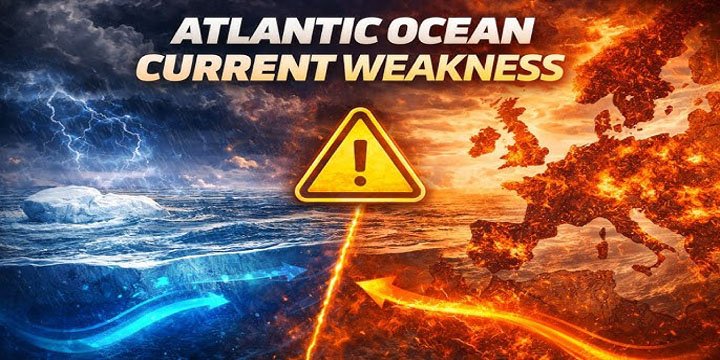
ATLANTIC OCEAN CURRENT WEAKENING
Why in News
- Recent studies show that the Atlantic Meridional Overturning Circulation (AMOC) is steadily weakening
- Scientists warn that a possible collapse could:
- Increase global warming
- Disrupt climate systems worldwide
- Research published in scientific journals highlights:
- Risk of tipping point behaviour
This is a major concern for global climate stability
WHAT IS AMOC?
- AMOC (Atlantic Meridional Overturning Circulation) is a system of:
- Ocean currents acting like a conveyor belt
How it Works
- Warm surface water moves:
- From tropics → North Atlantic (Arctic region)
- Cold dense water sinks and returns:
- From North Atlantic → tropics (deep ocean currents)
This circulation helps in:
- Regulating global climate
- Maintaining temperature balance
IMPORTANCE OF AMOC
- Controls:
- Climate of Europe and North America
- Helps in:
- Heat distribution across Earth
- Acts as:
- A climate stabilising system
Tipping Element
- AMOC is one of the Earth’s climate tipping elements
Meaning:
- It can undergo sudden and irreversible change
EVIDENCE OF WEAKENING
- Observations over the last two decades show:
- Continuous decline in AMOC strength
- Data collected from:
- Multiple ocean monitoring systems (mooring arrays)
- Strongest decline observed at:
- Around 5°N latitude
Indicates AMOC may be approaching a tipping point
CAUSES OF AMOC WEAKENING
(A) Global Warming
- Increase in greenhouse gases raises temperature
(B) Melting of Greenland Ice Sheet
- Releases large amounts of freshwater into ocean
(C) Reduction in Salinity
- Freshwater reduces:
- Salt concentration (salinity)
- This affects:
- Water density
- Ocean circulation
Key Problem:
- Weakens the sinking process of cold water
RISK OF COLLAPSE
- Studies suggest collapse could occur between:
- 2037 and 2109
- Even without additional warming:
- Collapse is still possible
Recovery may not occur in a warming world
IMPACT OF AMOC COLLAPSE
(A) Global Warming Increase
- Additional warming:
- Around 2°C globally
(B) Carbon Cycle Disruption
- Release of:
- 47–83 gigatonnes of CO₂
- Southern Ocean may change from:
- Carbon sink → Carbon source
(C) Regional Temperature Changes Northern Hemisphere
- Arctic cooling:
- Up to 7°C decrease
- Cause:
- Reduced heat transport
Southern Hemisphere
- Antarctica warming:
- Up to 6–10°C increase
(D) Climate Imbalance
- Uneven temperature distribution
- Disruption of:
- Weather patterns
- Ocean systems
SEA ICE ALBEDO FEEDBACK
- Ice reflects more sunlight than water
- More cooling leads to:
- More ice formation
- More ice increases:
- Reflection (albedo)
This creates a feedback loop of further cooling
SCIENTIFIC MODELLING
- Scientists used:
- CLIMBER-X climate model
- Simulation method:
- Added freshwater to North Atlantic
- Adjusted salinity globally
Key Findings
- AMOC can collapse:
- Even without major warming
- Recovery is:
- Difficult in current climate conditions
BROADER IMPLICATIONS
- Risk of:
- Abrupt climate change
- Impacts on:
- Agriculture
- Fisheries
- Ecosystems
- Could trigger:
- Chain reactions in climate system
CHALLENGES IN MONITORING
- Difficult to:
- Measure ocean circulation continuously
- Scientists use:
- Ocean Bottom Pressure (OBP) data
Need for:
- Better long-term monitoring systems
Note: Connect with Vajirao & Reddy Institute to keep yourself updated with latest UPSC Current Affairs in English.
Note: We upload Current Affairs Except Sunday.