
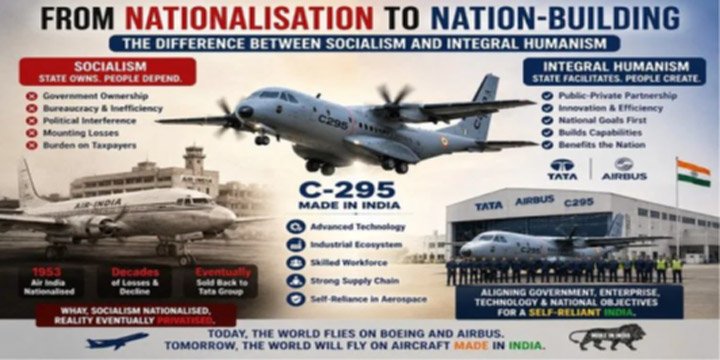
C 295 MILITARY AIRCRAFT
Why in News?
- On 10 June 2026, the first C 295 military transport aircraft manufactured in India successfully completed its maiden test flight from the Tata-Airbus Final Assembly Line (FAL), Vadodara, Gujarat.
- This aircraft has been built by Tata Advanced Systems Limited (TASL) in partnership with Airbus Defence and Space.
- The achievement is historic because it is the first military aircraft ever manufactured and rolled out by a private Indian company, marking a major step towards Aatmanirbhar Bharat (Self-Reliant India) in the defence sector.
HISTORIC SIGNIFICANCE
First Military Aircraft Built by India’s Private Sector
Traditionally, military aircraft production in India was dominated by public sector organisations such as:
- Hindustan Aeronautics Limited (HAL)
- Defence Public Sector Undertakings (DPSUs)
The C295 programme marks:
- The first successful military aircraft production by a private Indian company.
- A major expansion of private sector participation in defence manufacturing.
- A shift from defence imports towards domestic production.
- Growing confidence in India’s private aerospace industry.
WHY IS IT A LANDMARK EVENT?
The successful maiden flight demonstrates India’s growing capability in:
- Aerospace manufacturing
- Aircraft assembly
- Defence industrial production
- Technology absorption
- Global defence collaboration
It shows that India is moving beyond merely importing defence equipment and is developing the capability to manufacture sophisticated military platforms domestically.
ABOUT C 295 PROGRAM
Background
In September 2021, India signed a contract with Airbus for the procurement of:
- 56 C295 Military Transport Aircraft
Contract Value
- ₹21,935 crore
Production Distribution
First 16 Aircraft
- Manufactured in Spain by Airbus.
- Delivered directly to the Indian Air Force (IAF).
Remaining 40 Aircraft
- Manufactured in India.
- Produced at the Tata-Airbus facility in Vadodara, Gujarat.
This arrangement aims to gradually transfer manufacturing capabilities to India.
OBJECTIVES OF THE PROGRAM
The C295 aircraft is being inducted to replace the ageing:
- Avro HS-748 transport aircraft
The Avro fleet has served the Indian Air Force for more than six decades and has become increasingly outdated.
ABOUT THE MAIDEN TEST FLIGHT
Successful First Flight
The first India-built C295:
- Successfully completed its maiden flight.
- Tested key onboard systems.
- Demonstrated manufacturing quality standards.
- Entered the certification process before induction into the IAF.
Purpose of the Test Flight
The flight was conducted to verify:
- Aircraft performance
- Structural integrity
- Flight control systems
- Safety and reliability standards
Successful completion of these tests is essential before final delivery to the Indian Air Force.
HOW INDIGENOUS IS THE AIRCRAFT?
Current Status
The aircraft is not yet fully indigenous.
India currently undertakes:
- Structural manufacturing
- Component fabrication
- Final assembly
- System integration
However, some high-end systems continue to be imported.
IMPORTED COMPONENTS
Engines
- Supplied by Pratt & Whitney (USA)
Avionics
- Supplied by Collins Aerospace (USA)
These systems are imported and integrated into the aircraft during assembly in India.
INDIGENOUS COMPONENTS
Airframe Manufacturing
Major structures manufactured in India include:
- Fuselage sections
- Tail assembly
- Structural components
Production of these parts began at Tata’s Hyderabad facility in 2023.
INDIGENOUS DEFENCE SYSTEMS
Bharat Electronics Limited (BEL)
Developed:
- Radar Warning Receivers (RWR)
- Missile Approach Warning Systems (MAWS)
Bharat Dynamics Limited (BDL)
Manufactured:
- Countermeasure Dispensing Systems
These systems improve aircraft survivability during combat operations by detecting threats and deploying defensive measures.
INDIGENISATION ROADMAP
Component Manufacturing
The C295 airframe contains:
- More than 14,000 components
Out of these:
- Around 3,500 components are expected to be manufactured annually in India.
Increasing Indigenous Content
According to Airbus:
Initial Aircraft
- Lower indigenous content.
- Greater dependence on imported systems.
Later Aircraft
- Increasing local manufacturing participation.
By the 32nd Aircraft
- Indigenisation expected to reach 98% on a labour-hour basis.
Last Eight Aircraft
- Expected to have the highest level of indigenous manufacturing.
This indicates a gradual transfer of manufacturing expertise and production capabilities to India.
ABOUT C 295 AIRCRAFT
Type
- Tactical Military Transport Aircraft
Developed By
- Airbus Defence and Space
Key Features
Twin-Engine Aircraft
- Powered by turboprop engines.
Medium Transport Category
Used for:
- Troop transport
- Cargo transport
- Logistics support
- Humanitarian missions
- Disaster relief operations
Operational Capability
The aircraft can operate from:
- Short runways
- Semi-prepared airstrips
- Remote and rugged locations
This makes it highly suitable for:
- Himalayan regions
- Northeast India
- Island territories
IMPACT ON INDIA’S DEFENCE ECOSYSTEM
Employment Generation
The programme is expected to create:
More than 15,000 Jobs
Including:
- Direct employment
- Indirect employment
- Skilled aerospace jobs
This will help build a highly trained aerospace workforce in India.
BOOST TO MSMEs
The programme creates opportunities for:
- Micro, Small and Medium Enterprises (MSMEs)
- Tier-II suppliers
- Tier-III suppliers
These companies will become part of India’s defence manufacturing supply chain.
Benefits to Industry
Indian firms will gain:
- Aerospace manufacturing expertise
- Exposure to global standards
- Advanced engineering capabilities
- Participation in global supply chains
CONTRIBUTION TO ATMA NIRBHAR BHARAT
Reducing Import Dependence
For decades, India has been among the world’s largest defence importers.
The C295 programme supports:
- Domestic defence manufacturing
- Indigenous capability development
- Strategic self-reliance
Growth of Defence Manufacturing
- India’s defence production reached:
- ₹1.46 Lakh Crore (2024-25)
- The C295 programme is an important contributor to this growing defence-industrial capacity.
CHALLENGES AHEAD
Complete Indigenisation
India still needs to develop:
- Indigenous aircraft engines
- Advanced avionics
- High-end aerospace systems
These remain critical gaps in self-reliance.
Supply Chain Development
Success will depend on:
- Strengthening domestic suppliers
- Maintaining global quality standards
- Building aerospace manufacturing clusters
Technology Absorption
India must continue investing in:
- Research and Development (R&D)
- Aerospace engineering
- Advanced manufacturing technologies
WAY FORWARD
Expand Private Sector Participation
- Encourage more private aerospace projects.
- Increase private investment in defence manufacturing.
Strengthen Indigenous Components
- Develop Indian aircraft engines.
- Promote indigenous avionics and electronic systems.
- Increase local content in future aircraft programmes.
Build a Strong Aerospace Ecosystem
- Support MSMEs.
- Improve skill development.
- Encourage collaboration between industry and academia.
- Promote global technology partnerships.
Leverage Technology Transfer
- Move from assembly to complete design capability.
- Develop indigenous aircraft design and manufacturing expertise.
Note: Connect with Vajirao & Reddy Institute to keep yourself updated with latest UPSC Current Affairs in English.
Note: We upload Current Affairs Except Sunday.