
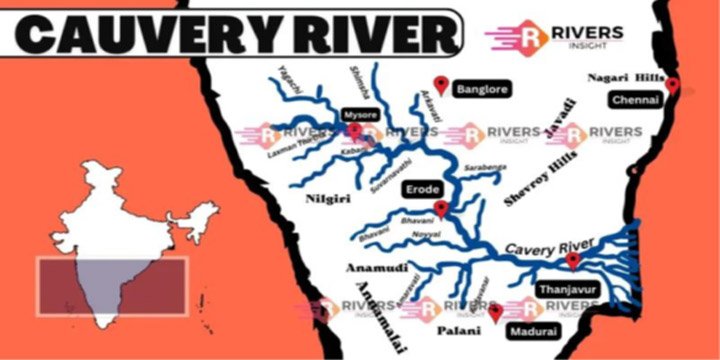
CAUVERY RIVER DISPUTE
Why in News?
- The Tamil Nadu Chief Minister urged the Prime Minister to ensure that no statutory or administrative approval is granted to Karnataka’s Mekedatu Project unless it complies with the Cauvery Water Disputes Tribunal (CWDT) Award, 2007 and the Supreme Court judgment (2018).
- The demand followed the Ministry of Jal Shakti’s reply in Parliament, which stated that the Supreme Court’s 2018 judgment does not expressly require Karnataka to obtain the consent of downstream States before constructing a structure on the Cauvery River.
- Tamil Nadu argued that the reply ignores settled legal principles governing inter-state rivers and the rights of lower riparian States.
BACKGROUND
Historical Background
- Historically, Tamil Nadu utilised nearly 602 TMC of the Cauvery’s water, leaving only about 138 TMC for Karnataka.
- In 1924, Tamil Nadu constructed the Mettur Dam, and Karnataka (then Mysore) and Madras Presidency signed a 50-year agreement.
- The agreement permitted:
- Tamil Nadu to expand irrigation from 16 lakh acres to 27 lakh acres.
- Karnataka to increase irrigation from 3 lakh acres to 10 lakh acres.
- After the agreement expired in 1974, Karnataka claimed that it restricted its irrigation development and began constructing reservoirs, leading to disputes with Tamil Nadu.
- On Tamil Nadu’s demand, the Cauvery Water Disputes Tribunal (CWDT) was constituted by the Union Government in 1990.
CWDT AWARD 2007
Water Allocation
Out of 740 TMC of utilisable water, the Tribunal allocated:
- Tamil Nadu: 419 TMC
- Karnataka: 270 TMC
- Kerala: 30 TMC
- Puducherry: 7 TMC
- Environmental Protection: 14 TMC
MONTHLY WATER RELEASE BY KARNATAKA
During a normal water year (June–May), Karnataka was directed to release 192 TMC annually at Biligundlu according to the following schedule:
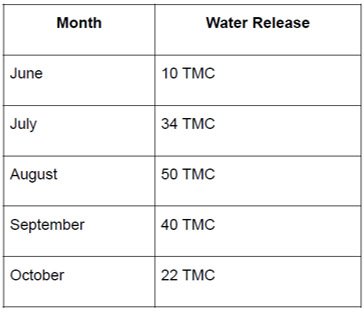
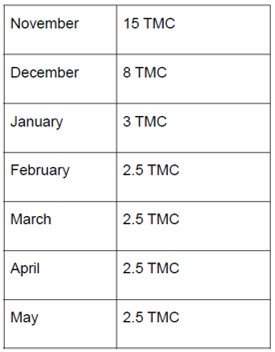
- In distress years, water allocation was to be reduced proportionately among Karnataka, Tamil Nadu, Kerala and Puducherry.
- Karnataka challenged the award seeking 312 TMC, while Tamil Nadu also approached the Supreme Court.
SC JUDGEMENT 2018
Revised Water Allocation
The Supreme Court modified the Tribunal’s award:
- Karnataka: Increased from 270 TMC to 75 TMC
- Tamil Nadu: Reduced from 419 TMC to 25 TMC
- Tamil Nadu was permitted to extract an additional 10 TMC of groundwater.
- Kerala: 30 TMC (unchanged)
- Puducherry: 7 TMC (unchanged)
Key Observation
- The Court held that Karnataka’s drinking water requirements, particularly for Bengaluru, deserve higher priority.
MEKEDATU PROJECT
About
- Proposed 48 TMC balancing reservoir on the Cauvery River.
- Located at Mekedatu in Ramanagara district, Karnataka, about 100 km south of Bengaluru, close to the Tamil Nadu border.
- Estimated project cost is around ₹6,000 crore.
Objectives
According to Karnataka, the project aims to:
- Supply drinking water to Bengaluru.
- Recharge groundwater.
- Generate hydropower.
- It is not intended for additional irrigation and therefore would not alter the water allocation fixed by the CWDT or the Supreme Court.
WHY DOES TN OPPOSE THE PROJECT?
- Tamil Nadu argues that increased upstream storage would allow Karnataka to regulate water releases during dry and distress years.
- This could reduce water availability for farmers in the Cauvery Delta.
- Tamil Nadu cites Clause XI of the CWDT Award, which states:
- An upper riparian State should not undertake any activity affecting scheduled water deliveries to downstream States.
- Any modification in delivery schedules requires mutual agreement and consultation with the Regulatory Authority.
- Hence, Tamil Nadu contends that the Mekedatu project cannot be treated merely as an engineering project but must comply with the legal framework governing interstate river sharing.
IMMEDIATE BACKGROUND
- Between 1 June and 23 July, Tamil Nadu was entitled to receive about 32 TMC under the Tribunal Award as modified by the Supreme Court.
- However, it received only around 3.5 TMC.
- Even after accounting for deficient southwest monsoon rainfall and distress-year reductions, Tamil Nadu argues that at least 3 TMC more should have been released.
- Delayed or reduced releases threaten agriculture in the Cauvery Delta.
- The Cauvery Water Regulation Committee (CWRC) subsequently directed Karnataka to release 4 TMC at a rate of 3,500 cusecs per day for 15 days.
- The Tamil Nadu Chief Minister has also sought a meeting with the Karnataka Deputy Chief Minister to discuss the issue through dialogue.
KEY FACTS ABOUT THE KAVERI RIVER
About
- Known as the “Ganga of the South”.
- One of India’s major east-flowing peninsular rivers and the subject of one of the country’s longest-running interstate water disputes.
Origin and Course
- Originates at Talakaveri in the Brahmagiri Hills, Kodagu (Karnataka).
- Flows through Karnataka and Tamil Nadu before emptying into the Bay of Bengal near Poompuhar.
DRAINAGE BASIN
- Covers about 81,155 sq. km across:
- Karnataka
- Tamil Nadu
- Kerala
- Puducherry
Unique Feature
- A perennial river because:
- Upper basin receives the Southwest Monsoon.
- Lower basin receives the Northeast Monsoon.
MAJOR TRIBUTARIES
Left-bank Tributaries
- Harangi
- Hemavati
- Shimsha
- Arkavati
Right-bank Tributaries
- Lakshmana Tirtha
- Kabini
- Suvarnavathi
- Bhavani
- Noyyal
- Amaravati
Major Dams
- Krishna Raja Sagara (Karnataka)
- Mettur Dam (Tamil Nadu)
Protected Areas in the Basin
- Nagarhole National Park (Karnataka)
- Wayanad Wildlife Sanctuary (Kerala)
- Sathyamangalam Tiger Reserve (Tamil Nadu)
Note: Connect with Vajirao & Reddy Institute to keep yourself updated with latest UPSC Current Affairs in English.
Note: We upload Current Affairs Except Sunday.