
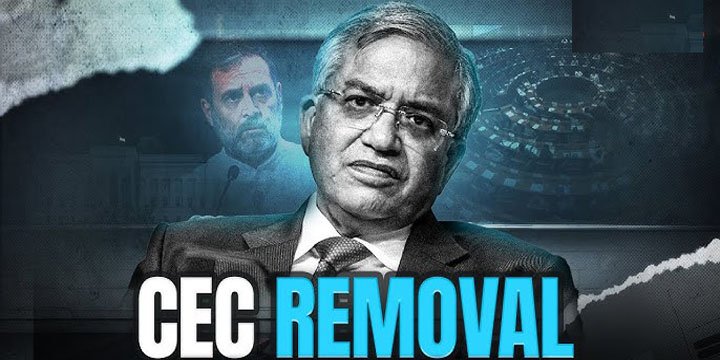
CEC REMOVAL
Why in News
- The Opposition MPs filed notices seeking removal of the Chief Election Commissioner (CEC) Gyanesh Kumar
- The notices were rejected by:
- P. Radhakrishnan
- Om Birla
- Reason:
- Lack of evidence
- No prima facie case of “misbehaviour”
The issue relates to constitutional provisions for removal of CEC
CONSTITUTIONAL BASIS FOR REMOVAL
- Removal of CEC is governed by:
- Article 324(5) → Conditions of service and removal of Election Commissioners
- Article 124(4) → Procedure similar to removal of Supreme Court judges
- Also linked with:
- Judges (Inquiry) Act, 1968
KEY REQUIREMENTS
- Removal requires:
- Proof of “misbehaviour” or “incapacity”
- Must meet a high constitutional threshold
It is not a simple political process
DETAILS OF THE REMOVAL NOTICE
- Submitted on:
- 12 March 2026
- Signed by:
- 63 Rajya Sabha MPs
- 130 Lok Sabha MPs
- Included:
- 7 charges against the CEC
Each charge was examined and rejected
MAIN GROUNDS FOR REJECTION
(A) Lack of Evidence
- Allegations were:
- Not supported by clear proof
- Many issues were:
- Already decided by courts
- Or pending before judiciary
(B) No Prima Facie Case
- The presiding officers held:
- No initial evidence of misconduct
Therefore, proceedings cannot begin
(C) High Constitutional Standard
- Removal requires:
- Strong and proven misconduct
- Political allegations alone are:
- Not sufficient
KEY ALLEGATION & RESPONSES
(A) Allegation: Appointment was “Tainted”
- Argument:
- Law under which CEC was appointed is under challenge in Supreme Court
Response
- Court challenge ≠ misbehaviour
Legal challenge cannot be basis for removal
(B) Allegation: Bias due to Administrative Background
- Claim:
- CEC had close links with executive
Response
- Many previous CECs had:
- Similar administrative backgrounds
No automatic presumption of bias
(C) Allegation: Bias in Election Commission Decisions
- Claim:
- Different standards for government and opposition
Response
- No clear evidence of abuse of power
Mere allegation without proof is insufficient
(D) Allegation: Obstruction of Electoral Investigations
- Claim:
- Refusal to share information with State authorities
Response
- Once FIR is filed:
- Matter lies with courts
Cannot be ground for removal
(E) Allegation: Refusal to Share Electoral Rolls Data
- Issue:
- Machine-readable electoral rolls not shared
Response
- Action was:
- In line with Supreme Court directions
- Consistent with Right to Privacy (Puttaswamy case)
No violation of law found
SIR ISSUE
- Allegations related to:
- Electoral roll revision in Bihar Response
- Election Commission has:
- Plenary powers under Article 324
- Supreme Court:
- Already reviewed and supported the process
Judicial scrutiny ≠ misbehaviour
CONTEMPT OF COURT ALLEGATION
- Claim:
- Non-compliance with Supreme Court orders
Response
- Such issues fall under:
- Contempt jurisdiction of courts
Not a ground for removal
ALLEGATION OF LACK OF INDEPENDENCE
- Claim:
- CEC failed to maintain institutional independence
Response
- Allegation was:
- Vague and generalised
- No specific evidence Cannot meet constitutional standard
KEY CONSTITUTIONAL INSIGHT
- The Election Commission of India (ECI) operates under:
- Article 324
- It has:
- Autonomous and independent status
Removal process is kept strict to protect independence
SIGNIFICANCE OF THE DECISION
(A) Protects Institutional Independence
- Prevents:
- Political misuse of removal process
(B) Upholds Constitutional Morality
- Ensures:
- High standards for removal
(C) Reinforces Judicial Role
- Many issues:
- Must be resolved by courts, not Parliament
CONCLUSION
- The rejection of removal notice shows that:
- Constitutional authorities are protected by strict safeguards
- Removal of CEC requires:
- Strong, proven, and specific evidence
- Political disagreements:
- Cannot be used as grounds for removal
Note: Connect with Vajirao & Reddy Institute to keep yourself updated with latest UPSC Current Affairs in English.
Note: We upload Current Affairs Except Sunday.