
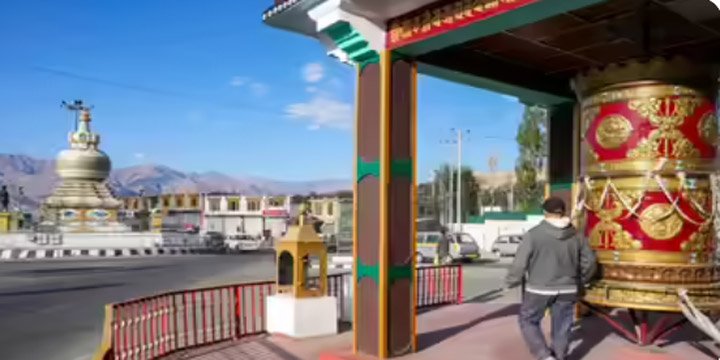
CENTRE PROPOSES CUSTOMISED ARTICLE 371 FOR LADAKH
Why in News?
- The Ministry of Home Affairs (MHA) has proposed a customised constitutional model under Article 371 for the Union Territory (UT) of Ladakh to provide greater democratic representation and institutional autonomy.
- During the fifth round of discussions with representatives of the Leh Apex Body (LAB) and the Kargil Democratic Alliance (KDA), the Centre shared a draft proposing the establishment of a Union Territory-level elected body with executive, financial, and legislative powers.
- While acknowledging Statehood as Ladakh’s long-term aspiration, the proposal seeks to strengthen self-governance through a unique constitutional arrangement suited to the region’s geographical, cultural, and administrative needs.
BACKGROUND
Ladakh became a Union Territory without a legislature on 31 October 2019 following the enactment of the Jammu and Kashmir Reorganisation Act, 2019, which bifurcated the erstwhile State of Jammu and Kashmir into:
- Union Territory of Jammu & Kashmir (with legislature)
- Union Territory of Ladakh (without legislature)
Since then, various political, social, and civil society groups in Ladakh have consistently demanded:
- Statehood for Ladakh.
- Constitutional safeguards under the Sixth Schedule.
- Protection of land, jobs, culture, language, and environment.
- Greater democratic participation in governance.
These demands intensified following concerns over administrative centralisation and the absence of an elected legislative institution.
WHAT IS CENTRE’S NEW PROPOSAL?
- The Ministry of Home Affairs has proposed adopting a customised sui generis (unique) governance model under Article 371 of the Constitution for Ladakh.
- Instead of immediately granting Statehood, the proposal envisages a phased approach that would strengthen democratic governance within the existing Union Territory framework.
KEY FEATURES OF THE PROPOSED MODEL
1. Customised Model under Article 371
- The Centre has proposed that Ladakh be provided constitutional safeguards through a special provision under Article 371, similar in principle to the special arrangements available for several other States, but specifically designed to suit Ladakh’s unique circumstances.
- The meeting minutes state that:
- Existing provisions under Article 371(A–J) were examined.
- A customised model most suitable for Ladakh would be developed.
- The model would be tailored to Ladakh’s geographical, demographic, ecological, and cultural characteristics.
- The proposal reflects a sui generis approach, meaning a unique constitutional arrangement rather than a direct replication of existing models.
2. Establishment of a Union Territory-Level Elected Body
- A major feature of the proposal is the creation of an elected governing institution at the Union Territory level.
- The proposed body would possess:
- Executive powers
- Financial powers
- Legislative powers
- This would provide Ladakh with an institutional political voice while remaining a Union Territory.
3. Statehood as a Long-Term Goal
- The discussions acknowledged that:
- Statehood remains the long-term aspiration of Ladakh.
- However, considering the present circumstances, both sides agreed that establishing an elected UT-level governance structure would serve as an important first step toward greater autonomy.
4. Democratic Institutional Framework
- The proposed model aims to:
- Strengthen democratic participation.
- Improve local accountability.
- Enhance people’s representation in governance.
- Decentralise decision-making.
- The elected body would function alongside existing local institutions while exercising authority over devolved subjects.
5. Harmonious Relationship with Panchayati Raj Institutions
- The proposed governance structure would function in coordination with existing:
- Panchayati Raj Institutions (PRIs)
- Autonomous Hill Development Councils
- The objective is to avoid institutional overlap while ensuring effective grassroots governance.
6. Accountability of Bureaucracy
- Representatives from Ladakh emphasised that:
- The bureaucracy should be accountable to the elected executive.
- The Centre agreed that, for subjects transferred to the elected body:
- Administrative control,
- Supervision, and
- Performance appraisal of civil servants
- would be exercised by the elected executive. This represents a significant step toward democratic accountability in administration.
WHAT HAPPENED DURING 5TH HIGH POWERED COMMITTEE?
- The proposal emerged during the fifth meeting of the Sub-Committee of the High-Powered Committee (HPC) on Ladakh, held on 22 May 2026.
- Subsequently, a follow-up meeting was held in Leh, where the minutes were jointly signed by representatives of:
- Ministry of Home Affairs
- Ladakh Administration
- Leh Apex Body (LAB)
- Kargil Democratic Alliance (KDA)
- Political representatives from Ladakh
- For the first time, the MHA publicly released a detailed presentation outlining progress made through five rounds of dialogue.
DEMANDS RAISED BY LADAKH REPRESENTATIVES
Despite welcoming continued dialogue, representatives reiterated several long-standing demands.
1. Statehood
Civil society organisations maintained that full Statehood remains the ultimate objective for ensuring democratic governance and greater constitutional autonomy.
2. Inclusion under the Sixth Schedule
The demand for inclusion under the Sixth Schedule was reiterated to provide constitutional safeguards for:
- Tribal communities
- Land ownership
- Natural resources
- Local customs
- Traditional governance
3. Separate Administrative and Police Services
Leaders demanded the creation of:
- Ladakh Administrative Service
- Ladakh Police Service
to ensure greater local representation in governance and public administration.
4. Withdrawal of Cases
Representatives also sought withdrawal of criminal cases related to the 24 September 2025 protests, during which violence resulted in:
- Four civilian deaths
- Around ninety injuries
GOVT’S DEVELOPMENT INITIATIVES IN LADAKH
During the discussions, the Ministry highlighted various measures undertaken since 2019.
These include:
- Domicile-based protections.
- Reservation policies.
- Employment initiatives.
- Infrastructure development.
- Administrative reforms.
- Cultural preservation.
- Continuous dialogue with stakeholders.
The Centre maintained that these initiatives demonstrate its commitment to Ladakh’s long-term development and welfare.
ARTICLE 371
- Article 371 and its sub-clauses (Articles 371A to 371J) provide special constitutional provisions for certain States to address their unique historical, cultural, social, geographical, and developmental circumstances.
- These provisions enable asymmetric federal arrangements within the Indian constitutional framework.
Objectives of Article 371 Provisions
The special provisions seek to:
- Protect local customs and traditions.
- Safeguard land and natural resources.
- Promote balanced regional development.
- Preserve tribal identity and culture.
- Provide administrative flexibility.
- Address region-specific governance needs.
| Constitutional Provision | State | Major Objective |
| Article 371 | Maharashtra & Gujarat | Regional development boards |
| Article 371A | Nagaland | Protection of customary law, land and resources |
| Article 371B | Assam | Special committee for tribal areas |
| Article 371C | Manipur | Hill Areas Committee |
| Article 371F | Sikkim | Protection of existing laws and political arrangements |
| Article 371G | Mizoram | Protection of customary law and land |
| Article 371H | Arunachal Pradesh | Special powers of the Governor regarding law and order |
| Article 371I | Goa | Legislative Assembly provisions |
| Article 371J | Karnataka (Hyderabad-Karnataka region) | Educational and employment reservations |
WHAT IS LADAKH SEEKING 6TH SCHEDULE?
Supporters argue that Sixth Schedule protection would:
- Safeguard tribal identity.
- Protect land from unrestricted acquisition.
- Preserve local culture and language.
- Strengthen environmental conservation.
- Ensure greater control over natural resources.
- Promote local self-governance.
The demand has gained prominence since Ladakh’s reorganisation as a Union Territory in 2019.
Note: Connect with Vajirao & Reddy Institute to keep yourself updated with latest UPSC Current Affairs in English.
Note: We upload Current Affairs Except Sunday.