
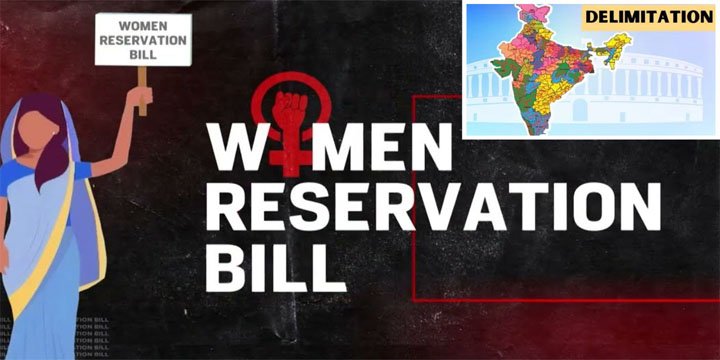
DELIMITATION & WOMEN RESERVATION BILL
Why in News
- The Union Government has introduced a set of important legislative measures to implement 33% reservation for women in the Lok Sabha and State Assemblies and to reform the long-pending delimitation process, which involves redrawing electoral constituencies.
- The delimitation exercise has effectively remained frozen since the 1970s, and these new proposals aim to restart and modernise the process.
WHAT IS THIS REFORM PACKAGE?
- This reform package is a landmark legislative initiative designed to overhaul both the composition of the Indian Parliament and the mechanism of electoral delimitation.
- It proposes amendments to key constitutional provisions, including Article 81 (composition of Lok Sabha), Article 82 (delimitation), and Article 334A (women’s reservation), in order to address changes in population distribution and the need for better gender representation.
- The overall objective is to bring the electoral system in line with current demographic realities and ensure inclusive political participation.
LEGISLATIVE PACKAGE
- The reform consists of 3 major Bills.
- The Constitution (131st Amendment) Bill, 2026 proposes the expansion of the Lok Sabha and introduces amendments to Articles 81, 82 and 334A.
- The Delimitation Bill, 2026 provides a new legal framework for carrying out delimitation through a restructured Delimitation Commission.
- A third Bill facilitates the implementation of women’s reservation in State Assemblies and Union Territories, thereby extending the reform beyond Parliament.
CORE AIMS OF THE REFORM
- One of the primary aims is to expand the Lok Sabha so that it reflects the significant population growth since the 1971 Census, which is currently the base for seat allocation.
- Another important objective is to enable the immediate implementation of one-third reservation for women, by removing the earlier requirement that linked it to a future Census-based delimitation.
- The reform also seeks to create a modern and flexible legal framework for delimitation so that electoral boundaries can be updated using the most relevant demographic data available.
KEY PROVISIONS
- The Bills propose to increase the strength of the Lok Sabha from the current 543 seats to a maximum of 850 seats, including 815 members from States and 35 from Union Territories.
- This expansion is expected to improve the representation ratio between population and elected representatives, thereby making democracy more responsive at the grassroots level.
- The reform also accelerates the implementation of women’s reservation, which was earlier delayed due to its linkage with post-2026 delimitation.
- Under the new proposal, reservation can take effect immediately after delimitation, making 2029 elections a realistic target.
- A significant constitutional change is the redefinition of “population” under Article 81, which now allows Parliament to decide which Census data should be used.
- This introduces flexibility, but also raises concerns regarding potential political discretion.
- Additionally, the amendment to Article 82 removes the earlier restriction that delimitation could only take place after the first Census conducted after 2026.
- This allows the government to proceed using 2011 Census data, thereby avoiding further delay.
STRUCTURAL SHIFT IN DELIMITATION
- Traditionally, delimitation was a constitutionally mandated process linked directly to each Census, ensuring regular and rule-based adjustments.
- The new framework transforms this into a Parliament-triggered process, meaning delimitation can now be initiated based on legislative decision rather than automatic constitutional requirement.
- Another major change is that postponement or modification of delimitation will now require only a simple majority in Parliament, instead of the earlier two-thirds majority, thereby reducing institutional safeguards against misuse.
DELIMITATION COMMISSION (2026 FRAMEWORK)
- The proposed Delimitation Commission will be responsible for redrawing constituency boundaries and reallocating seats across states.
- It will be chaired by a serving or retired Supreme Court judge, and will include the Chief Election Commissioner and State Election Commissioners as ex-officio members.
- Each state will also have 10 associate members (5 MPs and 5 MLAs), although they will not have voting rights.
- The Commission will take into account factors such as population, administrative boundaries, geographical features, and public convenience.
- Importantly, its orders will have the force of law and cannot be challenged in any court, which ensures finality but raises concerns about lack of judicial oversight.
- The system will also introduce rotation of reserved seats for women, ensuring wider representation across constituencies over time.
THE NORTH SOUTH DIVIDE
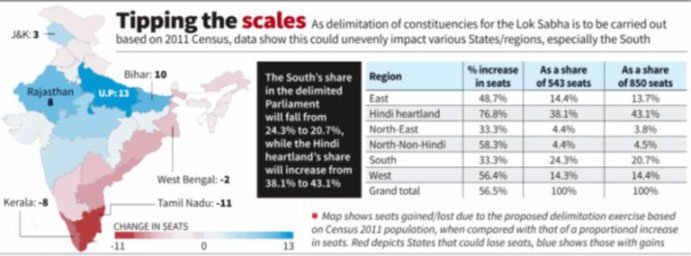
- One of the most critical issues arising from delimitation is the regional imbalance between northern and southern states.
- Southern states such as Tamil Nadu, Kerala and Karnataka have successfully controlled population growth, whereas northern states have experienced higher population increases.
- If delimitation is carried out strictly on population basis, northern states will gain more seats while southern states may lose relative representation.
- This creates a conflict between the constitutional principle of equal representation (one person, one vote) and the political commitment to maintain federal balance.
MAJOR CHALLENGES
- The reform faces a fundamental constitutional tension between population-based equality and regional fairness.
- The reduction of safeguards, such as shifting from a constitutional trigger to a legislative trigger, raises concerns about political manipulation of electoral boundaries.
- The delay in completion of the 2021 Census has already created uncertainty, and reliance on 2011 data is only a temporary solution. The timeline for women’s reservation is also dependent on the timely and smooth execution of delimitation.
SIGNIFICANCE
- The expansion of Lok Sabha will improve the representation of citizens, especially in densely populated regions.
- The reform has the potential to significantly increase women’s participation in politics, thereby making governance more inclusive.
- Updating constituency boundaries will correct the distortions created by outdated population data, making the electoral system more realistic and fair.
Note: Connect with Vajirao & Reddy Institute to keep yourself updated with latest UPSC Current Affairs in English.
Note: We upload Current Affairs Except Sunday.