
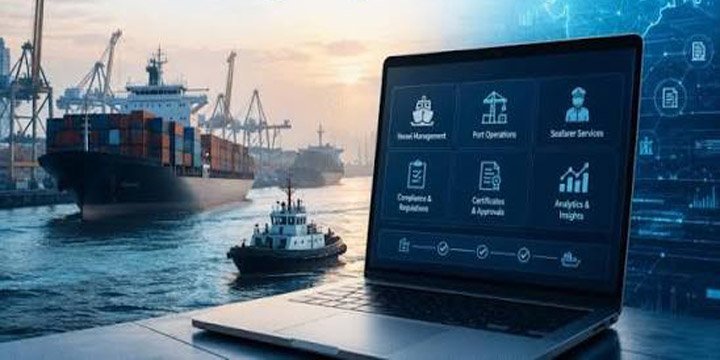
E SAMUDRA: DIGITAL TRANSFORMATION OF MARITIME GOVERNANCE
Why in News?
- E-Samudra, a comprehensive digital platform for maritime governance, was launched on 8 August 2026 in Mumbai.
- It was inaugurated by Union Minister for Ports, Shipping and Waterways Sarbananda Sonowal during a national stakeholder interaction on “Seafarer Security, Safety and Welfare and Inauguration of E-Samudra”.
- The programme was organised by the Directorate General of Maritime Administration (DGMA) under the Ministry of Ports, Shipping and Waterways (MoPSW).
- The platform aims to provide single-window digital services to seafarers, shipping companies, ports and other maritime stakeholders.
WHAT IS E SAMUDRA?
- E-Samudra is an integrated digital ecosystem for maritime administration.
- It aims to shift maritime governance from a physical office-based system to Digital First and Faceless Governance.
- It will bring multiple maritime services under a single digital window.
- Key features include:
- End-to-end digital workflows
- Online payments
- Real-time tracking
- Digitally issued certificates
- Time-bound and transparent service delivery
- The platform is designed to allow a seafarer onboard a vessel to access government services as easily as someone on shore.
KEY INITIATIVES LAUNCHED ALONGSIDE E SAMUDRA
- e-NAVIK 24×7 Grievance Redressal System: Provides round-the-clock grievance redressal for seafarers.
- Seafarer Tracking Dashboard: An upcoming system for tracking seafarers and improving administrative oversight.
- Digital Seafarers Employment Agreement (d-SEA): A digital system for employment agreements of seafarers.
- Seafarers Welfare Fund Society (SWFS): Enhanced welfare measures for seafarers.
- Sagar Mein Yog: Promotes the physical and mental wellbeing of seafarers.
- Sagar Mein Samman: Aims to improve opportunities and support for women seafarers.
WHY IS DIGITALISATION OF MARITIME GOVERNANCE IMPORTANT?
- India’s active seafarer workforce increased from around 1.03 lakh in 2013 to more than 3.23 lakh in 2025.
- The rapidly expanding workforce requires:
- Faster government services.
- Better regulatory compliance.
- Transparent processes.
- Stronger welfare mechanisms.
- Easier access to certificates and documentation.
- E-Samudra is expected to reduce compliance burdens, improve service delivery and strengthen transparency.
INDIA’S GROWING MARITIME POSITION
- India has emerged as the second-largest supplier of seafarers globally.
- India aims to become the world’s largest supplier of seafarers.
- India has also emerged as the world’s leading ship recycling destination.
- The country is working towards becoming one of the top five shipbuilding nations
- These developments support India’s broader maritime ambitions under:
- Maritime India Vision 2030
- Maritime Amrit Kaal Vision 2047
THREE PILLARS OF INDIA’S MARITIME POLICY
According to the Ministry of Ports, Shipping and Waterways, India’s maritime policy is anchored in three major pillars:
1. Merchant Shipping Act, 2025
o Recognises seafarers as Key Workers.
2. Maritime Amrit Kaal Vision 2047
o Provides a long-term roadmap for India’s maritime development.
3. Minimum Government, Maximum Governance
o Focuses on simplified procedures, digital governance and improved service delivery.
DGMA’S ROLE DURING GLOBAL SHIPPING DISRUPTIONS
- Recent geopolitical disruptions have affected global shipping and Indian seafarers.
- DGMA monitored:
- More than 16,000 calls.
- Over 40,000 communications.
- Safe repatriation of more than 4,000 stranded Indian seafarers.
- These efforts involved coordination among:
- Ministry of External Affairs
- Indian missions
- Indian Navy
- Shipowners
- Other maritime stakeholders.
FOCUS ON SEAFARER WELFARE
- The government has placed seafarer security, safety, welfare and dignity at the centre of maritime development.
- Sagar Mein Yog focuses on physical and mental wellbeing.
- Sagar Mein Samman focuses on increasing opportunities and support for women in the maritime sector.
- The rising number of women seafarers reflects increasing inclusivity in India’s maritime workforce.
SIGNIFICANCE OF E SAMUDRA
- Ease of Living: Makes government services easier and more accessible for seafarers.
- Ease of Doing Business: Simplifies regulatory processes for maritime companies and stakeholders.
- Transparency: Reduces physical interaction and makes processes digitally traceable.
- Accountability: Real-time tracking and digital records can improve monitoring.
- Efficiency: Reduces paperwork and processing delays.
- Faceless Governance: Enables services without requiring physical visits to government offices.
- Seafarer Welfare: Improves access to grievance redressal and welfare services.
- Maritime Competitiveness: Supports India’s ambition to become a leading global maritime power.
WAY FORWARD
- Expand integration of all maritime services through the E-Samudra
- Ensure strong cybersecurity and protection of seafarers’ personal data.
- Improve digital access for seafarers working in remote or offshore locations.
- Strengthen 24×7 grievance redressal and emergency support.
- Continue improving welfare, safety and career opportunities for Indian seafarers.
- Use digital governance to support the objectives of Maritime India Vision 2030 and Maritime Amrit Kaal Vision 2047.
CONCLUSION
E-Samudra marks an important shift towards technology-enabled, transparent and citizen-centric maritime governance. By bringing multiple services onto a common digital platform, India aims to improve the ease of living for seafarers, strengthen the ease of doing business for maritime stakeholders and support its ambition of becoming a leading global maritime nation.
Note: Connect with Vajirao & Reddy Institute to keep yourself updated with latest UPSC Current Affairs in English.
Note: We upload Current Affairs Except Sunday.