
eCOMMERCE COUNCIL OF INDIA
Context
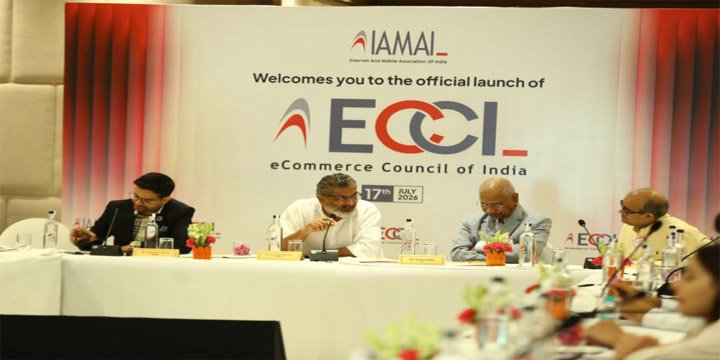
- The Internet and Mobile Association of India (IAMAI) launched the E-Commerce Council of India (ECCI) on 17 July 2026.
- The ECCI is the first national platform established to bring together stakeholders across India’s $120 billion digital commerce ecosystem.
- The initiative aims to promote collaboration between industry participants and the government to support the sustainable growth of India’s digital economy.
ABOUT THE ECCI
- The ECCI has been established as a collaborative platform to strengthen India’s digital commerce ecosystem through policy advocacy, research, and stakeholder engagement.
- It will facilitate dialogue between industry participants and policymakers on issues affecting the digital commerce sector.
- The Council will promote evidence-based policymaking by generating research, developing industry best practices, and contributing to regulatory discussions.
- The initiative seeks to ensure that India’s digital commerce sector remains innovative, trusted, and globally competitive.
OBJECTIVES OF ECCI
- To provide a common platform for digital commerce stakeholders to engage with policymakers.
- To promote research and knowledge-sharing on emerging issues in the digital commerce sector.
- To develop industry-wide best practices that improve transparency, efficiency, and consumer trust.
- To strengthen policy advocacy by presenting a unified industry perspective on regulatory matters.
- To create a conducive business environment that supports innovation, investment, and sustainable growth.
KEY HIGHLIGHTS
- IAMAI President Subho Ray stated that digital commerce has emerged as one of the most important pillars of India’s digital economy.
- He emphasized that the future growth of the sector will depend on continuous collaboration between the government and industry.
- Economist Laveesh Bhandari, while delivering the keynote address, highlighted that innovation alone would not be sufficient and that greater collaboration among stakeholders would be essential for the sector’s next phase of growth.
- IAMAI stressed the need for the industry to speak with a unified voice on major policy issues to facilitate informed policymaking and regulatory certainty.
STAKEHOLDERS INCLUDED
The ECCI seeks to bring together a wide range of stakeholders, including:
- Policymakers and government agencies.
- E-commerce marketplaces and online retailers.
- Brands and Direct-to-Consumer (D2C) companies.
- Logistics and supply chain service providers.
- Technology companies and digital payment solution providers.
- Startups, exporters, and MSMEs.
- Industry experts and academic institutions.
MAJOR COMPANIES EXPECTED TO PARTICIPATE
The Council is expected to include leading digital commerce companies such as:
- Amazon
- Flipkart
- Swiggy
- Eternal
- IndiaMART
- MakeMyTrip
- Ixigo
- Uber
- Rapido
- Shiprocket
- Transport Corporation of India Limited (TCIL)
- eBay
- Meesho
- Tata 1mg
SIGNIFICANCE
- The ECCI is expected to improve coordination between the government and the digital commerce industry.
- It will promote regulatory certainty through structured policy dialogue.
- The initiative will strengthen consumer trust by encouraging responsible business practices.
- It will improve the ease of doing business for digital commerce enterprises.
- The Council is expected to support innovation, entrepreneurship, and investment in India’s digital economy.
- It will help MSMEs and exporters integrate more effectively into domestic and global digital markets.
- The initiative aligns with India’s vision of becoming a global digital economy and expanding its digital public infrastructure.
INDIA’S DIGITAL E COMMERCE ECOSYSTEM
- India’s digital commerce sector has evolved beyond traditional online retail.
- It now includes online marketplaces, mobility services, travel technology, logistics, digital payments, supply chain management, Direct-to-Consumer (D2C) brands, cross-border trade, exporters, and AI-powered commerce.
- The sector has become a significant contributor to employment generation, innovation, and economic growth.
CHALLENGES
- Rapid technological changes require continuous policy adaptation.
- Regulatory uncertainty may affect long-term investments.
- Ensuring consumer protection and data privacy remains a key challenge.
- Balancing innovation with fair competition requires effective regulatory frameworks.
- Small businesses and MSMEs need greater digital capacity and infrastructure to fully benefit from digital commerce.
WAY FORWARD
- Regular dialogue between industry and government should be institutionalized through platforms such as the ECCI.
- Evidence-based policymaking should be encouraged through research and stakeholder consultations.
- Consumer protection frameworks should be strengthened while promoting innovation.
- Greater support should be provided to MSMEs to improve digital adoption and market access.
- Policies should encourage responsible AI adoption, cross-border digital trade, and global competitiveness.
Note: Connect with Vajirao & Reddy Institute to keep yourself updated with latest UPSC Current Affairs in English.
Note: We upload Current Affairs Except Sunday.