
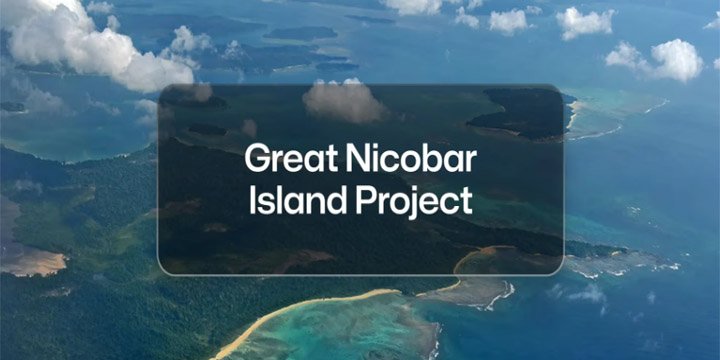
GREAT NICOBAR ISLAND DEVELOPMENT PROJECT
Why in News?
- The Government of India has approved a ₹13,000 crore Greenfield Civil-Military Airport in Great Nicobar Island.
- The airport will be developed near Galathea Bay under the larger ₹81,000 crore Great Nicobar Island Development Project.
- The government has decided not to expand INS Baaz, the existing naval air station at Campbell Bay.
- The project has triggered debate over its strategic benefits, environmental impact, and tribal rights concerns.
KEY DECISION: NEW GREENFIELD CIVIL MILITARY AIRPORT
Location
- Chingen, near Galathea Bay.
- Southeastern coast of Great Nicobar Island.
Cost
- Approximately ₹13,000 crore.
Timeline
- Expected completion within 5 years.
Operational Structure
- Will function as a dual-use airport.
- Serve both:
- Civilian aviation.
- Military operations.
- Will remain under Indian Navy operational control.
WHY WAS INS BAAZ EXPANSION DROPPED?
Earlier Proposal
- Expansion of runway at INS Baaz in Campbell Bay.
- Existing runway length: 4,500 feet.
- Proposed expansion: Around 10,000 feet.
REASONS FOR REJECTION
Terrain Constraints
- Difficult geographical conditions.
- Limited availability of land.
Navigational Challenges
- Operational difficulties due to surrounding terrain.
Infrastructure Limitations
- Large supporting infrastructure required.
Environmental Concerns
Expansion could have led to:
- Greater forest diversion.
- Disturbance to wildlife habitats.
- Impact on tribal settlements.
Government Assessment
- Greenfield airport considered more feasible.
- Better scope for future expansion.
WHY GREAT NICOBAR MATTERS?
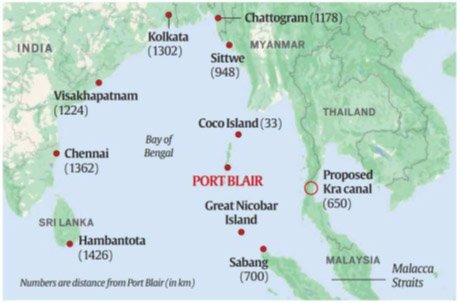
Strategic Location
- India’s southernmost island.
- Located in the Andaman and Nicobar archipelago.
- Positioned near major international sea routes.
PROXIMITY WITH STRAIT OF MALACCA
Importance
- One of the world’s busiest maritime chokepoints.
- Connects:
- Indian Ocean.
- South China Sea.
- Pacific Ocean.
Significance
- Large share of global trade passes through it.
- Major route for oil and energy shipments.
- Critical for international supply chains.
Six Degree Channel
- Great Nicobar lies close to the Six Degree Channel.
- Important sea route leading into the Malacca Strait.
STRATEGIC VALUE
Enables India to:
- Monitor maritime traffic.
- Track naval movements.
- Strengthen maritime surveillance.
- Protect Sea Lines of Communication (SLOCs).
STRATEGIC SIGNIFICANCE FOR INDIA
Strengthening Indo-Pacific Presence
The project will help India:
- Expand its strategic footprint.
- Enhance influence in the Indo-Pacific.
- Improve maritime domain awareness.
Military Advantages
Enhanced Surveillance
- Better monitoring of Indian Ocean shipping routes.
- Improved tracking of military activities.
Increased Operational Reach
- Faster deployment of aircraft and troops.
- Improved logistics support.
Disaster Response
- Quicker humanitarian assistance and disaster relief operations.
Countering Chinese Presence
The project is expected to:
- Strengthen India’s position in the Indian Ocean Region (IOR).
- Respond to increasing Chinese maritime activity.
- Improve strategic deterrence capabilities.
EXISTING MILITARY INFRASTRUCTURE
Andaman and Nicobar Command (ANC)
Established
- 2001
Significance
- India’s only Tri-Service Command.
- Integrates:
- Army.
- Navy.
- Air Force.
INS Baaz
Commissioned
- 2012
Importance
- India’s southernmost military air station.
- Strategic surveillance base in the Indian Ocean.
ABOUT GREAT NICOBAR ISLAND DEVELOPMENT PROJECT
Total Cost
- ₹81,000 Crore
- The airport is one component of a larger mega-project.
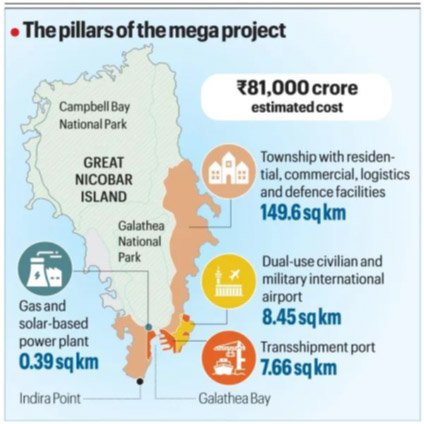
MAJOR COMPONENTS
1. International Container Transshipment Terminal Location: Galathea Bay.
Objective
Reduce dependence on foreign transshipment hubs such as:
- Singapore
- Colombo
Benefits
- Boost maritime trade.
- Improve logistics efficiency.
- Increase India’s role in global shipping.
2. Greenfield Airport
- Civil-military airport.
- Strategic aviation hub.
3. Power Infrastructure
- Reliable electricity supply.
- Support industrial and urban growth.
4. Township Development
Includes:
- Residential infrastructure.
- Commercial facilities.
- Social infrastructure.
GOVERNMENT’S JUSTIFICATION
Strategic Importance
Government argues that the project will:
- Enhance national security.
- Strengthen maritime surveillance.
- Improve military preparedness.
Economic Benefits
- Transform Great Nicobar into a maritime hub.
- Increase trade and investment.
- Create employment opportunities.
Connectivity Benefits
- Better connectivity with mainland India.
- Improved movement of people and goods.
ENVIRONMENTAL CONCERNS
Deforestation
Critics argue the project may require:
- Felling of over 1.5 crore trees.
Biodiversity Loss
Potential impact on:
- Tropical rainforests.
- Endemic species.
- Wildlife habitats.
Coral Reef Damage
Concerns regarding:
- Destruction of coral ecosystems.
- Marine biodiversity loss.
TRIBAL CONCERNS
Impact on Indigenous Communities Shompen Tribe
Most vulnerable community likely to be affected.
Concerns
- Habitat loss.
- Cultural disruption.
- Reduced access to traditional resources.
Importance of Shompen Tribe
- Classified as a Particularly Vulnerable Tribal Group (PVTG).
- Indigenous inhabitants of Great Nicobar.
- Depend heavily on forests for livelihood.
CRITICISM BY OPPOSITION
Rahul Gandhi’s Concerns
Rahul Gandhi
Criticised the project on grounds of:
- Environmental destruction.
- Tribal displacement.
- Lack of transparency.
Major Questions Raised
Environmental Clearances
- Adequacy of impact assessments.
Financial Viability
- Cost-benefit justification.
Tribal Rights
- Protection of indigenous communities.
Alternative Options
- Why not expand INS Baaz instead?
KEY ADVANTAGES OF THE NEW AIRPORT
Greater Expansion Potential
- More land availability.
- Long-term infrastructure growth.
Better Military Utility
- Larger aircraft operations.
- Enhanced logistics capabilities.
Improved Civilian Connectivity
- Supports tourism and economic development.
Strategic Surveillance
- Better monitoring of maritime routes.
CHALLENGES AHEAD
Environmental Sustainability
- Balancing development with conservation.
Protection of Tribal Rights
- Ensuring participation and welfare of indigenous communities.
Project Implementation
- Cost management.
- Timely execution.
- Infrastructure development.
Strategic-Ecological Balance
- Meeting security needs without irreversible ecological damage.
CONCLUSION
The Great Nicobar Island Development Project is one of India’s most ambitious strategic infrastructure initiatives. The proposed ₹13,000 crore Greenfield Airport, along with the transshipment port and township development, can significantly strengthen India’s Indo-Pacific strategy, maritime security, trade connectivity and military reach. However, concerns relating to forest loss, biodiversity, coral reefs and tribal communities such as the Shompen highlight the need for a balanced approach that combines national security, economic development and environmental sustainability.
Note: Connect with Vajirao & Reddy Institute to keep yourself updated with latest UPSC Current Affairs in English.
Note: We upload Current Affairs Except Sunday.