
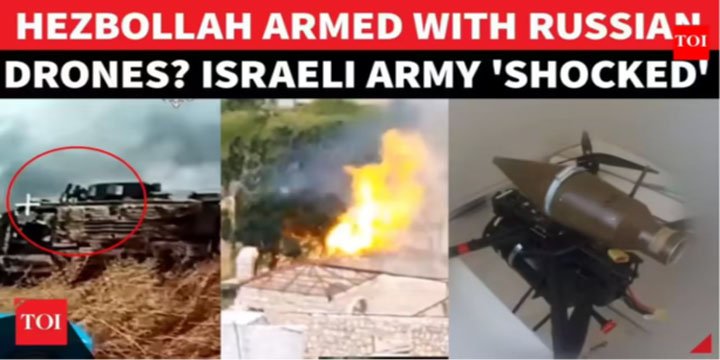
HEZBOLLAH USING FIBRE OPTIC DRONES
Why in News?
- Hezbollah is reportedly using fiber-optic drones in attacksagainst Israel.
- These drones are difficult to stop because they cannot be easily jammed through electronic warfare systems.
- The technology was earlier widely used during the Russia-Ukraine War.
WHAT ARE FIBRE OPTIC DRONES?
- Fiber-optic drones are drones controlled through very thin fiber-optic cables instead ofnormal radio signals.
- The cables are:
- Extremely thin
- Nearly invisible
- Similar in width to dental floss
WHY ARE THEY HARD TO DETECT?
Immune to Electronic Jamming
- Traditional drones depend on radio signals.
- Those signals can often be blocked or jammed electronically.
- Fiber-optic drones do not rely on radio communication.
- As a result, electronic jamming systems become ineffective.
Hard to Detect
According to drone experts:
- The drones fly:
- Very low
- Very fast
- They are also:
- Small in size
- Difficult to track
- Difficult to intercept
Difficult Interception
- Israel would need to:
- Physically intercept the drone
- Or cut the nearly invisible fiber-optic cable
- Both tasks are extremely challenging during active combat.
EXPERT OBSERVATIONS & CONCERNS
Robert Tollast’s View
- Drone expert Robert Tollast stated that:
- If operated properly, these drones can be “absolutely deadly.”
- He also noted that:
- Russia and Ukraine have used many types of drones on a massive scale.
Israeli Concerns
- Former Israeli air defence commander Ran Kochav admitted that Israel is struggling to counter such drones
- He stated that:
- The drones are very hard to detect and track.
- Israel focused more on missile and rocket defence systems and paid less attention to drone threats.
ORIGIN OF THE TECHNOLOGY
- Fiber-optic drones became prominent during the Russia-Ukraine War
- The technology was developed to bypass electronic jamming systems used in warfare.
Large-Scale Use in Ukraine
- The drones were used extensively by both Russia and Ukraine.
- Fiber-optic cables reportedly stretched up to:
- 50 kilometres
- In some frontline areas, the cables covered entire fields like spiderwebs.
HEZBOLLAH’S USE OF THE DRONES
- Hezbollah has released videos of attacks using these drones through:
- Social media platforms
- Al-Manar TV
Reported Attacks
- One attack reportedly:
- Killed an Israeli soldier
- Injured six others
- Another attack reportedly killed an Israeli civilian.
- Attack on Rescue Helicopter: In one incident:
- A second drone targeted a military helicopter arriving to evacuate injured soldiers.
- The drone narrowly missed the helicopter.
ISRAELI DRONE OPERATIONS
- Israel also operates a large drone fleet for:
- Surveillance
- Air strikes
- Monitoring Hezbollah movements
- Hezbollah officially announced the use of fiber-optic drones on March 2 during a phase of fighting.
SIGNIFICANCE OF THE DEVELOPMENT
Changing Nature of Warfare
- The conflict shows how modern wars increasingly depend on:
- Drone technology
- Artificial intelligence
- Electronic warfare systems
Rise of Low-Cost Precision Weapons
- Small drones can cause serious military damage at relatively low cost.
Lessons from Ukraine War
- Technologies developed during one conflict are now spreading to other regions.
CHALLENGE FOR THE AIR DEFENCE SYSTEMS
Traditional missile defence systems may not be fully effective against:
- Small
- Fast
- Low-flying drones
CONCLUSION
- The use of fiber-optic drones by Hezbollah highlights the growing importance of dronewarfare in modern conflicts.
- These drones are difficult to jam, track and intercept, creating major security challengesfor Israel.
- The development also reflects how technologies from the Russia-Ukraine war are influencing conflicts in other parts of the world.
Note: Connect with Vajirao & Reddy Institute to keep yourself updated with latest UPSC Current Affairs in English.
Note: We upload Current Affairs Except Sunday.