
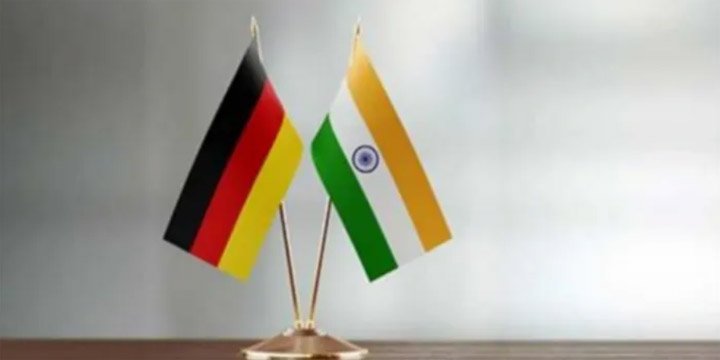
INDIA GERMANY TIES
Why in News?
- India and Germany are expected to sign the Project-75I submarine deal worth about €8 billion (over ₹90,000 crore) for six next-generation conventional submarines.
- The submarines will be built in India through collaboration between Germany’s ThyssenKrupp Marine Systems (TKMS) and Mazagon Dock Shipbuilders Limited (MDL).
- The agreement marks a shift in India–Germany relations from traditional economic cooperation towards a strategic-industrial partnership centred on defence manufacturing, technology transfer and supply-chain resilience.
EVOLUTION OF TIES
Phase I: Formative Years (1951–1970s)
- India was among the first countries to establish diplomatic relations with the Federal Republic of Germany (FRG) in 1951.
- Relations were influenced by the Hallstein Doctrine, as India maintained relations with both West Germany (FRG) and East Germany (GDR).
- Jawaharlal Nehru’s 1956 visit to West Germany laid the foundation for industrial cooperation, including the Rourkela Steel Plant.
Phase II: Developmental & Technical Cooperation (1970s–1990)
- India recognised East Germany (GDR) in 1972.
- Germany became one of India’s largest development partners.
- IIT Madras was established with German technical and financial assistance.
- India welcomed the reunification of Germany in 1990.
Phase III: Economic Liberalisation & Strategic Partnership (1991–2010)
- India’s economic reforms strengthened German investments.
- German Mittelstand (SMEs) began viewing India as a manufacturing destination.
- Relations were elevated to a Strategic Partnership in 2000.
- India and Germany became partners in the G4 Group along with Japan and Brazil to advocate UN Security Council reforms.Phase IV:
Institutional Partnership (2011–2021)
- Inter-Governmental Consultations (IGC) were launched in 2011, enabling meetings between both Cabinets.
- Germany became an important partner in:
- Renewable energy
- Green Energy Corridors
- Skill development
- Make in India
- Industry 4.0 initiatives.
Phase V: Strategic Convergence (2022–Present)
- Germany’s Indo-Pacific Guidelines (2020) and Focus on India Strategy (2024) identify India as a key strategic partner.
- Defence cooperation has expanded through:
- Project-75I submarine programme
- Defence Industrial Cooperation Roadmap (2026).
SIGNIFICANCE OF GERMANY FOR INDIA
Defence Indigenisation
- Project-75I represents a transition from a buyer-seller relationship to technology transfer and co-development.
- Six Type-214 submarines with Air Independent Propulsion (AIP) will be manufactured.
- Indigenous content is expected to increase from 45% in the first submarine to nearly 60% by the sixth, supporting Atmanirbhar Bharat.
Economic and Supply Chain Cooperation
- Germany is India’s largest trading partner within the European Union.
- Bilateral trade has crossed USD 50 billion, accounting for more than 25% of India’s trade with the EU.
- German Mittelstand investments strengthen India’s manufacturing and exports.
Climate and Energy Partnership
- Germany supports India’s low-carbon transition through the Green and Sustainable Development Partnership (GSDP).
- Germany has committed €10 billion by 2030, with nearly €5 billion already earmarked by early 2026.
- Cooperation includes:
- Green hydrogen
- Green ammonia
- Sustainable infrastructure.
Education and Skilled Mobility
- More than 60,000 Indian students study in Germany.
- The Migration and Mobility Partnership Agreement (MMPA) facilitates skilled migration.
- Programmes like SPARC-GIANT promote joint research in healthcare, sustainability and semiconductors.
Technology and Semiconductors
- Cooperation has expanded through:
- Joint Declaration on Semiconductor Ecosystem Partnership
- Innovation & Technology Roadmap (2024).
- Major investments include Infineon’s Global Capability Centre in GIFT City, Gujarat.
Indo-Pacific Security
- Germany recognises India as an important democratic partner in maintaining a rules-based Indo-Pacific.
- Cooperation includes:
- Naval exercises
- Maritime consultations
- Support for India-Middle East-Europe Economic Corridor (IMEC).
Multilateral Cooperation
- India and Germany cooperate in:
- G4
- G20
- They advocate:
- UNSC reforms
- Global financial reforms
- Digital Public Infrastructure
- Multipolar global governance.
MAJOR CHALLENGES
Defence Export Restrictions
- Germany’s strict arms export regulations create uncertainty in defence technology transfer.
- Project-75I approvals experienced prolonged delays.
Differences in AI and Digital Regulations
- The EU AI Act and India’s Digital Personal Data Protection (DPDP) Act create regulatory differences affecting:
- AI collaboration
- Data sharing
- Digital infrastructure.
Trade Issues
- Although India and the EU concluded FTA negotiations in 2026, implementation remains pending.
- Challenges remain regarding:
- Data governance
- Sustainability standards
- Market access
- Carbon Border Adjustment Mechanism (CBAM).
Geopolitical Differences
- Germany has concerns over India’s continued energy imports from Russia.
- India remains concerned about Germany’s economic dependence on China.
Climate Technology and Intellectual Property
- High licensing costs for German green technologies limit technology transfer.
- Limited funds under GSDP reach IP-sharing projects.
Ease of Doing Business
- German companies cite:
- Bureaucracy (64%)
- Corruption (39%)
- Tax complexity (27%) as major barriers to investment in India.
Labour Mobility Issues
- Challenges include:
- Recognition of professional qualifications
- German language requirements
- Limited mutual recognition of engineering degrees.
Sanitary and Phytosanitary (SPS) Standards
- Strict EU SPS standards restrict Indian agricultural exports.
- Example: Rejection of Indian mango exports due to pesticide residue concerns.
WAY FORWARD
- Establish an Indo-German Defence Innovation Bridge for co-development of defence technologies.
- Launch a Digital Sovereignty Dialogue to harmonise AI governance and digital standards.
- Develop a Green Hydrogen Offtake Corridor through long-term green ammonia agreements.
- Create a Mutual Skills Recognition Framework for easier mobility of skilled professionals.
- Launch a Mittelstand–Startup Synergy Fund to promote joint innovation.
- Expand maritime cooperation through a German liaison officer at IFC-IOR.
- Build a Circular Economy Partnership focusing on e-waste and plastic recycling.
- Harmonise agricultural standards through a Mutual Equivalence Agreement on SPS measures.
CONCLUSION
- India–Germany relations have evolved into a strategic-industrial partnership combining German technology with India’s manufacturing capabilities.
- Deepening cooperation in defence, technology, climate action and supply chains can strengthen a resilient, rules-based and multipolar Indo-Pacific, provided regulatory and strategic challenges are effectively addressed.
Note: Connect with Vajirao & Reddy Institute to keep yourself updated with latest UPSC Current Affairs in English.
Note: We upload Current Affairs Except Sunday.