
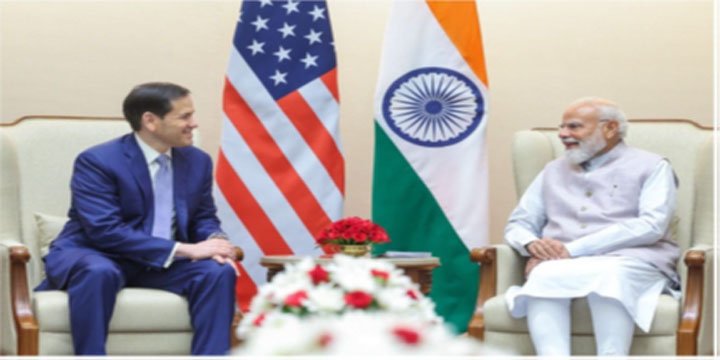
MARCO RUBIO VISITS INDIA
Why in News?
- Recent diplomatic engagements, including US Secretary of State Marco Rubio’s visit to India and the Quad Foreign Ministers’ Meeting, have highlighted both reassurance and uncertainty in India–US relations amid shifting global geopolitics.
- The discussions come against the backdrop of evolving US policies on trade, immigration, and strategic priorities, alongside broader changes in the Indo-Pacific balance.
INDIA US RELATIONS: HISTORICAL CONTEXT
The India–US relationship has strengthened significantly in the first quarter of the 21st century, driven by:
- Shared democratic values
- Common geopolitical interests
- Alignment on global issues such as:
- Technology cooperation
- Supply chain resilience
- Trade and investment
KEY STRATEGIC ASSUMPTIONS
- Both nations are vibrant democracies with converging interests
- China identified as a common strategic challenge
- Gradual de-hyphenation of India from Pakistan in US policy, viewing India as a key independent partner
CHALLENGES IN RECENT YEARS
1. Economic and Trade Frictions
- US tariffs on Indian goods disrupted assumptions of smooth trade convergence
- India was referred to as a “tariff king” in US discourse
- Raised concerns over trade predictability and fairness
2. Strategic and Defence Issues
- US use of CAATSA sanctions threats over India’s defence ties with Russia
- Highlighted limits of flexibility in bilateral defence cooperation
3. Immigration and Technology Frictions
- Tightening of H-1B visa policies
- Impact on India–US technology ecosystem:
- Silicon Valley–Bengaluru talent flow disrupted
4. Geopolitical Shifts
- US discussions on a potential “G2 framework” with China
- Renewed US engagement with Pakistan created regional unease in India
REASSURANCE & RESET ATTEMPT
US Secretary of State Marco Rubio sought to:
- Reaffirm long-term commitment to India–US strategic partnership
- Clarify that US tariffs and visa actions were not India-specific
- Emphasise reforms aimed at:
- Trade rebalancing
- Immigration modernization
Key Statement
- The relationship will become “stronger than it has ever been” by the end of the current US administration
Pakistan and Regional Messaging
- US engagement with other countries described as tactical
- Reassurance that it would not weaken strategic ties with India
India’s Strategic Framework
External Affairs Minister S. Jaishankar presented a five-point approach:
- Dialogue and diplomacy
- Safe and unimpeded maritime commerce
- Respect for international law
- Opposition to weaponisation of trade and resources
- Strengthening trusted partnerships and resilient supply chains
KEY OUTCOMES OF THE QUAD FOREIGN MINISTERS MEET
The Quad announced cooperation in:
- Maritime surveillance systems
- Port infrastructure development
- Critical minerals supply chains
- Energy security frameworks
These initiatives aim to:
- Strengthen Indo-Pacific stability
- Build resilient supply chains
- Counter strategic vulnerabilities
US CHINA FACTOR & GLOBAL REBALANCING
Emerging Developments:
- Signs of US–China rapprochement
- Possible US strategic focus shift toward West Asia
Implications:
- Raises questions about sustained US Indo-Pacific commitment
- Tests long-term cohesion of Quad objectives
- Reinforces need for India’s strategic adaptability
India–China Context
- India–China relationship remains:
- Structurally competitive
- Strategically sensitive
- Requires continuous diplomatic management
INDIA US GEOPOLITICAL RELATIONSHIP: KEY ANALYTICAL INSIGHTS
1. Nature of the Partnership
- Built on shared democracy and strategic convergence
- Strong alignment on:
- Countering China
- Global technology ecosystems
- Economic integration
2. Fragilities Exposed
The past years revealed vulnerabilities:
- Trade protectionism and tariff disputes
- Strategic conditionalities in defence cooperation
- Immigration tightening affecting tech ties
- Fluctuating US engagement in South Asia
3. Diplomatic Efforts for Stabilisation
Rubio’s visit reflects attempts to:
- Rebuild trust
- Separate trade tensions from security cooperation
- Reinforce India’s role in Indo-Pacific strategy
- Sustain Quad commitment
4. Suggested Directions for Strengthening Ties
Key recommendations emerging from analysis:
- Formalising India’s strategic partner status in US policy
- Recognising India’s independent foreign policy choices, including ties with Russia
- Protecting technology and skilled migration channels from political volatility
- Strengthening high-level political engagement (including Quad leadership summits)
KEY THEME: AMERICA FIRST V/S INDIA FIRST
- US continues “America First” approach
- India asserts “India First” approach
Meaning:
- Cooperation is based on converging interests, not alignment
- Relationship is increasingly transactional and interest-driven
STRUCTURAL INSIGHT
The evolving relationship shows:
- Diplomacy alone is insufficient without domestic economic strength
- Strategic autonomy is essential in a multipolar world
- External partnerships depend on internal capability building
CONCLUSION
India–US relations remain a critical but evolving strategic partnership, shaped by cooperation in the Indo-Pacific and tensions in trade, immigration, and geopolitics. While recent engagements reaffirm long-term commitment, the relationship is increasingly complex, interest-driven, and sensitive to global power shifts.
The future trajectory will depend on:
- Sustained diplomatic engagement
- Structural trust-building
- India’s domestic economic and technological strengthening
- Stability in US global strategic priorities
Note: Connect with Vajirao & Reddy Institute to keep yourself updated with latest UPSC Current Affairs in English.
Note: We upload Current Affairs Except Sunday.