
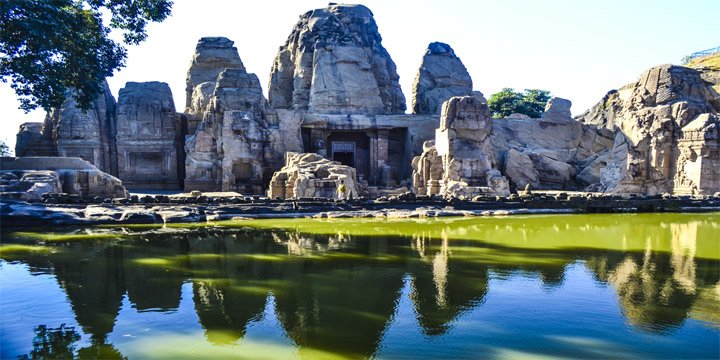
MASROOR ROCK CUT TEMPLES
Why in News?
- The Masroor Rock-Cut Temples of Himachal Pradesh have recently gained attention for their unique architecture and heritage value.
- They are often called the “Ellora of Himachal Pradesh” and the “Himalayan Pyramid”.
ABOUT THE TEMPLES
- An 8th-century rock-cut Hindu temple complex located in Kangra Valley on the banks of the Beas River in Himachal Pradesh.
- Consists of 15 monolithic rock-cut temples carved from a single rock.
- Dedicated to Lord Shiva, Lord Rama, Goddess Sita, and Lord Lakshmana.
HISTORICAL BACKGROUND
- Believed to have been built around the 8th century CE.
- Shows strong influence of Gupta-style architecture.
- No clear mention of the temple exists in ancient scriptures or historical records.
- First reported by Henry Shuttleworth (1913).
- Surveyed by Archaeological Survey of India (ASI) officer Harold Hargreaves (1915).
ARCHITECTURAL FEATURES
- Built in the North Indian Nagara style of temple architecture.
- Entire complex is carved out of a single monolithic rock.
- Follows a symmetrical square-grid layout.
- Main temple is surrounded by smaller shrines arranged in a Mandala pattern.
- Features prominent Shikharas (temple towers).
- Has a sacred water tank in front of the temple complex.
UNIQUE FEATURES
- Unlike most Hindu temples that face east, Masroor Temples face northeast towards the Dhauladhar Mountains.
- Has three entrances facing:
- Northeast
- Southeast
- Northwest
- Evidence suggests a fourth entrance was planned but left incomplete.
SCULPTURAL SIGNIFICANCE
- Contains elaborate carvings of Vedic and Puranic deities.
- Features relief sculptures and friezes depicting stories from Hindu mythology.
- Reflects the rich artistic and religious traditions of ancient India.
Damage and Conservation
- Large parts of the sculptures and carvings have been damaged over time.
- Repeated earthquakes in the Himalayan region are believed to be the main cause of destruction.
- Several original sculptures and decorative elements have been lost.
OVERALL SIGNIFICANCE
- One of India’s rare examples of rock-cut Nagara-style temple architecture.
- Important centre of Hindu religious and cultural heritage.
- Represents advanced engineering and artistic excellence of early medieval India.
- Holds immense archaeological, historical and tourism value.
Note: Connect with Vajirao & Reddy Institute to keep yourself updated with latest UPSC Current Affairs in English.
Note: We upload Current Affairs Except Sunday.