
NATIONAL HANDLOOM DAY
National Handloom Day is celebrated every year on 7 August to:
- Recognize the contribution of India’s handloom weavers to the country’s economy and cultural heritage.
- Promote the handloom sector and encourage the use of indigenous handloom products.
- Commemorate the Swadeshi Movement, which was launched on 7 August 1905 in response to the Partition of Bengal. The movement encouraged the use of indigenous goods, including handloom textiles.
4 PILLARS OF 2026 OBSERVANCE
- Innovation in Design & Operations: Developing digital solutions to enhance and modernize loom productivity.
- Market Access & Digital Integration: Expanding international trade routes and e-commerce platforms for local weavers.
- Sustainability & Environmental Impact: Promoting eco-friendly, natural-dyed, and upcycled textile practices.
- Weaver Livelihoods & Financial Inclusion: Strengthening targeted financial and digital identity support through the expanded e-Pehchan portal
HISTORY
Date: 7 August every year
First celebrated: 2015
Launched by: Prime Minister Narendra Modi at Chennai.
The day marks the anniversary of the Swadeshi Movement (1905), which emphasized self-reliance and the boycott of foreign goods.
IMPORTANCE OF HANDLOOM SECTOR
Economic Importance
- One of the largest employment generators after agriculture.
- Provides livelihood to millions of weavers and allied workers, particularly in rural areas.
- Supports MSMEs and rural entrepreneurship.
- Contributes to exports of textiles and handicrafts.
Social Importance
- Women constitute a significant share of the handloom workforce.
- Preserves traditional skills and provides income to artisan communities.
Cultural Importance
- Represents India’s rich textile diversity.
- Each region has its own distinctive weaving traditions.
Examples
- Banarasi Silk (Uttar Pradesh)
- Kanchipuram Silk (Tamil Nadu)
- Chanderi (Madhya Pradesh)
- Pochampally Ikat (Telangana)
- Muga Silk (Assam)
- Sambalpuri Ikat (Odisha)
- Paithani (Maharashtra)
- Bhujodi Weaving (Gujarat)
GOVERNMENT INITIATIVES
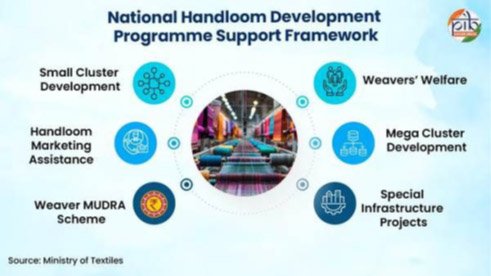
National Handloom Development Programme (NHDP)
- Financial and technical support for handloom clusters.
- Infrastructure development and capacity building.
Raw Material Supply Scheme (RMSS)
- Ensures timely availability of yarn at subsidized rates.
Weaver Mudra Scheme
- Provides concessional credit to handloom weavers.
India Handloom Brand
- Promotes high-quality authentic handloom products.
Handloom Mark
- Certifies that a product is genuinely handwoven.
Geographical Indication (GI) Tags
Many handloom products have GI protection, helping preserve traditional crafts and improve market value.
E-commerce and Digital Marketing
- Promotion through online platforms to improve market access for weavers.
CHALLENGES
- Competition from powerloom and machine-made textiles.
- Rising cost of raw materials.
- Low wages and declining profitability.
- Limited market access.
- Aging artisan population and declining interest among youth.
- Impact of climate variability on natural fibres like cotton and silk.
WAY FORWARD
- Strengthen branding and exports.
- Promote sustainable and eco-friendly textiles.
- Improve digital marketing and e-commerce access.
- Expand skill development and design innovation.
- Increase institutional credit and social security for weavers.
- Integrate handloom promotion with tourism and cultural initiatives.
Note: Connect with Vajirao & Reddy Institute to keep yourself updated with latest UPSC Current Affairs in English.
Note: We upload Current Affairs Except Sunday.