
NATIONAL MISSION FOR SUSTAINABLE AGRICULTURE
Why is this in news?
The Government of India highlighted the achievements of the National Mission for Sustainable Agriculture (NMSA), a major scheme that helps farmers deal with problems like:
- drought,
- floods,
- poor soil,
- water shortage, and
- climate change.
The mission focuses on making Indian agriculture more sustainable, productive, and climate-resilient.
SIMPLE MEANING OF NMSA
- The National Mission for Sustainable Agriculture (NMSA) was launched in 2014-15 under the National Action Plan on Climate Change (NAPCC).
Its main goal is:
“To help farmers continue farming successfully even during climate change and extreme weather conditions.”
It especially supports:
- rainfed farming areas,
- better water use,
- healthy soil,
- climate-resilient crops, and
- modern farming methods.
WHY IS NMSA IMPORTANT?
- Around 60% of India’s farmland depends on rainfall.
- Rainfed farming contributes nearly 40% of total food production.
- Climate change is increasing:
- droughts,
- heat waves,
- floods,
- irregular rainfall.
So, India needs farming systems that can survive changing weather conditions.
MAJOR COMPONENTS OF NMSA
1: RAINFED AREA DEVELOPMENT
WHAT IS IT?
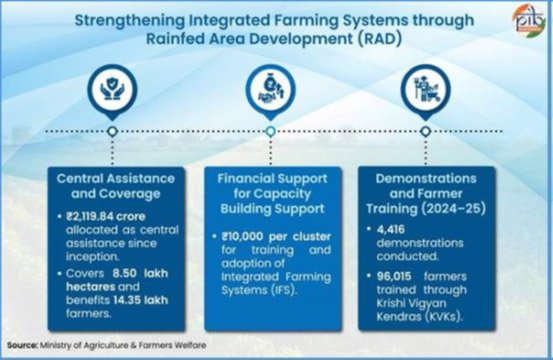
- This scheme helps farmers in rain-dependent areas adopt Integrated Farming Systems (IFS).
- Integrated Farming System (IFS) means:
Instead of depending on only one crop, farmers combine:
- crops,
- vegetables,
- livestock,
- fisheries,
- horticulture, etc.
This reduces risk and increases income.
Benefits
- Better income stability
- Less dependence on one crop
- Protection during bad weather
- More employment opportunities
Key Achievements
- ₹2,119.84 crore released since 2014-15
- 5 lakh hectares covered
- 35 lakh farmers benefited
- In 2025-26:
- ₹343.86 crore allocated
- 96,013 farmers trained
2: PER DROP MORE CROP
Main Aim:
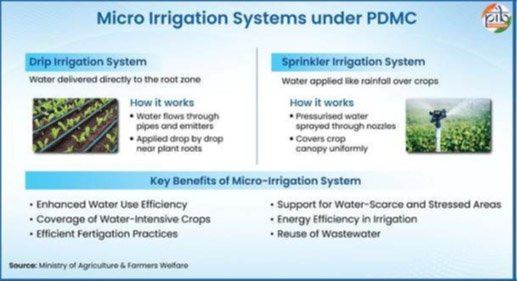
- To save water in farming through micro-irrigation.
Types of Micro-Irrigation
(a) Drip Irrigation
- Water is supplied directly to plant roots drop by drop.
(b) Sprinkler Irrigation
- Water is sprayed like rainfall through pipes and nozzles.
Why is it important?
- Saves water
- Reduces wastage
- Increases crop productivity
- Useful in water-scarce areas
Achievements
- Started in 2015-16
- Around 109 lakh hectares covered
- ₹26,325 crore central assistance released
Future Target
Government plans to cover:
- 100 lakh hectares more between 2025-26 and 2029-30
3: SOIL HEALTH MANAGEMENT
Aim:
- To improve soil fertility and encourage balanced use of fertilizers.
Focus Areas
- Soil testing
- Organic farming
- Reducing excessive fertilizer use
- Preventing soil erosion
Healthy soil leads to:
- better crop production,
- lower farming costs,
- long-term sustainability.
SOIL HEALTH CARD SCHEME
What is it?
Farmers receive a Soil Health Card after soil testing.
The card tells:
- which nutrients are lacking,
- how much fertilizer is needed,
- which crops are suitable.
Benefits
- Balanced fertilizer use
- Reduced overuse of urea
- Better productivity
- Improved soil quality
Achievements
- Started in 2015
- 79 crore Soil Health Cards generated
- In 2025-26:
- 53 lakh soil samples collected
- 87 lakh samples tested
NITI Aayog Findings
- 5% farmers saw major improvement in soil health
- Excessive urea use reduced
Soil Fertility Maps
- The government is also preparing village-level soil fertility maps.
Purpose
These maps help farmers know:
- nutrient condition of their land,
- proper fertilizer requirements.
Progress
- 6,954 model villages identified
- Mapping completed in 2,023 villages
ROLE OF ICAR & NICRA
ICAR
- The Indian Council of Agricultural Research conducts agricultural research in India.
NICRA
- The National Innovations on Climate Resilient Agriculture (NICRA) programme was launched in 2011.
Main Work
- Develop climate-resilient farming technologies
- Train farmers
- Prepare for extreme weather events
Achievements
- Vulnerability studies conducted in 651 districts
- 310 districts found highly vulnerable
- Climate Resilient Villages created in:
- 448 villages
- across 151 districts
CLIMATE RESILIENT CROP VARIETIES
Between 2014 and 2025:
- 2,996 climate-resilient crop varieties were released.
These crops can better tolerate:
- drought,
- heat,
- floods,
- changing climate conditions.
CONNECTION WITH SDGs
| SDG | Contribution |
| SDG 2 – Zero Hunger | Improves food production |
| SDG 6 – Clean Water | Saves water through micro-irrigation |
| SDG 13 – Climate Action | Helps farmers adapt to climate change |
Note: Connect with Vajirao & Reddy Institute to keep yourself updated with latest UPSC Current Affairs in English.
Note: We upload Current Affairs Except Sunday.