
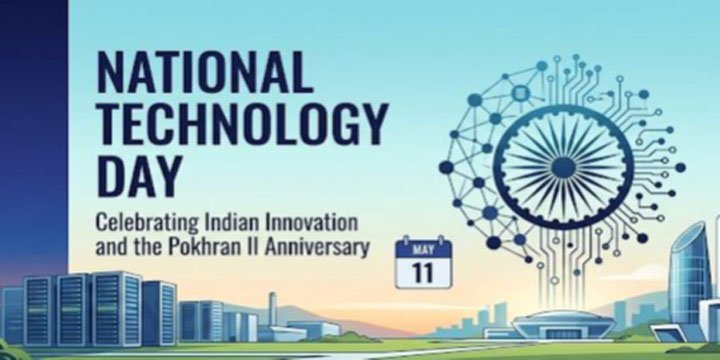
NATIONAL TECHNOLOGY DAY
Why in News
- Prime Minister Narendra Modi greeted the nation on the occasion of National Technology Day on 11 May 2026.
- He recalled the historic Pokhran-II nuclear tests (1998) and described them as a symbol of:
- Scientific excellence
- Strategic capability
- Self-reliance
- He stated that technology has become a key pillar in building an Aatmanirbhar Bharat by:
- Accelerating innovation
- Expanding opportunities
- Driving national growth
- He further highlighted that India’s focus remains on:
- Empowering talent
- Promoting scientific research
- Developing solutions for national progress
ABOUT NATIONAL TECHNOLOGY DAY
- National Technology Day is observed every year on 11 May.
- It commemorates India’s major technological achievements on 11 May 1998.
- The day is primarily associated with:
- Operation Shakti (Pokhran-II nuclear tests)
- It also marks:
- Successful testing of the Trishul missile
- Successful test flight of the Hansa-3 aircraft
- The first National Technology Day was celebrated in 1999 on 11 May.
THEME
- The theme for National Technology Day 2026 is:
- “Responsible Innovation for Inclusive Growth”
- The theme focuses on:
- Ethical innovation
- Inclusive development
- Sustainable technological progress
- Technology for public welfare
- It aligns with the vision of:
- Aatmanirbhar Bharat
ABOUT OPERATION SHAKTI
- Operation Shakti refers to India’s nuclear tests conducted in May 1998.
- The tests were conducted at:
- Pokhran Test Range, Rajasthan
- India carried out:
- Five nuclear tests
- The tests were conducted on:
- 11 May 1998
- 13 May 1998
- The first three detonations occurred simultaneously at:
- 15:45 IST on 11 May 1998
- The operation demonstrated India’s:
- Nuclear capability
- Scientific strength
- Technological advancement
- Strategic preparedness
LEADERSHIP INVOLVED
Political Leadership
- The operation was conducted under the leadership of Atal Bihari Vajpayee
- After the tests, India was declared a:
- Nuclear-weapon state
Scientific Leadership
- The operation was led by P. J. Abdul Kalam
- His role included:
- Coordinating scientific planning
- Supervising technological execution
- Ensuring operational secrecy
INSTITUTIONS INVOLVED
- Key institutions involved were:
- Defence Research and Development Organisation (DRDO)
- Bhabha Atomic Research Centre (BARC)
STRATEGIC SIGNIFICANCE
- The tests strengthened India’s:
- National security
- Nuclear deterrence capability
- Strategic autonomy
- They established India as:
- A nuclear-capable nation
- A major strategic power
- They enhanced India’s ability to:
- Protect national interests
- Maintain credible deterrence
SCIENTIFIC & TECHNOLOGICAL SIGNIFICANCE
- The tests demonstrated India’s:
- Indigenous nuclear capability
- Advanced defence technology
- Scientific expertise
- The operation showed India’s ability to:
- Develop complex weapon systems
- Conduct high-level technological missions
- Achieve self-reliance in strategic sectors
- Prime Minister Narendra Modi described Indian scientists as:
- “The true architects of the nation’s pride and self-respect”
INTERNATIONAL SIGNIFICANCE
- The tests introduced the world to India’s:
- Strategic capability
- Technological strength
- Independent foreign policy stance
- They marked India’s emergence as:
- A global technological power
- A strategically autonomous nation
THE BACKGROUND: POKHRAN 1
Operation Smiling Buddha (1974)
- India conducted its first nuclear test in:
- 1974
- The operation was named:
- Operation Smiling Buddha
- It was conducted at:
- Pokhran, Rajasthan
- It took place under the leadership of:
- Indira Gandhi
- It laid the foundation for India’s later nuclear programme.
OTHER TECHNOLOGICAL ACHIEVEMENTS ON MAY 11, 1998
Trishul Missile Test
- India successfully tested the:
- Trishul Surface-to-Air Missile
- It demonstrated:
- Indigenous defence capability
- Air defence strength
- It was designed as a:
- Short-range quick reaction missile
Hansa-3 Aircraft
- India also conducted the test flight of:
- Hansa-3
- It is an:
- Indigenous light aircraft
- It was developed for:
- Pilot training
- Civil aviation use
- Surveillance purposes
- It highlighted India’s progress in:
- Aerospace technology
- Aircraft development
INDIA’S MAJOR S&T INITIATIVES
National Quantum Mission
- The mission focuses on:
- Quantum computing
- Quantum communication
- Quantum sensing
- It aims to position India as a leader in:
- Quantum technology
India Semiconductor Mission 2.0
- The mission focuses on:
- Semiconductor manufacturing
- Electronics ecosystem development
- Reducing dependence on imports
- It aims to build:
- A self-reliant semiconductor industry
Deep Ocean Mission
- The mission focuses on:
- Deep-sea exploration
- Marine resource utilisation
- Underwater technology development
- It also aims to explore:
- Critical ocean minerals
Anusandhan National Research Foundation (ANRF)
Objective
- The foundation aims to:
- Strengthen research ecosystem
- Promote scientific innovation
- Improve collaboration between academia, industry, and government
- It supports:
- Research funding
- Scientific excellence
Vigyan Dhara Scheme
- It is an umbrella programme for:
- Scientific research
- Capacity building
- Innovation promotion
- It strengthens India’s:
- Science and technology ecosystem
Biotech-KISAN
- It connects:
- Biotechnology institutions
- Farmers
- It aims to:
- Improve agricultural productivity
- Promote scientific farming
- Support rural development
iDEX (Innovations for Defence Excellence)
Objective
- It promotes:
- Defence innovation
- Indigenous defence technology
- Startup participation
- It supports:
- Startups
- MSMEs
- Innovators
National Mission on Cyber-Physical Systems
Focus Areas
- It focuses on:
- Artificial Intelligence (AI)
- Robotics
- Internet of Things (IoT)
- Smart manufacturing
- Autonomous systems
- It strengthens India’s:
- Emerging technology ecosystem
Note: Connect with Vajirao & Reddy Institute to keep yourself updated with latest UPSC Current Affairs in English.
Note: We upload Current Affairs Except Sunday.