
PETERMANN GLACIER CALVING
Why in News?
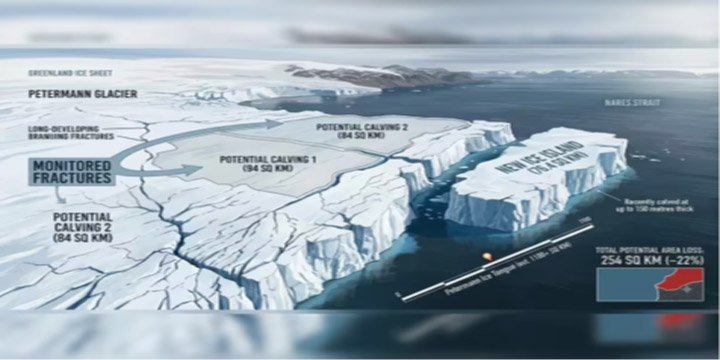
- Petermann Glacier in northwest Greenland calved a massive 76.4 sq. km ice island on 4 August 2026.
- It is the glacier’s largest loss of floating ice since 2012.
- It is also described as the largest Arctic calving event since 2020.
- The event was reported by an international research team partly led by the University of Ottawa.
KEY FEATURES
- The newly formed ice island is a tabular iceberg that detached from the glacier’s floating ice tongue.
- It is estimated to be up to 150 metres thick.
- Its area of 76.4 sq. km is roughly comparable to Manhattan Island.
- The ice island provides scientists with an opportunity to study how large Arctic ice masses:
- Form
- Drift
- Fracture
- Break apart over time
PETERMANN GLACIER
- Petermann Glacier is located in northwest Greenland.
- It has one of Greenland’s major remaining floating ice tongues.
- Scientists have been monitoring its ice tongue and developing fractures for several years.
- Long-term satellite observations have tracked changes in the glacier since 2019.
HOW WAS THE CALVING DETECTED?
- Researchers had been monitoring the glacier through satellite imagery and other observations.
- On 3 August 2026, imagery from the European Space Agency’s Sentinel-1 mission showed significant deterioration along the centreline of the ice tongue.
- By 20:00 UTC on 4 August, the new ice island had detached from the eastern side of the glacier.
- The event was detected by Adam Garbo, a doctoral student in glaciology at the University of Ottawa.
INTERNATIONAL RESEARCH COLLABORATION
The research involves scientists and institutions from:
- University of Ottawa
- University of Stirling
- Environment and Climate Change Canada
- Lancaster University
- University of Leeds
Researchers have been studying the glacier’s floating ice tongue, including the development of fractures and signs of instability.
WHY ARE ARCTIC ICE ISLANDS IMPORTANT?
- Large tabular icebergs are relatively common around Antarctica.
- Similar large ice islands are much rarer in the Arctic.
- Because large ice islands can remain intact for several years, they provide valuable opportunities to study:
- Glacier retreat
- Ocean conditions
- Ice dynamics
- Polar-region hazards
- Processes responsible for the formation and breakup of large ice masses
Research on Arctic ice islands can also provide knowledge that may be useful for understanding ice processes in other polar regions.
MORE CALVING EVENTS EXPECTED
- Researchers expect the recent event may not be the last major calving event from Petermann Glacier.
- Two additional large ice islands are expected to detach as existing rifts continue to spread across the ice tongue.
- Their projected areas are approximately:
- 94 sq. km
- 84 sq. km
If all three events occur, the combined loss could reach around 254 sq. km, equivalent to about 22% of the Petermann ice tongue.
IMPACT ON ARCTIC NAVIGATION
The event also has important implications for marine safety.
- Large ice islands can drift for years after separating from glaciers.
- As they move, they gradually fracture into smaller pieces.
- These smaller pieces can become difficult to track and create hazards for:
- Ships
- Offshore infrastructure
- Resource operations
- Arctic navigation
The Canadian Ice Service under Environment and Climate Change Canada is monitoring the movement of the newly formed ice island and assessing possible risks to Arctic navigation and offshore infrastructure.
HOW WILL SCIENTISTS MONITOR THE ICE ISLAND?
- Researchers will continue studying the aftermath using:
- Satellite imagery
- Aerial observations
- Tracking data
- These observations will help scientists understand the mechanisms responsible for ice-tongue instability, calving and Arctic glacier retreat.
SIGNIFICANCE
- The Petermann Glacier event is important because it combines climate science, glacier dynamics and Arctic maritime safety.
- The newly formed ice island provides a rare natural laboratory for studying the behaviour of large Arctic ice masses. At the same time, its movement and eventual fragmentation could create new challenges for shipping and offshore activities in the Arctic.
Note: Connect with Vajirao & Reddy Institute to keep yourself updated with latest UPSC Current Affairs in English.
Note: We upload Current Affairs Except Sunday.