
PM’S 80TH INDEPENDENCE DAY SPEECH
Why in News?
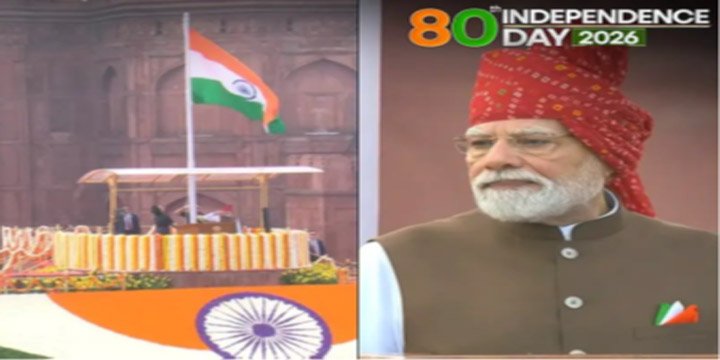
- Prime Minister Narendra Modi addressed the nation from the Red Fort on 15 August 2026, on the occasion of India’s 80th Independence Day.
- The address focused on the vision of Viksit Bharat by 2047, Aatmanirbhar Bharat, economic growth, technology, energy security, youth empowerment, national security, social welfare and the newly announced Saptdhara (Sapt Shakti)
- The Prime Minister also expressed solidarity with people affected by recent floods and landslides and paid tribute to freedom fighters and revolutionaries.
1: VISION VIKSIT BHARAT BY 2047
- The Prime Minister reiterated the goal of transforming India into a Viksit Bharat by 2047, when the country completes 100 years of independence.
- He stressed that this goal requires:
- High ambitions
- Firm resolve
- National capability
- Collective effort
- Self-confidence
- He called upon citizens to move beyond small ambitions and work towards a larger national vision.
- He emphasised the contribution of 140 crore Indians in achieving this goal.
PROGRESS HIGHLIGHTED
The Prime Minister presented a report card of India’s progress over the previous 12 years:
- 25 crore people have moved out of poverty.
- India has moved from the ‘Fragile Five’ to the position of the fastest-growing major economy.
- Defence production increased nearly 4 times.
- Khadi and Village Industries increased 5 times.
- Electronics manufacturing increased nearly 7 times.
- Railway coach production increased 21 times.
- Mobile phone manufacturing increased 33 times.
- Internet users increased 4 times.
- Patent grants increased 4 times.
- Digital transactions increased 100 times.
2: ATMANIRBHAR BHARAT & MAKE IN INDIA
- The Prime Minister stressed the need for self-reliance and reducing dependence on foreign imports.
- He called for strengthening India’s own production capabilities.
- The spirit of Make in India and Vocal for Local was highlighted.
- Indian products should be:
- High quality
- Affordable
- User-friendly
- Globally competitive
- He emphasised the importance of cost, quality and scale.
Semiconductors
- Three Indian semiconductor plants are already operational and exporting chips.
- 7–8 additional semiconductor production facilities are expected to become operational within 1–2 years.
- Semiconductor manufacturing was presented as an important pillar of technological self-reliance.
3: CRITICAL MINERALS SECURITY
- The Prime Minister highlighted the National Critical Minerals Mission.
- The Critical Minerals Corridor announced in the Budget was also highlighted.
- India has entered into international agreements to strengthen access to critical minerals.
- Critical minerals are important for:
- Semiconductors
- Renewable energy
- Electric vehicles
- Defence technology
- Advanced manufacturing
- The initiative aims to strengthen resource security and strategic autonomy.
4: NUCLEAR ENERGY & ENERGY SECURITY
SHANTI Act
- The Prime Minister highlighted reforms under the SHANTI Act.
Nuclear Energy Target
- India has set a target of 100 GW of nuclear capacity by 2047.
- Five new nuclear reactors are expected to become operational within the next 6–7 years.
- India will also focus on Fast Breeder Nuclear Technology.
- Greater domestic capability in nuclear fuel was presented as an important part of energy self-reliance.
5: OFFSHORE OIL & GAS EXPLORATION
- The government has changed its approach towards offshore exploration.
- Around 99% of India’s coastline has been shifted from ‘No-Go Areas’ to ‘Go-Ahead Areas’ for oil and gas exploration.
- The ₹85,000 crore Samudra Manthan initiative will support efforts to explore new offshore energy reserves.
- The move aims to improve domestic energy security and reduce dependence on imports.
6: EXPANSION OF GAS & SOLAR ENERGY
Over the past 12 years:
- City Gas Distribution expanded from 70 to 700 cities.
- Piped cooking gas reached 75 crore households.
- Solar capacity increased from 2 GW to 160 GW.
PM Surya Ghar Muft Bijli Yojana
- The scheme has crossed 50 lakh households.
- Families can receive financial assistance of up to ₹80,000.
- The objective is to reduce electricity bills through rooftop solar.
- Households can also earn by selling surplus electricity.
7: GREEN TRANSPORT & HYDROGEN
Railway Electrification
- The Prime Minister highlighted that India’s railway network achieved 100% electrification within a decade.
- This reduces dependence on imported diesel and supports cleaner transport.
Hydrogen Train
- India has started work on its first Made-in-India hydrogen train.
- It was described as the world’s longest and most powerful hydrogen train.
- This reflects India’s push towards clean transportation technologies.
8: AGRICULTURE & FARMER WELFARE
- The Prime Minister highlighted government support to farmers during global economic and geopolitical disruptions.
- The government provides subsidised fertilisers:
- Urea: International price around ₹3,000 → farmers receive it for less than ₹300.
- DAP: International cost above ₹5,000 → farmers receive it for ₹1,350.
- The government has absorbed the additional cost to protect farmers from international price shocks.
9: TRADE & GLOBAL MARKET ACCESS
- India has signed Free Trade Agreements with around 40 countries since 2014.
- These agreements create opportunities for Indian:
- Agriculture
- Fisheries
- Textiles
- MSMEs
- The Prime Minister called upon Indian businesses to produce goods that are better and cheaper than competing global products.
10: CORPORATE & GLOBAL BUSINESS AMBITIONS
The Prime Minister called for stronger Indian representation in global corporate rankings. Targets highlighted include:
- 50 Indian companies in the Fortune 500
- A major global Indian bank
- An Indian pharmaceutical company among the world’s top five
- Globally competitive Indian firms in:
- Law
- Rating
- Consulting
- Accounting
- Technology
11: YOUTH & STARTUP ECOSYSTEM
- Youth were placed at the centre of the Viksit Bharat
- India now has around 5 lakh registered startups.
- The Prime Minister highlighted:
- ₹1 lakh crore Research and Innovation Fund
- Skill India
- Khelo India
- National Drone Policy
- Private participation in space
- National Education Policy 2020
- The objective is to provide young people with both opportunities and financial support.
Education and Innovation
- Universities increased from fewer than 350 to nearly 1,000.
- Medical colleges increased from fewer than 400 to around 850.
- More than 10,000 Atal Tinkering Labs have been established.
- Young Indian companies have successfully developed satellites and rockets.
12: 1 CRORE YOUTH TO BE TRAINED IN AI
- A major new announcement was the plan to train 1 crore youth in Artificial Intelligence skills within the coming year.
- The objective is to ensure that Indian youth have the skills required to compete and lead in the global AI economy.
13: BIOECONOMY & ELECTRIC VEHICLES
The Prime Minister highlighted the growth of emerging sectors:
Bioeconomy
- Increased from around ₹60,000 crore in 2014 to nearly ₹20 lakh crore.
Electric Vehicles
- Annual EV sales increased from around 5 lakh to 25 lakh.
14: AEROSPACE & SVAMITVA
Aerospace
- The Prime Minister highlighted new aircraft maintenance hubs.
- He also referred to the successful flight of the Made-in-India C-295 defence transport aircraft.
SVAMITVA Scheme
- Drone technology is being used for rural property mapping.
- The scheme has covered around 25 crore families.
- It has potentially unlocked around ₹140 lakh crore in rural economic value.
- Digitised property records can help rural families access loans and business opportunities.
15: FREE ONLINE COACHING
- The Prime Minister announced a Free Online Coaching
- It will use Digital Public Infrastructure (DPI) and experienced teachers.
- The objective is to reduce the:
- Financial burden
- Emotional pressure
- Cost of competitive examination preparation
- It will create a nationwide network for free competitive-exam preparation.
16: SPORTS DEVELOPMENT
- The Prime Minister highlighted India’s improving performance in international sports.
- Important initiatives include:
- TOPS
- Khelo India
- India is preparing its bid to host the 2030 Commonwealth Games.
- India is also a strong candidate for hosting the 2036 Olympics.
Nationwide Sports Talent Hunt
- A new talent identification initiative will focus on children aged 5–15 years.
- Talent will be identified through:
- Schools
- Villages
- Grassroots programmes
- Selected children will receive specialised training to develop future international-level athletes.
17: NASHA MUKT YUVA ABHIYAN
- The Prime Minister called for a drug-free India.
- The Nasha Mukt Yuva Abhiyan will involve:
- Families
- NGOs
- Spiritual organisations
- Young people
- A 100-week nationwide campaign was highlighted.
- The objective is to protect the younger generation from substance abuse.
18: NAXALISM & INTERNAL SECURITY
- The Prime Minister said that Naxalism has been decisively dismantled.
- He recalled the sacrifice of more than 3,500 security personnel during the decades-long conflict.
- Formerly affected areas are now witnessing:
- Development
- Peace
- Trust
- Greater government presence
He also warned against ideological extremism and subversive elements and called for identifying, isolating and bringing young people into the mainstream.
19: CIVIL DEFENCE & DEFENCE EXPORTS
- The Prime Minister announced plans to create a modern and voluntary Civil Defence network.
- The initiative is linked to the changing nature of warfare, where critical civilian infrastructure can become a target.
- India’s defence exports have increased more than 50 times and now reach around 100 countries.
20: WOMEN EMPOWERMENT
The speech highlighted women’s contribution across:
- Aviation
- STEM
- Armed forces
- Entrepreneurship
- Manufacturing
- Public leadership
Lakhpati Didis
- The target of 3 crore Lakhpati Didis has been achieved.
- A new target of 6 crore Lakhpati Didis was announced.
- The initiative aims to strengthen the economic empowerment of rural women.
Women’s Political Representation
- The Prime Minister called upon political parties to support the implementation of one-third reservation for women in Parliament and State Assemblies.
21: SOCIAL SECURITY & AYUSHMAN BHARAT
- Social security coverage has expanded to around 100 crore people, compared with around 25 crore before 2014.
- The Prime Minister stressed that Viksit Bharat must reach the last person.
Ayushman Bharat
- Free medical coverage of up to ₹5 lakh has been extended to senior citizens above 70 years.
- The scheme has reportedly saved poor and middle-class families around ₹2 lakh crore in medical expenses.
22: DIGITAL CENSUS
- India’s first Digital Census is currently underway.
- The Prime Minister urged citizens to participate through digital self-registration using mobile phones.
- Accurate demographic data is important for:
- Development planning
- Policy formulation
- Resource allocation
- Public service delivery
- Youth were specifically encouraged to help their families complete the digital forms accurately.
23: SAPTDHARA
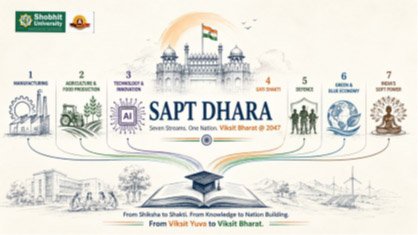
A major feature of the speech was the announcement of Saptdhara, or seven streams of national strength. The seven streams are:
1. Manufacturing Power
- Strengthen India’s manufacturing capabilities.
- Develop complete domestic value chains.
- Focus on:
- Zero defects
- Cost efficiency
- Global quality
- Large-scale production
- India should become a reliable centre of global supply chains.
2. Agriculture and Food Processing
- Promote chemical-free farming.
- Build integrated farm-to-export supply chains.
- Indian agricultural products should meet global standards.
- Traditional Indian foods can be expanded into international markets.
3. Technology and Innovation
India should become a global innovation hub in:
- Artificial Intelligence
- Quantum computing
- Space technology
- Advanced robotics
- Digital Public Infrastructure
- 6G
The Prime Minister stressed that Made-in-India 6G should reach every part of the country.
4. Gati Shakti
- Focus on integrated multimodal infrastructure.
- Key areas include:
- High-speed rail
- Highways
- Inland waterways
- Modern ports
- Greater emphasis will be placed on port-led development.
5. Defence Shakti
- Defence self-reliance was described as a national priority.
- India aims to become a major global defence technology supplier.
- Focus areas include:
- Drones
- Counter-drone systems
- Hypersonic technologies
- Defence exports have expanded significantly.
6. Green and Blue Economy
- India will focus on:
- Green hydrogen
- Renewable energy
- Energy storage
- Ocean economy
- Marine resources
- Coastal tourism
- The objective is to combine economic growth with climate action and green jobs.
7. Soft Power
India’s soft power will be strengthened through:
- Yoga
- Ayurveda
- Heritage
- Tourism
- VFX
- Animation
- Gaming
- Creative industries
- WAVES Summit
The Prime Minister also highlighted the potential of wildlife, national parks, international sports events and concerts to attract global visitors.
24: PANCH PRAN
The address concluded with a reaffirmation of the Panch Pran. The Prime Minister called upon citizens to:
- Put national interest above personal interest.
- Remove the colonial mindset.
- Work collectively for national development.
- Turn India’s dreams into concrete achievements.
- Move together towards Viksit Bharat.
Note: Connect with Vajirao & Reddy Institute to keep yourself updated with latest UPSC Current Affairs in English.
Note: We upload Current Affairs Except Sunday.