
PRADHAN MANTRI KRISHI SINCHAI YOJANA
Why in News?
- The Pradhan Mantri Krishi Sinchayee Yojana (PMKSY) has completed more than 10 years of implementation.
- It marks a decade of efforts towards expanding irrigation infrastructure, improving water-use efficiency, and promoting sustainable water resource management in Indian agriculture.
- Since its launch in 2015, the scheme has played a pivotal role in enhancing agricultural productivity by ensuring assured irrigation, conserving water, and encouraging the adoption of modern irrigation technologies.
WHAT IS PMKSY?
- The Pradhan Mantri Krishi Sinchayee Yojana (PMKSY) is a flagship Centrally Sponsored Scheme (Core Scheme)
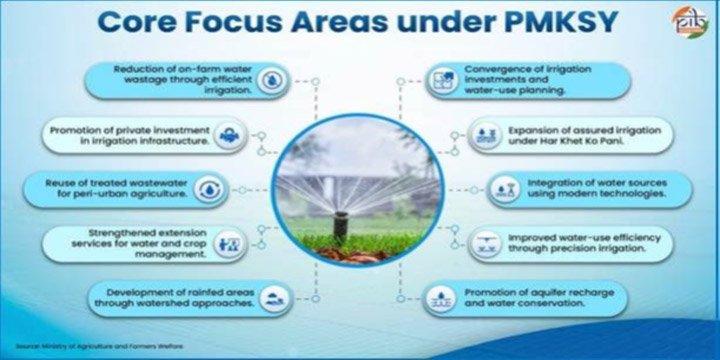
- Launched in 2015 with the objective of achieving the vision of “Har Khet Ko Pani” (Water to Every Field) and “Per Drop More Crop” by expanding irrigation coverage and promoting efficient water management across the country.
- The scheme seeks to address one of the biggest constraints in Indian agriculture—dependence on erratic monsoon rainfall—through the creation of irrigation infrastructure, watershed development, and adoption of micro-irrigation technologies.
OBJECTIVES OF PMKSY
The major objectives of the scheme are:
- Expand cultivable land under assured irrigation.
- Improve water-use efficiency at the farm level.
- Enhance access to irrigation facilities for farmers.
- Promote sustainable water conservation and groundwater recharge.
- Encourage scientific and precision irrigation practices.
- Reduce wastage of water through modern irrigation technologies.
- Increase agricultural productivity and farmers’ income.
FUNDING PATTERN
PMKSY is implemented as a Centrally Sponsored Core Scheme.
| Category | Centre : State Share |
| General States | 60 : 40 |
| North-Eastern & Himalayan States | 90 : 10 |
| Union Territories | 100% Central Funding |
This funding structure enables States to undertake irrigation projects while ensuring adequate financial support from the Union Government.
EVOLUTION OF PMKSY
PMKSY was designed by integrating several existing irrigation and water management programmes into a single umbrella scheme to ensure better coordination and convergence. It merged three major schemes:
1. Accelerated Irrigation Benefit Programme (AIBP)
- Earlier implemented by the Ministry of Water Resources, River Development and Ganga Rejuvenation (now Ministry of Jal Shakti).
- Focused on completing pending major and medium irrigation projects.
2. Integrated Watershed Management Programme (IWMP)
- Implemented by the Department of Land Resources, Ministry of Rural Development.
- Focused on watershed development, soil conservation, and rainfed area development.
3. On-Farm Water Management (OFWM)
- Implemented by the Department of Agriculture and Cooperation.
- Promoted efficient irrigation methods and water-saving technologies.
CORE PHILOSOPHY OF PMKSY
The scheme is built around two guiding principles:
1. Jal Sanchay (Water Conservation)
- Collection and storage of rainwater.
- Groundwater recharge.
- Water harvesting.
- Conservation of available water resources.
2. Jal Sinchan (Efficient Irrigation)
- Scientific distribution of water.
- Efficient application of irrigation at the farm level.
- Reduction of transmission losses.
- Adoption of micro-irrigation technologies.
Together, these principles ensure that water is stored, managed, and utilized efficiently, thereby maximizing agricultural output with minimal water use.
FINANCIAL OUTLAY
The Government approved the continuation of PMKSY for the period 2021–26.
- Overall Outlay
- ₹93,068.56 crore
Budget Allocation (2026–27)
- The Union Budget 2026–27 allocated: ₹6,587 crore
The allocation aims to:
- Expand irrigation infrastructure.
- Improve water-use efficiency.
- Promote sustainable water management.
- Strengthen climate-resilient agriculture.
MAJOR COMPONENTS OF PMKSY
PMKSY covers the complete irrigation value chain through four major components.
1. Accelerated Irrigation Benefit Programme (AIBP)
Objective
The Accelerated Irrigation Benefit Programme focuses on the speedy completion of ongoing major and medium irrigation projects, including nationally important irrigation projects.
Its objective is to:
- Expand irrigation infrastructure.
- Increase water availability for agriculture.
- Improve irrigation coverage.
Achievements
Since 2016–17:
- ₹21,023 crore released as Central Assistance.
- 17.30 million farmers benefited.
This makes AIBP the largest component of PMKSY in terms of beneficiary coverage.
Modernisation of Command Area Development & Water Management (CAD&WM):
- To improve last-mile irrigation efficiency, the Government launched the Modernization of Command Area Development and Water Management (M-CADWM) as a sub-scheme under PMKSY-AIBP in 2025–26.
- Initial Outlay ₹1,600 crore
Key Features
- Pressurized piped irrigation.
- Integration of micro-irrigation systems.
- Improved last-mile water delivery.
- Efficient field-level water distribution.
The programme complements AIBP by ensuring that water reaches farms efficiently after major irrigation infrastructure is created.
2. Har Khet Ko Pani
Objective
- The Har Khet Ko Pani component aims to ensure assured irrigation for every cultivable field by creating new water sources and expanding irrigation facilities.
Focus Areas
- Surface minor irrigation.
- Groundwater development.
- Repair, Renovation and Restoration (RRR) of water bodies.
- Expansion of irrigation potential.
Achievements
Since its inception:
- 3,462 Surface Minor Irrigation (SMI) and RRR schemes
- 5.93 lakh hectares of irrigation potential created.
- Groundwater interventions expanded irrigation to 55 thousand hectares.
These interventions have significantly increased irrigation coverage in water-deficit regions.
3. Watershed Development
Objective
- The Watershed Development component focuses on improving the productivity of rainfed and degraded lands through integrated natural resource management.
Major Activities
- Soil conservation.
- Moisture conservation.
- Water harvesting.
- Vegetative cover restoration.
- Sustainable land management.
Achievements
Since 2016–17:
- Central assistance of ₹12,432.09 crore.
- 34 million farmers benefited.
The programme has enhanced soil fertility, groundwater recharge, and agricultural sustainability in rainfed areas.
4. Per Drop More Crop (PDMC)
Objective
- The Per Drop More Crop (PDMC) component promotes efficient field-level water use through the adoption of modern micro-irrigation technologies.
- Originally an integral component of PMKSY from 2015–16 to 2021–22, it has been implemented under the Pradhan Mantri Rashtriya Krishi Vikas Yojana (PM-RKVY) since 2022–23.
Micro-Irrigation Technologies Promoted
Drip Irrigation
- Delivers water and nutrients directly to plant roots.
- Minimizes evaporation and runoff losses.
- Enhances water-use efficiency.
- Improves crop yield and fertilizer efficiency.
Sprinkler Irrigation
- Sprays water uniformly over crops through pipelines and sprinkler heads.
- Mimics natural rainfall.
- Suitable for uneven terrain and various crops.
Benefits of Micro-Irrigation
- Saves water.
- Reduces irrigation costs.
- Improves soil moisture.
- Enhances crop productivity.
- Reduces weed growth.
- Promotes climate-resilient agriculture.
- Minimizes fertilizer losses.
Micro Irrigation Fund (MIF)
- To accelerate the adoption of micro-irrigation, the Government established the Micro Irrigation Fund (MIF) under the National Bank for Agriculture and Rural Development (NABARD).
- The fund supports States in expanding micro-irrigation infrastructure and financing irrigation projects.
Financial Assistance
To encourage farmers:
- 55% subsidy for small and marginal farmers.
- 45% subsidy for other farmers.
This financial support reduces the initial cost of installing micro-irrigation systems.
Achievements
Since its inception:
- 92 lakh hectares brought under micro-irrigation.
- Covers approximately 98% of India’s Net Sown Area (NSA).
This has significantly improved water-use efficiency and agricultural productivity.
CHALLENGES
Despite notable achievements, PMKSY continues to face several implementation challenges:
- Slow completion of major irrigation projects.
- Regional disparities in irrigation coverage.
- Over-extraction of groundwater in several States.
- Limited adoption of micro-irrigation by small farmers in some regions.
- Fragmented landholdings affecting irrigation efficiency.
- Climate change-induced variability in water availability.
- Need for better convergence among implementing agencies.
Note: Connect with Vajirao & Reddy Institute to keep yourself updated with latest UPSC Current Affairs in English.
Note: We upload Current Affairs Except Sunday.