
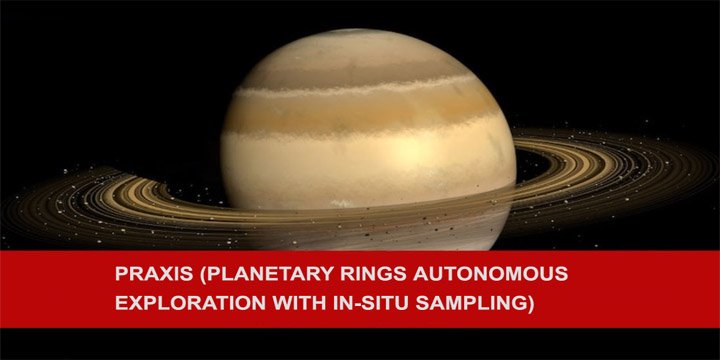
PRAXIS (PLANETARY RINGS AUTONOMOUS EXPLORATION WITH IN-SITU SAMPLING)
Why in News?
- NASA has selected PRAXIS under the Innovative Advanced Concepts (NIAC) 2026 Phase-I funding programme.
- The mission aims to directly sample particles from planetary ring systems, something that has never been attempted before.
ABOUT PRAXIS
- PRAXIS stands for Planetary Rings Autonomous Exploration with In-situ Sampling.
- It is a mission concept selected under NASA’s Innovative Advanced Concepts (NIAC) 2026 Phase-I
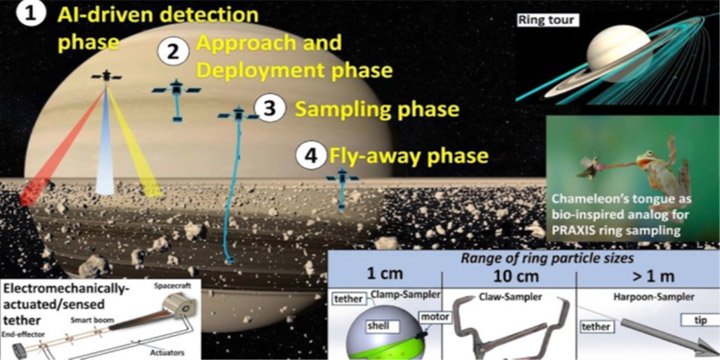
- The mission will consist of a bio-inspired robotic explorer driven by an Artificial Intelligence (AI)
- It is designed to directly sample particles from planetary ring systems.
OBJECTIVES
- Directly sample particles from planetary rings.
- Address key scientific questions related to:
- Formation of planetary rings.
- Evolution of planetary rings.
- Composition of ring particles.
KEY FEATURES
Bio-inspired AI-based Explorer
- Uses a bio-inspired robotic explorer.
- Operates using an Artificial Intelligence (AI)
Touch-and-Go Sampling
- The spacecraft will graze the ring plane instead of flying through the rings to avoid collision hazards.
- After identifying a target particle, it will perform a touch-and-go sampling operation.
- A long deployable boom will collect samples from the particle’s surface while maintaining a safe distance from moving ring particles.
Multiple Sampling Locations
- After collecting one sample, the spacecraft will move to:
- Another region of the rings.
- A gap within the rings.
- This will allow sampling from different parts of the ring system.
In-situ Analysis
- Small onboard instruments will capture free-floating particles.
- The AI model will help measure:
- Particle size.
- Porosity.
- Composition.
MISSION DEVELOPMENT
- Selection under NIAC Phase-I enables the team to:
- Conduct simulations.
- Study the mission’s system design.
- If selected for Phase-II, the team can:
- Develop a physical prototype.
Potential Applications
- According to its developers, the PRAXIS sampling system can be used in future missions to study multiple ringed planets.
SIGNIFICANCE
- It will be the first mission concept designed to directly sample particles from planetary ring systems.
- It seeks to answer important scientific questions identified by NASA’s Planetary Science Decadal Survey regarding the formation, evolution and composition of planetary rings.
- The mission demonstrates the use of AI-driven autonomous exploration and in-situ sampling for future planetary missions.
Note: Connect with Vajirao & Reddy Institute to keep yourself updated with latest UPSC Current Affairs in English.
Note: We upload Current Affairs Except Sunday.