
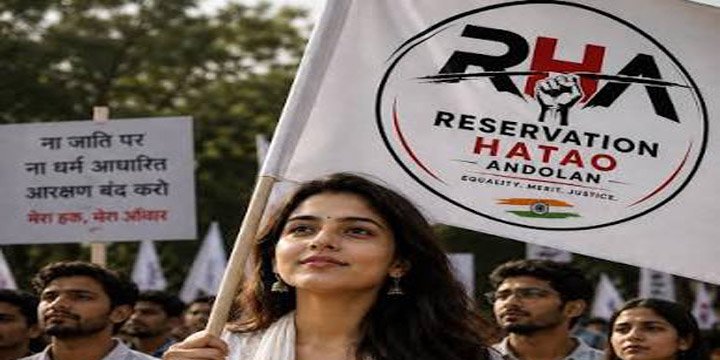
PROTESTS AGAINST RESERVATION
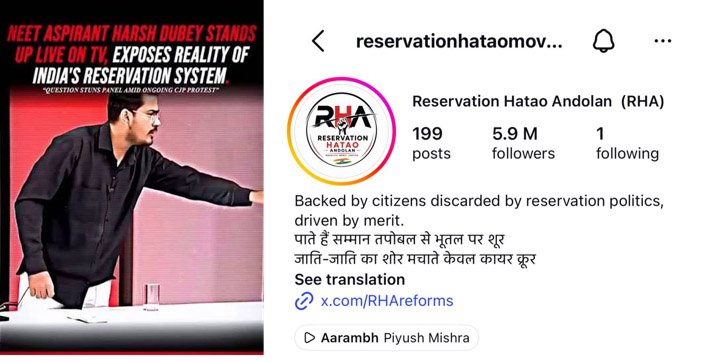
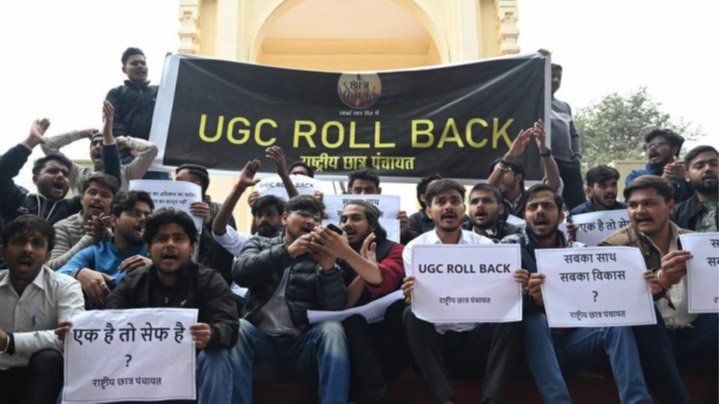
- JAIPUR: Students took to the streets and clashed with police over the now-stayed UGC’s caste equity regulations.
- NAGPUR: The Reservation Hatao Movement (RHM) on July 30 made its on-ground debut in Nagpur with a rally.
- LUCKNOW: They demanded a complete rollback of UGC rules and an end to caste-based reservation.
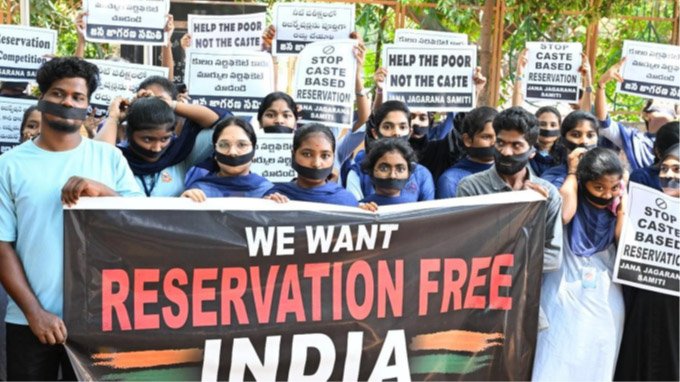
- VISAKHAPATNAM: Students preparing for the National Eligibility-cum-Entrance Test (NEET) staged a silent protest in support of the Reservation Hatao Andolan (RHA) GEN-Z campaign.
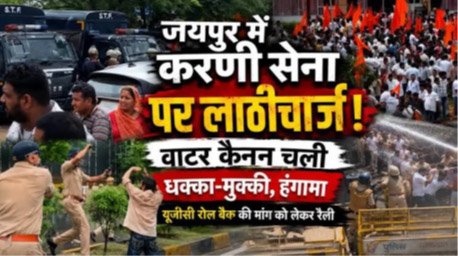
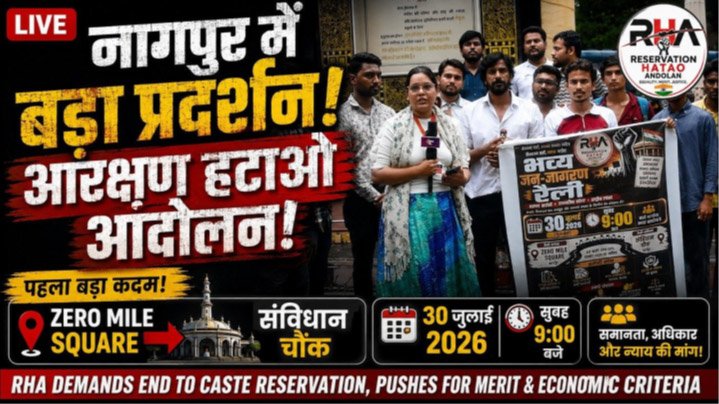
CORE DEMANDS OF RESERVATION HATAO ANDOLAN
- The movement seeks to replace caste-based quotas with “income-based reservations.”
- It argued that “poverty has no caste”.
- “One family, One reservation, One time”
- A minimum qualifying mark for all categories, and
- The transfer of unfilled reserved seats to the general category.
- Periodic reviews to move economically advanced communities off of the reservation list.
The proposal further called for a “sunset clause” to gradually phase out reservations as educational inequality narrows, while banning political parties from promising new or higher reservation quotas during elections.
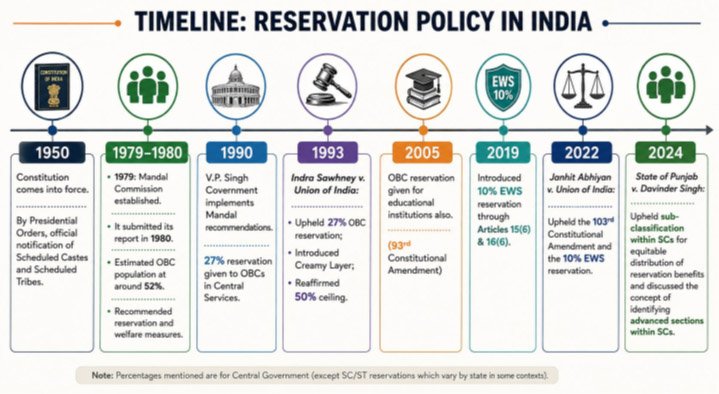
EVOLUTION OF RESERVATION IN INDIA
1950: Constitution comes into force. By Presidential Orders, official notification of Scheduled Castes and Scheduled Tribes.
1979: Mandal Commission established. It submitted its report in 1980. Estimated OBC population at around 52%; recommended reservation and welfare measures.
1990: V.P. Singh Government implements Mandal recommendations. 27% reservation given to OBCs in Central Services.
1993: Indra Sawhney v. Union of India: Upheld 27% OBC reservation; introduced Creamy Layer; reaffirmed 50% ceiling.
2005: OBC reservation given for educational institutions also. (93rd AA)
2019: Introduced 10% EWS reservation through Articles 15(6) & 16(6)
2022: Janhit Abhiyan v. Union of India: Upheld the 103rd Constitutional Amendment and the 10% EWS reservation.
2024: State of Punjab v. Davinder Singh: Upheld sub-classification within SCs for equitable distribution of reservation benefits and discussed the concept of identifying advanced sections within SCs.
IMPACT OF RESERVATION
POSITIVE IMPACTS
1. Promotes Social Justice
- Corrects historical discrimination and exclusion faced by SCs, STs, and socially and educationally backward classes.
- Gives practical effect to Articles 14, 15, 16, 17, and 46.
Example: Greater representation of marginalized communities in public institutions.
2. Improves Representation
- Ensures participation of disadvantaged groups in:
- Government services
- Legislatures
- Educational institutions
- Makes public institutions more representative of society.
3. Expands Educational Opportunities
- Enables first-generation learners to access higher education.
- Improves literacy and educational attainment among historically disadvantaged communities.
4. Enhances Economic Mobility
- Government employment and higher education improve income, job security, and living standards.
- Helps break intergenerational poverty.
5. Strengthens Democracy
- Broader representation increases the legitimacy and inclusiveness of democratic institutions.
- Encourages political participation among marginalized groups.
6. Reduces Social Exclusion
- Promotes integration of marginalized communities into mainstream institutions.
- Encourages greater social interaction and inclusion.
7. Encourages Inclusive Development
- Supports the constitutional vision of an egalitarian society.
- Contributes to achieving Sustainable Development Goals (SDGs), particularly those related to reducing inequalities.
8. Corrects Structural Inequalities
- Recognizes that equality requires addressing unequal starting points.
- Reflects the concept of substantive equality, not merely formal equality.
NEGATIVE IMPACTS:
1. Perceived Impact on Merit
- Critics argue that reservations may reduce the weight given to open competition in admissions and recruitment.
- Supporters counter that merit is shaped by unequal access to opportunities and resources.
2. Vote-bank Politics
- Reservation has often become a political issue.
- Demands for inclusion in reserved categories sometimes intensify around elections.
Examples: Agitations by Marathas, Jats, Patidars, Gujjars.
3. Creamy Layer Issue
- Relatively better-off members within OBCs may repeatedly benefit.
- The intended beneficiaries may not always receive the advantages.
4. Uneven Distribution of Benefits
- Within reserved categories, some communities are better represented than others.
- This concern led to discussions on sub-classification within SCs in recent judicial decisions.
5. Social Polarization
- Reservation debates can reinforce caste identities and create tensions between communities.
6. Continued Dependence on Caste
- Although intended to reduce inequality, reservation policies rely on caste as a basis for identifying beneficiaries.
- Some argue this may slow the transition toward a caste-neutral society.
7. Limited Reach
- Reservation mainly benefits those who can access schools, colleges, and competitive examinations.
- The poorest among marginalized groups may still lack the foundational education needed to benefit.
8. Does Not Address Root Causes
Reservation alone cannot overcome:
- Poor school education
- Malnutrition
- Healthcare deficits
- Lack of infrastructure
- Rural deprivation
9. Litigation and Administrative Complexity
- Frequent legal challenges create uncertainty.
- Issues such as:
- 50% ceiling
- Creamy Layer
- Reservation in promotions
- EWS criteria
- State-specific policies often require judicial clarification.
SC’s VIEWPOINT
The Supreme Court has consistently held that:
- Reservation is an instrument of substantive equality, not an exception to equality.
- At the same time, it should be implemented in a manner that preserves administrative efficiency, fairness, and the constitutional balance between equality of opportunity and affirmative action.
WAY FORWARD
- Ensure periodic review of reservation policies using updated socio-economic data.
- Improve the identification of genuinely disadvantaged beneficiaries.
- Strengthen school education and healthcare to reduce structural inequalities.
- Expand scholarships, hostels, skill development, and mentoring alongside reservations.
- Ensure transparency in implementation and effective grievance redressal.
- Promote evidence-based policy making through regular socio-economic surveys.
- Balance social justice, efficiency, and equality of opportunity in line with constitutional principles.


Note: Connect with Vajirao & Reddy Institute to keep yourself updated with latest UPSC Current Affairs in English.
Note: We upload Current Affairs Except Sunday.