
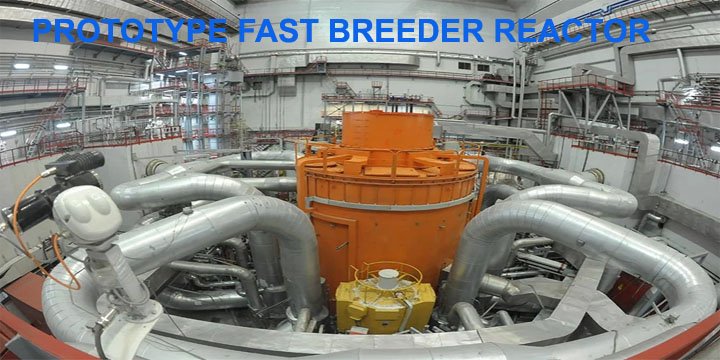
PROTOTYPE FAST BREEDER REACTOR
- On 6 April 2026, India achieved a major milestone when the Prototype Fast Breeder Reactor (PFBR) attained first criticality.
- The reactor is located at Kalpakkam, Tamil Nadu and has a capacity of 500 MWe (Megawatt electrical).
- It has been built by Bharatiya Nabhikiya Vidyut Nigam Limited.
- This event marks:
- The beginning of a sustained nuclear chain reaction
- India’s entry into Stage 2 of its nuclear programme
This is a historic development in India’s nuclear energy programme and clean energy transition
WHAT IS FIRST CRITICALITY?
- Criticality refers to the stage when a self-sustaining nuclear chain reaction begins inside a reactor.
- At this point:
- Neutrons produced = neutrons consumed
- The reactor becomes operational at basic level
It is the first and most important milestone before full power generation
GLOBAL SIGNIFICANCE
- Once fully operational, India will become:
- The second country in the world after Russia to operate a commercial Fast Breeder Reactor (FBR)
This gives India a strategic and technological advantage in nuclear energy
THREE STAGES OF INDIA’S NUCLEAR PROG
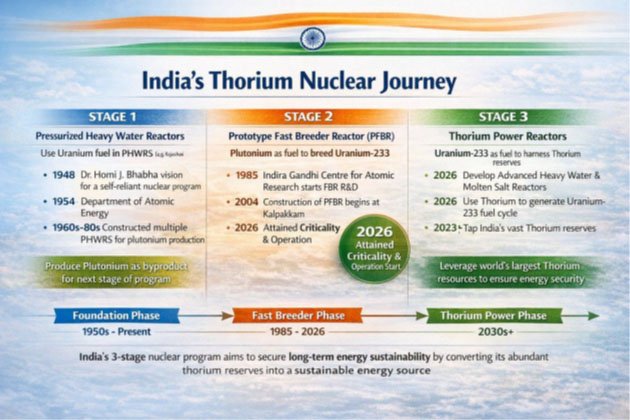
THE THREE STAGES
Stage 1: Pressurised Heavy Water Reactors (PHWRs)
- Fuel used: Natural Uranium
- Output:
- Generates electricity
- Produces Plutonium (Pu-239) as by-product
This plutonium is used in Stage 2
Stage 2: Fast Breeder Reactors (FBRs)
- Fuel used:
- Plutonium from Stage 1
- Key Feature:
- These reactors produce more fuel than they consume
- The PFBR at Kalpakkam marks India’s entry into this stage
It also helps in producing Uranium-233 from Thorium
Stage 3: Thorium-Based Reactors
- Fuel:
- Uranium-233 (derived from Thorium)
- Importance:
- India has large thorium reserves
This stage will ensure long-term sustainable energy supply
Overall Concept
- The programme follows a closed nuclear fuel cycle
Meaning:
- Waste fuel is reprocessed and reused
VISION BEHIND INDIA’S NUCLEAR PROGRAM
- The three-stage nuclear programme was designed by Homi Jehangir Bhabha
- It is based on:
- Limited uranium reserves in India
- Abundant thorium reserves
The aim is to achieve:
- Energy security
- Self-reliance in nuclear fuel
PFBR: DETAILED OVERVIEW
Development
- Developed by Indira Gandhi Centre for Atomic Research
- Operated by Bharatiya Nabhikiya Vidyut Nigam Limited
Fuel Type
- Uses MOX Fuel (Mixed Oxide Fuel)
- Composition:
- Uranium + Plutonium
- Source:
- Reprocessed fuel from PHWRs
Breeder Concept
- Core is surrounded by Uranium-238 blanket
- Process:
- Fast neutrons convert U-238 → Plutonium-239
This allows the reactor to:
- Generate more fuel than it consumes
BRIDGE TO STAGE 3
- PFBR can use Thorium-232 in future
- Conversion:
- Thorium → Uranium-233
This is crucial for Stage 3 (thorium-based reactors)
Closed Fuel Cycle
- Spent fuel is:
- Reprocessed
- Recycled back into reactor
This ensures:
- Maximum utilization of nuclear resources
- Minimum waste
CURRENT NUCLEAR POWER STATUS IN INDIA
- Installed Capacity:
- Around 8.78 GW
- Electricity Generation (2024–25):
- 56,681 Million Units
- Share in Total Electricity:
- Around 3.1%
Nuclear power currently plays a small but stable role
FUTURE EXPANSION PLANS
- India plans to increase capacity to:
- 22.38 GW by 2031–32
- Development includes:
- 700 MW indigenous reactors
- 1000 MW reactors with international cooperation
International Cooperation
- India has signed agreements with:
- 18 countries for civil nuclear cooperation
This reflects global trust in India’s nuclear programme
LONG TERM NUCLEAR ENEGY MISSION
- Announced in Union Budget 2025–26
- Target:
- 100 GW nuclear capacity by 2047
- Linked to:
- Net Zero target by 2070
KEY MEASURES
Financial Investment
- Allocation of Rs 20,000 crore
- Focus on:
- Small Modular Reactors (SMRs)
SMR Development
- Target:
- At least 5 SMRs by 2033
- Designs by Bhabha Atomic Research Centre:
- BSMR-200 (200 MWe)
- SMR-55 (55 MWe)
- High-Temperature Gas Reactor (for hydrogen production)
Legal Reform
- Introduction of SHANTI Act, 2025
- Features:
- Modernises nuclear laws
- Allows limited private sector participation
- Ensures regulatory oversight
SIGNIFICANCE OF PFBR ACHIEVEMENT
Energy Security
- Reduces dependence on imported fuels
Clean Energy Transition
- Nuclear energy is:
- Low-carbon
- Reliable
Supports climate goals
Technological Advancement
- Demonstrates indigenous capability
Strategic Importance
- Positions India among advanced nuclear nations
CHALLENGES
- High cost of nuclear infrastructure
- Safety and waste management concerns
- Need for strong regulatory mechanisms
- Public perception and acceptance issues
CONCLUSION
- The achievement of first criticality of PFBR marks a turning point in India’s nuclear journey
- It shows:
- Progress from planning to implementation
- Strength of indigenous scientific capability
- With expansion and policy support, nuclear energy will play a larger role in India’s future energy mix
Note: Connect with Vajirao & Reddy Institute to keep yourself updated with latest UPSC Current Affairs in English.
Note: We upload Current Affairs Except Sunday.