
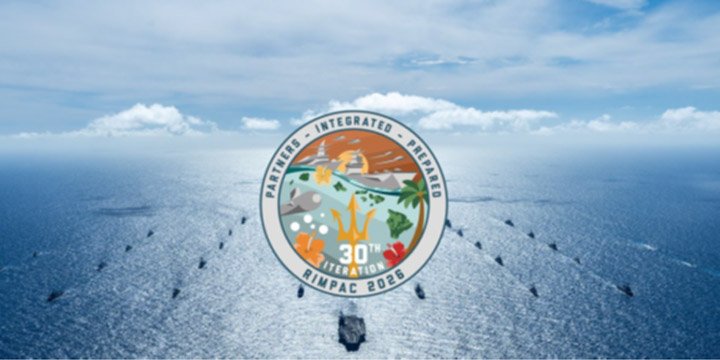
RIM OF THE PACIFIC (RIMPAC)
Why in News?
- The Rim of the Pacific (RIMPAC) 2026, the world’s largest multinational maritime exercise, commenced on 24 June 2026 in Hawaii.
- The exercise is being hosted by the United States Pacific Fleet and will continue until 31 July 2026.
- It brings together military forces from 30 countries to strengthen maritime security, interoperability, and regional stability in the Indo-Pacific.
WHAT IS RIMPAC?
About
- Rim of the Pacific (RIMPAC) is the world’s largest international maritime military exercise.
- It is a multinational naval exercise involving naval, air, and land forces.
- Conducted biennially under the leadership of the United States Navy.
Origin
- First held in 1971.
Edition
- RIMPAC 2026 is the 30th edition of the exercise.
Objective
- Enhance interoperability among participating nations.
- Improve operational readiness and combat capabilities.
- Promote a free, open, and secure Indo-Pacific region.
THEME OF RIMPAC 2026
“Partners: Integrated and Prepared”
Focus Areas
- Collective preparedness.
- Joint operational capability.
- Multinational cooperation.
- Regional maritime security.
KEY HIGHLIGHTS OF RIMPAC 2026
Scale of Participation
- 30 participating countries.
- More than 30 warships and surface vessels.
- 5 submarines.
- More than 206 aircraft.
- 15 national land forces.
- Approximately 30,000 military personnel.
Area of Operations
- Conducted in and around the Hawaiian Islands and the Pacific Ocean region.
MULTINATIONAL COMMAND STRUCTURE
Deputy Commander
- Andres Howard (Chile)
Vice Commander
- Takuo Kobayashi (Japan)
Combined Forces Maritime Component Commander
- In-Ho Kim (South Korea)
Combined Forces Air Component Commander
- S. Davis (Canada)
MAJOR EXERCISES CONDUCTED
Amphibious Operations
- Joint coastal and beach assault exercises.
Missile and Gunnery Drills
- Live-fire and precision engagement exercises.
Anti-Submarine Warfare
- Detection, tracking, and neutralization of submarines.
Air Defence Operations
- Protection against aerial threats and missile attacks.
Counter-Piracy Missions
- Maritime security and anti-piracy operations.
Mine Countermeasure Operations
- Detection and removal of naval mines.
Explosive Ordnance Disposal (EOD)
- Handling and disposal of explosive threats.
Diving and Salvage Operations
- Underwater recovery and rescue missions.
Humanitarian Assistance and Disaster Relief (HADR)
- Emergency response and disaster management exercises.
Military Medicine
- Medical support and casualty management training.
OBJECTIVES OF RIMPAC 2026
Strengthen Maritime Security
- Enhance the safety of international sea lanes and maritime trade routes.
Improve Interoperability
- Enable participating militaries to operate effectively together.
Enhance Combat Readiness
- Improve tactical proficiency and operational preparedness.
Promote Regional Stability
- Support peace, security, and stability in the Indo-Pacific.
Build Strategic Partnerships
- Strengthen cooperation among allied and partner nations.
IMPORTANCE OF INDO PACIFIC REGION
Global Trade Hub
- A significant share of global trade passes through Indo-Pacific sea routes.
Strategic Importance
- Home to major economic and military powers.
- Critical for global supply chains and energy transportation.
Emerging Security Challenges
- Maritime disputes.
- Piracy.
- Illegal fishing.
- Strategic competition among major powers.
SIGNIFICANCE OF RIMPAC
Collective Security
- Demonstrates the ability of partner nations to respond jointly to security challenges.
Operational Coordination
- Improves coordination among naval, air, and land forces.
Confidence Building
- Enhances trust and cooperation among participating countries.
Support for a Free and Open Indo-Pacific
- Reinforces commitment to freedom of navigation and rule-based maritime order.
Disaster Response Preparedness
- Strengthens multinational humanitarian and emergency response capabilities.
INDIA & RIMPAC
India’s Participation
- India has participated in previous editions of RIMPAC through the Indian Navy.
- Participation supports India’s vision of a secure and inclusive Indo-Pacific.
Alignment with India’s Maritime Vision
- Complements India’s SAGAR (Security and Growth for All in the Region)
- Supports cooperation with like-minded maritime partners.
CHALLENGES
Complex Multinational Coordination
- Managing diverse military doctrines and operational procedures.
Geopolitical Rivalries
- Strategic competition among major powers may affect cooperation.
Resource and Logistics Management
- Large-scale exercises require extensive planning and coordination.
Emerging Maritime Threats
- Cyber threats, unmanned systems, and hybrid warfare challenges.
WAY FORWARD
Strengthen Multilateral Cooperation
- Expand collaboration among Indo-Pacific nations.
Enhance Joint Training
- Increase interoperability through regular multinational exercises.
Focus on Emerging Security Domains
- Include cyber security, artificial intelligence, and autonomous systems.
Improve Maritime Domain Awareness
- Strengthen information-sharing mechanisms.
Promote Rule-Based Maritime Order
- Uphold international law and freedom of navigation.
CONCLUSION
RIMPAC 2026 highlights the growing importance of multinational maritime cooperation in maintaining peace, security, and stability across the Indo-Pacific. By bringing together 30 nations and around 30,000 personnel, the exercise strengthens collective readiness, operational interoperability, and commitment to a free, open, and secure Indo-Pacific region.
Note: Connect with Vajirao & Reddy Institute to keep yourself updated with latest UPSC Current Affairs in English.
Note: We upload Current Affairs Except Sunday.