
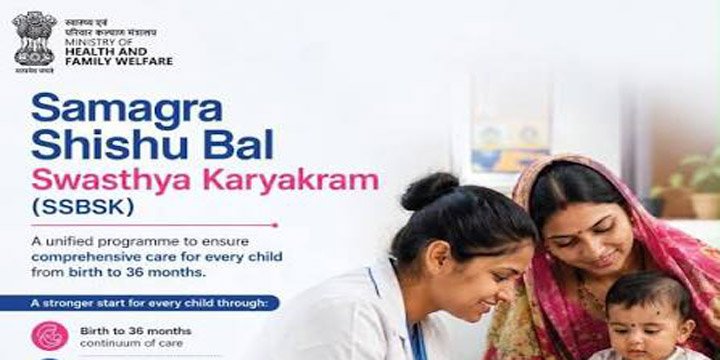
SAMAGRA SHISHU BAL SWASTHYA KARYAKRAM
Why in News?
- Union Health Minister Jagat Prakash Nadda launched the Samagra Shishu Bal Swasthya Karyakram (SSBSK) during the 16th Conference of Central Council of Health and Family Welfare (CCHFW).
- The programme aims to provide a seamless continuum of home and community-based care for every child from birth to 36 months of age.
ABOUT SSBSK
Vision
- Based on the concept of (Comprehensive Care During the First Three Years).
- Focuses on ensuring holistic child development during the most critical phase of life.
Objective
- Strengthen newborn and child healthcare services.
- Improve child survival, nutrition, growth, and development.
- Provide integrated care from birth to three years of age.
Coverage
- Children from birth to 36 months.
- Special focus on vulnerable and high-risk children.
KEY FEATURES OF SSBSK
Integration of Existing Programmes
SSBSK integrates:
- Home-Based Newborn Care (HBNC).
- Home-Based Care for Young Child (HBYC).
Significance
- Creates a unified framework for child healthcare.
- Ensures continuity of care during the first three years of life.
Risk-Stratified Approach
Identification of ‘At-Risk’ Children
Children are categorized as “At-Risk” if they have:
- Low birth weight.
- Premature birth.
- Delayed initiation of breastfeeding.
- Discharge from newborn care units.
- Malnutrition
- Recurrent illness.
- Developmental delays.
Enhanced Home Visits
For At-Risk Newborns
- Up to 9 home visits during the first 42 days of life.
For At-Risk Children
- Up to 8 home visits up to the age of 36 months.
Purpose
- Early detection of complications.
- Timely intervention and referral.
- Continuous monitoring of growth and development.
Community-Based Care Framework
Key Functionaries Involved
- Accredited Social Health Activists (ASHAs).
- Auxiliary Nurse Midwives (ANMs).
- Community Health Officers (CHOs).
- Anganwadi Workers (AWWs).
Joint Home Visits
For At-Risk Newborns
- Day 3.
- Day 7.
For At-Risk Children
- Third month.
- Sixth month.
Benefits
- Coordinated care delivery.
- Better counselling and follow-up.
- Improved referral mechanisms.
Well-Baby Sessions
Village Health, Sanitation and Nutrition Day (VHSND)
- Well-Baby Sessions will be conducted regularly.
Objectives
- Growth monitoring.
- Developmental assessment.
- Early identification of health concerns.
Monthly Shishu Shivir Venue
- Conducted at Ayushman Arogya Mandirs.
Functions
- Screening of children.
- Developmental assessments.
- Community-based management of health conditions.
Maternal Mental Health Component
Importance
- Recognizes the close link between maternal and child well-being.
Role of ASHAs
- Conduct postpartum mental health screening.
- Facilitate referral for counselling and treatment when required.
Significance
- Supports both maternal health and healthy child development.
Nurturing Care for Early Childhood Development (ECD)
Key Components
- Responsive caregiving.
- Early learning opportunities.
- Age-appropriate play.
- Child safety.
- Family participation.
Objective
- Promote cognitive, emotional, social, and physical development.
Digital Health Integration
Decision Support Systems (DSS)
- Assist healthcare workers in service delivery and follow-up.
Child-Wise Digital Tracking
- Monitor individual children throughout the care continuum.
Referral and Alert Systems
- Enable timely interventions for vulnerable children.
Integration with National Digital Health
Platforms: SSBSK will be linked with: JANANI Portal
- Maternal and newborn care tracking.
U-WIN Portal
- Vaccination and immunisation management.
MPCDSR Portal
- Monitoring maternal and child mortality.
RBSK 2.0 Portal
- Child health screening and intervention.
POSHAN Tracker
- Nutrition monitoring and service delivery.
Digital Identity
- Utilizes ABHA ID.& Baal-ABHA ID.
Focus on Urban Vulnerable Populations
Target Groups
- Slum dwellers.
- Migrant populations.
- Underserved urban communities.
Objective
- Ensure equitable access to child healthcare services.
Addressing Digital Era Challenges
Emerging Concerns
- Excessive screen exposure.
- Reduced physical interaction among children.
Potential Risks
- Delayed brain development.
- Emotional and behavioural issues.
- Reduced social skills.
SSBSK Response
- Encourages:
- Physical activity.
- Interactive play.
- Mental stimulation.
- Family engagement.
SIGNIFICANCE OF SSBSK
Improved Child Survival
- Strengthens care during the critical neonatal period.
Early Childhood Development
- Supports healthy cognitive and physical growth.
Integrated Healthcare Delivery
- Brings together health, nutrition, and developmental services.
Technology-Enabled Monitoring
- Enhances efficiency and accountability through digital platforms.
Support for Vulnerable Children
- Provides targeted interventions for high-risk groups.
CHALLENGES
Implementation Capacity
- Requires effective coordination among frontline workers.
Digital Infrastructure Gaps
- Rural and remote areas may face connectivity challenges.
Human Resource Constraints
- Additional responsibilities for ASHAs and health workers.
Monitoring and Follow-Up
- Ensuring timely and quality service delivery across the country.
WAY FORWARD
Strengthen Frontline Workforce
- Provide training and capacity-building support.
Enhance Digital Infrastructure
- Improve connectivity and interoperability of health platforms.
Promote Community Participation
- Increase awareness among families regarding child development.
Focus on Early Intervention
- Strengthen screening and referral systems for at-risk children.
Ensure Universal Coverage
- Expand access to quality child healthcare services across rural and urban India.
Note: Connect with Vajirao & Reddy Institute to keep yourself updated with latest UPSC Current Affairs in English.
Note: We upload Current Affairs Except Sunday.