
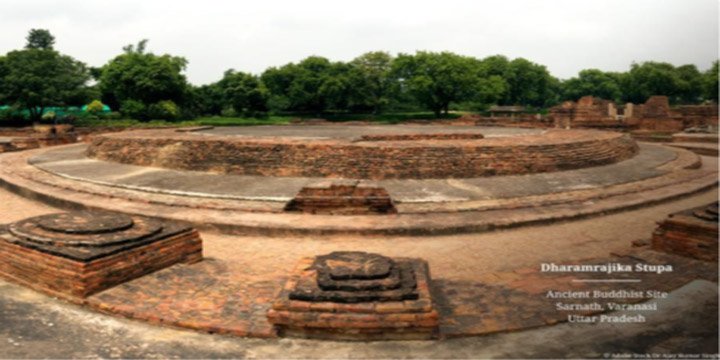
SARNATH ON UNESCO WORLD HERITAGE LIST
Why in News?
- At the 48th Session of the World Heritage Committee held in Busan, South Korea, the Ancient Buddhist Site of Sarnath was inscribed on the UNESCO World Heritage List.
- It was India’s official nomination for the 2025–26 cycle.
- With this inscription, Sarnath became India’s 45th World Heritage Property.
ANCIENT BUDDHIST SITE OF SARNATH
About
- The inscribed property is a serial property comprising:
- Chaukhandi Stupa.
- Archaeological Remains of Sarnath, including:
- Dhamekh Stupa.
- Dharmarajika Stupa.
- Mulagandhakuti Vihara.
- Ashokan Pillar.
- Other associated monuments.
- Located in Varanasi, Uttar Pradesh.
- The site is known in Buddhist tradition by different names:
- Rishipatana.
- Ishipatana.
- Mrigadava.
- It is regarded as the place where Gautama Buddha delivered his first sermon (Dharmachakra Pravartana) in the 6th century BCE.
- The event marked:
- The beginning of the Buddhist Sangha.
- The establishment of the Noble Eightfold Path.
HISTORICAL DEVELOPMENT
- Identified by the Buddha as one of the four principal Buddhist pilgrimage sites.
- Developed over centuries through:
- Royal patronage.
- Monastic patronage.
- Lay patronage.
- Numerous stupas, temples and viharas were constructed around the site of the first sermon.
- Declined during the 12th century CE and subsequently suffered destruction.
- Rediscovered during the 18th century.
ARCHAEOLOGICAL IMPORTANCE
- Contains monuments dating from:
- Pre-Mauryan period (5th–4th century BCE).
- Up to the 12th century CE, with some later additions.
- One of the most extensively excavated sites by the Archaeological Survey of India (ASI).
- Excavations reveal a continuous settlement spanning nearly 16 centuries.
UNESCO INSCRIPTION PROCESS
- Included in the UNESCO Tentative List in 1998.
- Nomination submitted to the World Heritage Committee in January 2025.
- Followed an 18-month evaluation process, including:
- Technical meetings with UNESCO advisory bodies.
- Site evaluation mission by ICOMOS.
- Final inscription approved at the 48th Session of the World Heritage Committee in Busan, South Korea.
HOW UNESCO CHOOSES SITES?
UNESCO names Cultural & Natural sites as UNESCO world heritage sites. There are certain sites which can be designated as mixed heritage site. (natural & cultural).
The Ministry of Culture proposes for inclusion in the UNESCO World Heritage List. This recommendation is done considering the cultural values (in case of cultural sites) & Ecological significance (in case of natural sites).
UNESCO World Heritage Committee has its own Parameters of selecting the places based on cultural or Natural significance attached to them.
THE PARAMETERS
- Human creative genius.
- Interchange of values.
- Testimony to cultural tradition.
- Significance in human history.
- Traditional human settlement.
- Heritage associated with events of universal significance.
- Natural phenomena or beauty.
- Major stages of Earth’s history.
- Significant ecological and biological processes.
- The significant natural habitat for biodiversity.
HOW MANY UNESCO WORLD HERITAGE SITES IN INDIA?
Now, with the recent addition of Shantiniketan & Sacred Ensembles of Hoysalas in 2023, India has 45 UNESCO heritage sites. (37 CULTURAL; 7 NATURAL & 1 MIXED).
https://en.wikipedia.org/wiki/List_of_World_Heritage_Sites_in_India
Which Country has the highest no. of sites?
Italy>China>Germany> France> Spain> India.
CRITERIA FOR INSCRIPTION
Criterion (iii)
- Recognises Sarnath’s enduring spiritual significance as one of the four principal Buddhist pilgrimage destinations.
- Reflected through the large number of religious monuments constructed and reconstructed over centuries.
Criterion (vi)
- Recognises the site’s direct association with events in the life of the Buddha, namely:
- His first sermon.
- His meeting with the first disciples.
- The monuments at Sarnath embody the Buddha’s teachings and the concept of Triratna.
IMPORTANT DISCOVERIES AT SARNATH
- Mauryan Lion Pillar, later adopted as the National Emblem of India.
- Dharmachakrapravartan Buddha of the Classical Gupta period.
- These artefacts are displayed at India’s earliest site museum, established in 1904.
WORLD HERITAGE CONTEXT
- Following the inscription of Sarnath, three of the four most significant Buddhist pilgrimage sites are included in the UNESCO World Heritage List:
- Lumbini (Nepal).
- Mahabodhi Temple, Bodh Gaya (India).
- Sarnath (India).
- Other important Buddhist World Heritage Sites mentioned include:
- Sanchi.
- Nalanda.
- Ajanta.
- Anuradhapura (Sri Lanka).
- Paharpur (Bangladesh).
- Taxila (Pakistan).
- Takht-i-Bahi (Pakistan).
STATUS OF INDIA
Current Status
- India now has 45 World Heritage Sites.
- India ranks:
- 6th globally.
- 2nd in the Asia-Pacific Region in terms of the number of World Heritage Sites.
- 196 countries have ratified the World Heritage Convention, 1972.
- India has 69 sites on the Tentative List, which is a prerequisite for future nominations.
- Each State Party can nominate one site annually for inscription.
Note: Connect with Vajirao & Reddy Institute to keep yourself updated with latest UPSC Current Affairs in English.
Note: We upload Current Affairs Except Sunday.