
SDG INDEX 2026
Why in News?
- India has achieved its highest-ever ranking in the 2026 UN Sustainable Development Goals (SDG) Index, securing the 94th position among 167 countries with an overall score of 3 out of 100, according to the Sustainable Development Report (SDR) 2026 released by the UN Sustainable Development Solutions Network (SDSN).
- Since the adoption of the SDGs in 2015, India has improved its ranking by 18 places, reflecting significant progress in several socio-economic indicators.
- However, the report also highlights persistent challenges in areas such as hunger, health, governance, environmental sustainability, and climate action.
SUSTAINABLE DEVELOPMENT GOALS
WHAT IS SUSTAINABLE DEVELOPMENT REPORT?
- The Sustainable Development Report (SDR) is an annual global assessment published by the UN Sustainable Development Solutions Network (SDSN).
- It evaluates countries’ progress towards achieving the 17 Sustainable Development Goals (SDGs) adopted under the 2030 Agenda for Sustainable Development.
OBJECTIVES:
- Measure global and national progress on SDGs.
- Identify areas requiring urgent policy intervention.
- Promote evidence-based policymaking.
- Encourage international cooperation and accountability.
KEY FINDINGS OF SUSTAINABLE DEVELOPMENT REPORT
Global Scenario
1. World Off Track to Achieve SDGs by 2030
The report paints a concerning global picture:
- None of the 17 Sustainable Development Goals are currently on track to be fully achieved by 2030.
- Only 16.5% of the SDG targets are progressing satisfactorily.
- Nearly 50% of the targets are witnessing only marginal progress.
- Around 15% of the indicators have actually deteriorated since 2015.
This reflects the impact of multiple global crises including:
- Climate change
- Armed conflicts
- Rising debt burdens
- Economic slowdowns
- COVID-19 aftereffects
TOP PERFORMING COUNTRIES
The Nordic countries continue to dominate global sustainability rankings due to their strong social welfare systems, environmental policies, and institutional governance.
| Rank | Country |
| 1 | Finland |
| 2 | Sweden |
| 3 | Denmark |
These countries perform exceptionally well in:
- Quality education
- Universal healthcare
- Gender equality
- Renewable energy
- Strong democratic institutions
LOWEST RANKED COUNTRIES
Countries affected by prolonged conflict and political instability remain at the bottom.
- Chad
- Central African Republic
- South Sudan
Poor governance, humanitarian crises, and weak institutions continue to hinder SDG progress.
MOST CHALLENGING GLOBAL GOALS
The SDGs that are progressing the slowest globally are:
- SDG 2: Zero Hunger
- SDG 11: Sustainable Cities and Communities
- SDG 14: Life Below Water
- SDG 15: Life on Land
- SDG 16: Peace, Justice and Strong Institutions
These goals require significant global cooperation and investment.
COMMITMENT TO MULTILATERALISM
The report also assessed countries based on their support for the United Nations and multilateral cooperation.
- Barbados ranked first in commitment to UN-based multilateralism.
- United States ranked last due to:
- Opposition to parts of the 2030 Agenda
- Withdrawal from several international organizations
- Reduced engagement in multilateral frameworks
INDIA’S PERFORMANCE IN SDG INDEX 2026
Highest Ever Ranking
India secured:
- Rank: 94 out of 167 countries
- Score: 68.3/100
This marks a significant improvement from:
- 2015 Rank: 112
- 2026 Rank: 94
India has emerged as one of the fastest-improving major economies alongside China.
INDIA’S PROGRESS TOWARDS SDGs
According to the report:
- 33.3% of SDG targets are on track for achievement by 2030.
- 42.7% show only limited or moderate progress.
- 24% of indicators have deteriorated.
This indicates that although India is progressing, the pace is insufficient to fully achieve the SDGs by 2030.
MAJOR CHALLENGES IDENTIFIED
1. SDG 2: Zero Hunger — India’s Biggest Concern
The report identifies hunger as India’s most serious development challenge.
Key Indicators
- Child wasting: 19% (highest in the world)
- Child stunting: 29.3%
- Undernourishment: 12%
These figures highlight continuing nutritional deficiencies despite improvements in food production and welfare schemes.
Reasons
- Poor maternal nutrition
- Poverty
- Unequal food distribution
- Inadequate dietary diversity
- Climate-related agricultural stress
2. Major Structural Challenges
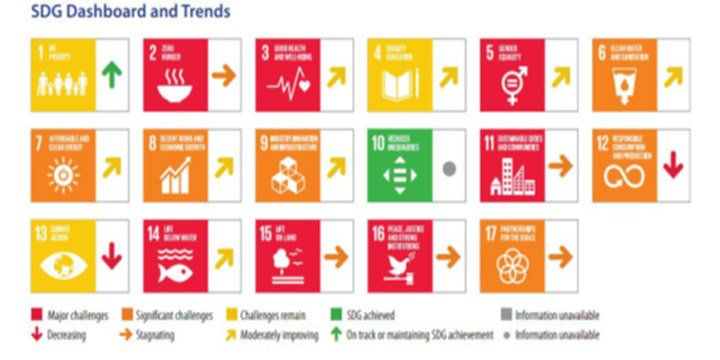
India continues to face “major challenges” in 7 out of 17 SDGs.
These include:
- SDG 2: Zero Hunger
- SDG 3: Good Health and Well-being
- SDG 5: Gender Equality
- SDG 11: Sustainable Cities and Communities
- SDG 14: Life Below Water
- SDG 15: Life on Land
- SDG 16: Peace, Justice and Strong Institutions
3. Health Concerns (SDG 3)
The report notes worsening outcomes in:
- Air pollution-related mortality
- Non-communicable diseases (NCDs)
- Lifestyle disorders
Rapid urbanization, pollution, and changing lifestyles continue to burden India’s healthcare system.
4. Governance and Institutional Decline (SDG 16)
The report records a substantial decline in India’s Press Freedom Index score.
- 2015: 51
- 2026: 96
Institutional quality and governance indicators remain areas requiring improvement.
5. Environmental Setbacks
India is showing deterioration in:
SDG 12
Responsible Consumption and Production
SDG 13
Climate Action
The decline is mainly attributed to:
- Increasing fossil fuel consumption
- Cement production
- Rising industrial emissions
Record CO₂ Emissions
- Per capita carbon dioxide emissions reached: 21 tonnes per person, the highest level recorded for India.
Areas Where India Has Performed Well
- Despite several challenges, the report highlights notable achievements.
SDG 7: Affordable and Clean Energy
India has significantly expanded:
- Electricity access
- Rural electrification
- Household electrification
Government initiatives such as:
- Saubhagya Scheme
- Deen Dayal Upadhyaya Gram Jyoti Yojana
- Renewable energy expansion have contributed substantially.
SDG 9: Industry, Innovation and Infrastructure
India has witnessed remarkable progress in:
- Mobile broadband coverage
- Internet penetration
- Digital infrastructure
- Digital public services
The Digital India programme and expanding telecom networks have accelerated digital inclusion.
INDIA’S DOMESTIC SDG ARCHITECTURE
1. NITI Aayog
NITI Aayog is the nodal institution for SDG implementation in India.
Its key initiatives include:
- SDG India Index
- SDG Dashboard
- Promotion of cooperative and competitive federalism
2. Ministry of Statistics and Programme Implementation (MoSPI)
MoSPI monitors SDG progress through the:
- National Indicator Framework (NIF)
- 277 national indicators
It is supported by the Data for Development Coordination Forum (DDCF) in collaboration with NITI Aayog and the UN Resident Coordinator Office.
3. Ministry of Panchayati Raj
The Ministry promotes localization of SDGs through:
- Nine Localisation of SDGs (LSDGs) themes
- Local Indicator Framework (LIF)
- Panchayat Advancement Index (PAI)
The PAI evaluates over 2.5 lakh Gram Panchayats using a 100-point performance scale, encouraging grassroots implementation of sustainable development.
WAY FORWARD
India’s improved ranking in the SDG Index 2026 reflects meaningful progress in expanding electricity access, digital connectivity, and infrastructure. However, the report underscores that significant challenges remain in eliminating hunger, improving public health, strengthening institutions, advancing gender equality, and addressing environmental degradation. Achieving the SDGs by 2030 will require accelerated policy implementation, stronger Centre–State coordination, increased investment in nutrition and healthcare, sustainable urban planning, climate-resilient development, and robust monitoring mechanisms. With only one-third of its SDG targets currently on track, India must intensify efforts to ensure that economic growth translates into inclusive, equitable, and environmentally sustainable development, in line with the overarching commitment to “Leave No One Behind.”
Note: Connect with Vajirao & Reddy Institute to keep yourself updated with latest UPSC Current Affairs in English.
Note: We upload Current Affairs Except Sunday.