
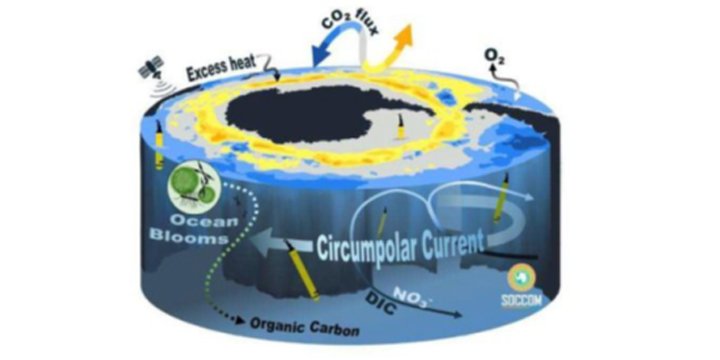
SOUTHERN OCEAN CARBON ANOMALY
Why in News?
- Scientists have discovered that the Southern Ocean has absorbed more carbon dioxide than expected, contradicting long-standing climate model predictions.
- This unexpected behaviour is referred to as the Southern Ocean carbon anomaly.
- The findings were published in Nature Climate Change in October 2025 by researchers from Germany.
IMPORTANCE OF SOUTHERN OCEAN
- The Southern Ocean surrounds Antarctica and is one of the least explored oceans on Earth.
- It plays a critical role in regulating global climate.
- The Southern Ocean covers about 25–30 percent of the global ocean area.
- It absorbs nearly 40 percent of the carbon dioxide taken up by the world’s oceans.
- Its ability to absorb heat and carbon makes it a major buffer against global warming.
WHY THE SOUTHERN OCEAN IS A STRONG CARBON SINK?
- The surface of the Southern Ocean is cold and relatively fresh, making it lighter than deeper waters.
- Below the surface lie warmer, saltier, and carbon-rich deep waters.
- This layered structure, known as stratification, traps carbon dioxide below the surface.
- As long as this layering remains stable, the ocean continues to absorb more carbon than it releases.
CLIMATE MODEL PREDICTIONS
- For nearly two decades, climate models predicted that the Southern Ocean would become a weaker carbon sink.
- Rising greenhouse gases and ozone depletion were expected to strengthen westerly winds in the Southern Hemisphere.
- Stronger winds were expected to increase upwelling, bringing carbon-rich deep waters to the surface.
- This process was expected to release carbon dioxide into the atmosphere and accelerate climate change.
WHAT SCIENTISTS ACTUALLY OBSERVED?
- Observations since the early 2000s show that the Southern Ocean has been absorbing more carbon, not less.
- Long-term ocean chemistry data revealed that deep waters are indeed rising, as models predicted.
- Circumpolar deep waters have moved upward by about 40 metres since the 1990s.
- Carbon dioxide pressure in subsurface waters has increased by around 10 microatmospheres.
- Despite this, carbon dioxide has not escaped into the atmosphere.
WHAT THE CLIMATE MODELS MISSED?
- Scientists found that a thin but persistent layer of freshwater at the surface prevented carbon release.
- The Southern Ocean has become less salty due to:
- Increased rainfall
- Melting Antarctic glaciers
- Transport of sea ice
- Fresher water is lighter and strengthens surface stratification.
- This stratification traps carbon-rich waters 100–200 metres below the surface, preventing gas exchange with the atmosphere.
COMPETING PHYSICAL PROCESS AT WORK
- Two opposing mechanisms are operating simultaneously:
- Upwelling, which pushes deep carbon-rich water upward
- Stratification, which blocks vertical mixing
- Climate models captured the upwelling correctly but underestimated surface stratification.
- Stratification is difficult to model because it depends on complex processes like:
- Ocean eddies
- Ice-shelf cavities
- Small-scale turbulence
- Limited observational data in the Southern Ocean worsened this modelling gap.
WHY THIS CARBON SINK MAY BE TEMPORARY?
- Scientists warn that the current situation may not last long.
- Since the early 2010s, the stratified freshwater layer has started to thin in some regions.
- Surface salinity has begun increasing again in parts of the Southern Ocean.
- Strong winds could soon penetrate the weakened stratified layer.
- This could allow carbon-rich deep waters to mix with surface waters and release carbon dioxide into the atmosphere.
FUTURE CLIMATE RISK
- The deep carbon reservoir is now closer to the surface than before.
- If stratification weakens further, carbon dioxide could be released suddenly and in large amounts.
- This could cause a rapid weakening of the Southern Ocean carbon sink, as models had originally predicted.
WHAT THIS MEANS FOR CLIMATE MODELS?
- The findings do not invalidate climate models.
- Instead, they show that models:
- Correctly identify long-term vulnerabilities
- May miss short-term or regional exceptions
- Observations complement models by revealing unexpected real-world behaviour.
- Together, models and observations improve understanding of Earth’s climate system.
NEED FOR BETTER OBSERVATIONS
- Scientists stress the need for continuous, year-round monitoring of the Southern Ocean.
- The region is one of the harshest environments on Earth, making data collection difficult.
- Improved observations are essential to predict whether the ocean will absorb or release carbon in the future.
CONCLUSION
- The Southern Ocean carbon anomaly highlights the complex and dynamic nature of Earth’s climate system.
- Temporary processes like surface freshening can delay long-term climate impacts.
- However, these buffers may weaken, leading to sudden changes.
- Understanding this balance is crucial for accurate climate prediction and global climate policy.
Note: Connect with Vajirao & Reddy Institute to keep yourself updated with latest UPSC Current Affairs in English.
Note: We upload Current Affairs Except Sunday.