
STARTUP VILLAGE ENTREPRENEURSHIP PROGRAM
Why in News?
- As of 30 June 2026, the Start-up Village Entrepreneurship Programme (SVEP) has supported 32 lakh rural enterprises across India.
- The programme has emerged as an effective model for grassroots entrepreneurship, poverty reduction, employment generation and rural economic development.
ABOUT SVEP
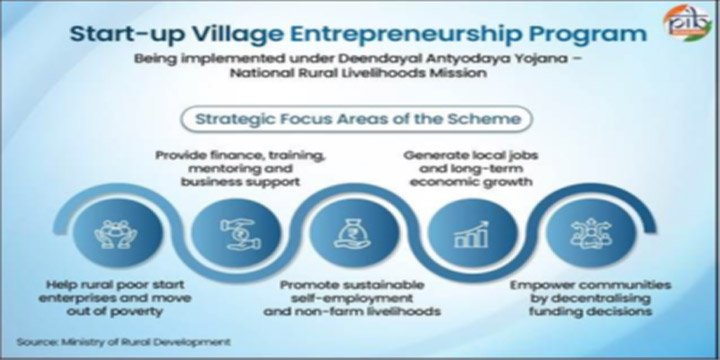
- SVEP was launched in 2016.
- It is a sub-scheme of the Deendayal Antyodaya Yojana–National Rural Livelihoods Mission (DAY-NRLM).
- The programme promotes non-farm rural enterprises by supporting Self-Help Groups (SHGs) and their family members in establishing small businesses.
- It provides:
- Financial assistance.
- Institutional support.
- Business management training.
- Soft skill development.
- Business development services.
- It also facilitates:
- Bank linkages.
- Convergence with government schemes.
- Community-based enterprise promotion.
OBJECTIVES
- Promote rural entrepreneurship.
- Support non-farm enterprises.
- Generate sustainable livelihoods.
- Create self-employment opportunities.
- Reduce rural poverty.
- Strengthen local economies through community institutions.
KEY FEATURES
Community-led Enterprise Promotion
- Funding and enterprise support are based on community-led decision-making.
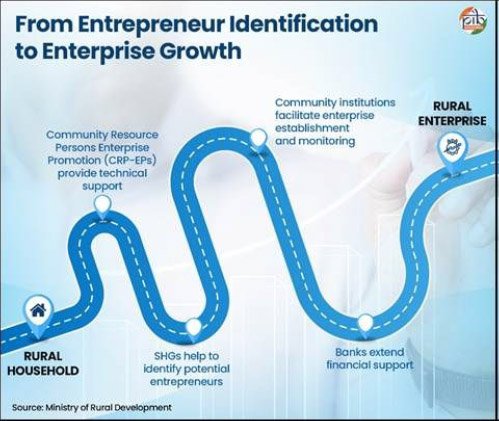
- Community institutions identify entrepreneurs and provide continuous handholding support.
Financial Support
- Facilitates:
- Bank credit.
- Community Enterprise Fund (CEF).
- Convergence with schemes such as Pradhan Mantri Mudra Yojana.
Institutional Support
- Provides:
- Training.
- Mentoring.
- Business planning.
- Enterprise management support.
- Credit facilitation.
Digital Support
- Digital tools are used for:
- Business planning.
- Loan appraisal.
- Enterprise tracking.
IMPLEMENTATION MECHANISM
State Rural Livelihood Missions (SRLMs)
- SVEP is implemented through State Rural Livelihood Missions (SRLMs).
- Financial provision:
- ₹6.50 crore per block.
- Average investment of ₹27,083 per enterprise.
Block Resource Centres–Enterprise Promotion (BRC-EPs)
- Coordinate programme implementation at the block level.
Community Resource Persons–Enterprise Promotion (CRP-EPs)
- Provide:
- Technical assistance.
- Mentoring.
- Training.
- Credit facilitation.
- At least:
- 90% selected from SHG households.
- 60% are women.
- Each CRP-EP supports up to 50 enterprises.
ROLE OF SHG
- Identify potential entrepreneurs.
- Facilitate enterprise establishment.
- Manage loans through the Community Enterprise Fund (CEF).
- Monitor enterprise performance.
BENEFICIARY SELECTION
- Entrepreneurs are selected based on:
- Need.
- Poverty status.
- Entrepreneurial potential.
- Beneficiaries receive:
- Training.
- Mentoring.
- Financial support.
- Programme mandates:
- At least 60% women beneficiaries.
- Representation of SC, ST, Minority communities and Persons with Disabilities (PwDs).
ACHIEVEMENTS
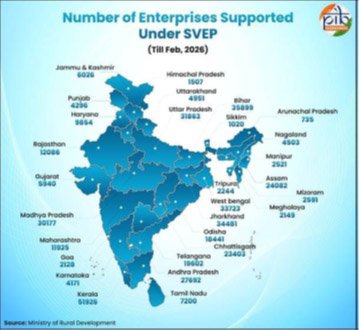
- 4.32 lakh rural enterprises supported.
- Around 86% of entrepreneurs belong to:
- SC.
- ST.
- Minority.
- OBC communities.
- Highest number of enterprises supported in:
- Assam.
- Bihar.
- Jharkhand.
- West Bengal.
- Madhya Pradesh.
MONITORING
- Monitored through:
- Quarterly reviews.
- Periodic assessments.
- Centralised Management Information System (MIS) for:
- Enterprise performance.
- Fund utilisation.
- Programme progress.
IMPACT ASSESSMENT
Major Findings
- 99% of SVEP-supported enterprises were profitable.
- Enterprises contributed 57% of total household income.
- Average monthly enterprise revenue: ₹39,000.
- Manufacturing enterprises earned an average of ₹47,800 per month.
- 96% of entrepreneurs reported increased savings.
- 75% of enterprises were owned or managed by women.
Social Impact
- Promoted first-generation entrepreneurship.
- Improved confidence and livelihood security.
- Enhanced:
- Education.
- Nutrition.
- Health.
- Sanitation.
- Increased savings and long-term enterprise growth.
- Improved social status of beneficiaries.
ABOUT DAY NRLM
Deendayal Antyodaya Yojana–National Rural Livelihoods Mission
- One of the world’s largest livelihood programmes.
- Mobilises rural poor households into Self-Help Groups (SHGs), predominantly women.
- Focuses on:
- Sustainable livelihoods.
- Financial inclusion.
- Skill development.
- As of mid-June 2026, more than 29 crore rural households had been mobilised into SHGs.
SIGNIFICANCE
- Promotes grassroots entrepreneurship and inclusive rural development.
- Generates local employment through non-farm enterprises.
- Empowers women and socially disadvantaged communities.
- Strengthens community-based institutions.
- Contributes to the vision of Atmanirbhar Bharat and a vibrant rural start-up ecosystem.
Note: Connect with Vajirao & Reddy Institute to keep yourself updated with latest UPSC Current Affairs in English.
Note: We upload Current Affairs Except Sunday.