
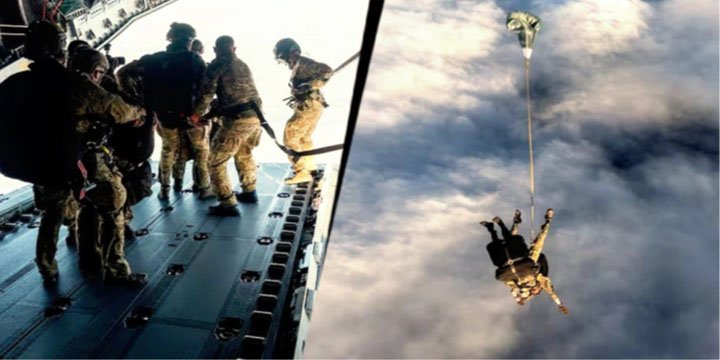
UK ARMY’S PARACHUTE MISSION TO TRISTAN DA CUNHA AMID HANTAVIRUS OUTBREAK
Why in News
- The British Army conducted a rare parachute-based humanitarian medical missionto the remote island of Tristan da Cunha.
- The mission was launched to assist a British resident suspected of contracting hantavirus after leaving the cruise ship MV Hondius.
- The operation became globally significant because it marked the first-ever emergency deployment of UK military medical personnel through parachute insertion.
- The event also highlighted concerns regarding the ongoing hantavirus outbreak linked to the cruise ship.
BACKGROUND OF THE INCIDENT
- A resident of Tristan da Cunha disembarked from the cruise ship MV Hondius on 14 April 2026.
- According to the World Health Organization, the individual later developed symptoms such as:
- Diarrhoea
- Fever
- These symptoms raised suspicion of hantavirus infection.
- Due to the island’s geographic isolation and limited healthcare facilities, emergency medical support became necessary.
DETAILS OF THE MILITARY OPERATION
- The mission was conducted by the 16 Air Assault Brigade.
- The operation involved:
- Six paratroopers
- Two intensive-care medical specialists
- The team travelled from RAF Brize Norton aboard an Airbus A400M Atlas aircraft.
- The medical personnel parachuted onto the island through tandem jumps because the island lacks an airport.
- The aircraft also delivered:
- Critical oxygen supplies
- 3.3 tonnes of medical equipment and medicines
WHY THE MISSION WAS EXTRAORDINARY?
- The Ministry of Defence described the mission as an unprecedented humanitarian deployment.
- It was the first time UK military doctors and nurses were deployed into a medical emergency through a parachute insertion operation.
- The mission was carried out under:
- Strong winds
- Difficult weather conditions
- Severe geographic isolation
ABOUT TRISTAN DA CUNHA
- Tristan da Cunha is regarded as the world’s most remote inhabited islandsettlement.
- Key facts:
- Population: Around 221 residents
- Located in the South Atlantic Ocean
- It is a British Overseas Territory
- The island has no airport
- Access is possible only by sea
- Its nearest inhabited neighbour is Saint Helena, located over 2,400 km away.
HANTAVIRUS OUTBREAK ON MV HONDIUS
- The outbreak originated aboard the expedition cruise vessel MV Hondius.
- Current outbreak figures include:
- 3 deaths
- 6 confirmed infections
- 2 suspected cases
- The ship later reached Tenerife, where passengers began disembarkation and repatriation.
WHAT IS HANTAVIRUS?
- Hantaviruses are zoonotic viruses, meaning they spread from animals to humans.
- They belong to the Hantaviridae family under the order Bunyavirales.
- Hantaviruses are a group of viruses mainly carried by rodents.
- Each hantavirus strain is generally linked to a specific rodent species.
- Rodents usually carry the virus without becoming ill.
- Humans usually become infected through contact with:
- Rodent urine
- Droppings
- Saliva
- Infection can cause:
- Severe respiratory illness
- Kidney complications
- Death in serious cases
- In the Americas, hantaviruses can cause Hantavirus Cardiopulmonary Syndrome (HCPS), which affects the lungs and heart.
- HCPS may have a fatality rate of up to 50%.
- In Europe and Asia, hantaviruses mainly cause Hemorrhagic Fever with Renal Syndrome (HFRS), which affects kidneys and blood vessels.
- The Andes virus found in South America is the only known hantavirus capable of limited human-to-human transmission.
TYPES OF HANTAVIRUS DISEASES
Hantavirus Cardiopulmonary Syndrome (HCPS)
- Found mainly in:
- North America
- Central America
- South America
- It affects:
- Lungs
- Heart
- Symptoms may rapidly progress to:
- Cough
- Breathlessness
- Fluid accumulation in lungs
- Shock
Haemorrhagic Fever with Renal Syndrome (HFRS)
- Found mainly in:
- Europe
- Asia
- It primarily affects:
- Kidneys
- Blood vessels
- Severe cases may lead to:
- Bleeding disorders
- Kidney failure
- Low blood pressure
TRANSMISSION OF HANTAVIRUS
- Infection mainly spreads through:
- Contact with contaminated rodent waste
- Inhalation of virus particles in enclosed spaces
- Rodent bites (rare)
- High-risk activities include:
- Cleaning poorly ventilated rooms
- Farming
- Forestry work
- Staying in rodent-infested areas
- Human-to-human transmission has been documented only for the Andes virus.
SYMPTOMS
- Symptoms usually appear between 1 and 8 weeks after exposure.
- Common symptoms include:
- Fever
- Headache
- Muscle pain
- Abdominal pain
- Nausea
- Vomiting
- Severe disease may lead to:
- Respiratory failure
- Shock
- Kidney complications
DIAGNOSIS
- Early diagnosis is difficult because symptoms resemble diseases such as:
- Influenza
- COVID-19
- Dengue
- Viral pneumonia
- Leptospirosis
- Diagnosis depends on:
- Patient history
- Rodent exposure history
- Travel history
- Laboratory confirmation includes:
- IgM and IgG antibody testing
- RT-PCR testing
TREATMENT
- There is currently:
- No specific antiviral treatment
- No licensed vaccine
- Treatment mainly involves:
- Intensive supportive care
- Oxygen support
- Management of respiratory and kidney complications
- Early medical intervention significantly improves survival chances.
WHO’s RESPONSE
- The World Health Organization supports countries through:
- Disease surveillance
- Laboratory strengthening
- Risk communication
- Outbreak response
- Infection-control guidance
- WHO also promotes a One Health approach, linking:
- Human health
- Animal health
- Environmental management
Note: Connect with Vajirao & Reddy Institute to keep yourself updated with latest UPSC Current Affairs in English.
Note: We upload Current Affairs Except Sunday.