
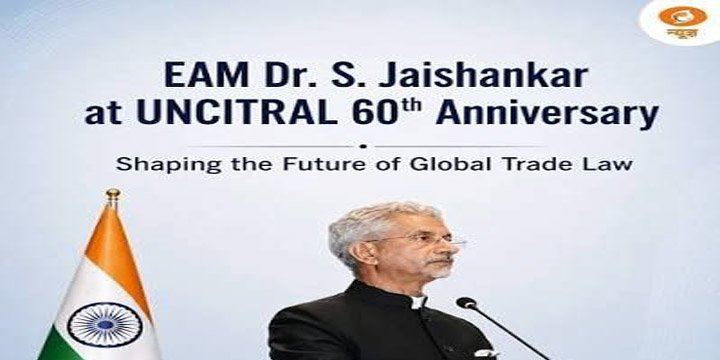
UNCITRAL’S 60TH ANNIVERSARY
Why in News?
- India hosted an international conference to commemorate the 60th anniversary of the United Nations Commission on International Trade Law (UNCITRAL).
- Addressing the conference, External Affairs Minister (EAM) S. Jaishankar emphasised the need for predictable, harmonised and inclusive international trade laws, with greater participation of the Global South in shaping global legal norms.
UNITED NATIONS COMMISSION ON INTERNATIONAL TRADE LAW
About
- UNCITRAL is the United Nations Commission on International Trade Law.
- Over the past 60 years, it has contributed to:
- Harmonisation of international trade law.
- Modernisation of commercial legal frameworks.
- Progressive development of international trade law.
- It develops:
- Model laws.
- International conventions.
- Legal standards governing international trade.
WHY IS UNCITRAL BECOMING MORE RELEVANT?
According to the External Affairs Minister, the global economy is undergoing major changes due to:
- Rapid technological advancements.
- Growth of digital commerce.
- Changing global supply chains.
- New investment patterns.
- Geopolitical volatility.
- Cross-border movement of goods, services, capital and data.
These developments have increased the need for:
- Predictable legal systems.
- Harmonised international rules.
- Efficient dispute resolution mechanisms.
- Stable cross-border commercial frameworks.
KEY HIGHLIGHTS OF EAM’S ADDRESS
Need for Predictable Legal Frameworks
- Countries require:
- Reliable legal certainty.
- Harmonised trade rules.
- Efficient dispute resolution systems.
- Such frameworks are essential for facilitating:
- International trade.
- Cross-border investment.
- Commercial cooperation.
Inclusive International Trade Law
- International trade law should reflect the developmental priorities of the Global South.
- Developing countries should have a greater role in framing international legal norms.
- The future global legal architecture should be:
- Democratic
- Inclusive.
- Responsive to the needs of developing economies.
Trade Law as an Equaliser
- International trade law should function as a leveller by bridging the gap between:
- Developed economies.
- Developing economies.
INDIA’S ASSOCIATION
- India is among the eight countries that have maintained continuous membership of UNCITRAL.
- India has actively contributed to the evolution of international trade law.
INDIA’S LEGAL REFORMS
The External Affairs Minister highlighted India’s reforms in:
- Arbitration
- Commercial dispute resolution.
- Insolvency.
These reforms demonstrate India’s commitment to creating:
- A modern legal framework.
- A transparent legal system.
- An internationally compatible commercial environment.
LINK WITH VIKSIT BHARAT
According to the External Affairs Minister, achieving the vision of Viksit Bharat 2047 requires:
- A resilient economy.
- Technological innovation.
- Expansion of manufacturing.
- Deeper global economic integration.
- Predictable legal frameworks that support international trade and commercial cooperation.
OBJECTIVES HIGHLIGHTED AT THE CONFERENCE
- Promote harmonised international trade laws.
- Strengthen legal certainty in cross-border transactions.
- Improve dispute resolution mechanisms.
- Encourage inclusive participation of developing countries in global rule-making.
- Support seamless international trade and investment.
OTHER DIPLOMATIC ENGAGEMENTS
The External Affairs Minister also:
- Unveiled the book “We The People – 250 Voices that Shaped US-India Relationship”, published by the US-India Strategic Partnership Forum.
- Participated in:
- ASEAN Post-Ministerial Conference with India.
- ASEAN Regional Forum (ARF).
- East Asia Summit Foreign Ministers’ Meeting.
- QUAD Foreign Ministers’ Meeting in Manila.
- Held bilateral meetings with counterparts during these engagements.
SIGNIFICANCE
- Highlights the growing importance of international trade law in an evolving global economy.
- Reinforces the need for predictable, harmonised and inclusive legal frameworks for international commerce.
- Reflects India’s active role in shaping the future of global trade governance.
- Emphasises greater representation of the Global South in developing international legal norms.
- Supports India’s vision of becoming a globally integrated economy under Viksit Bharat 2047.
Note: Connect with Vajirao & Reddy Institute to keep yourself updated with latest UPSC Current Affairs in English.
Note: We upload Current Affairs Except Sunday.