
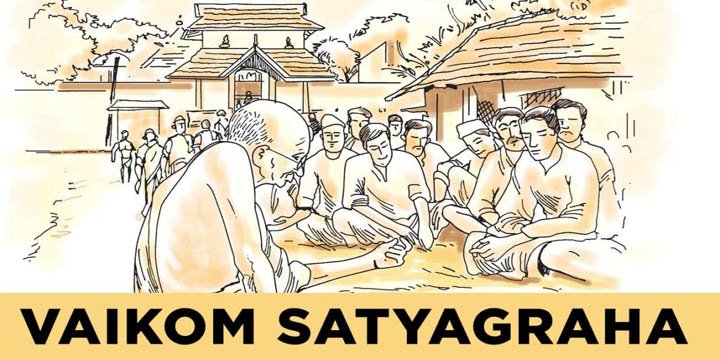
VAIKOM SATYAGRAHA
Vaikom, a temple town in the princely state of Travancore, saw the start of a non-violent agitation on March 30, 1924 — the first among temple entry movements that would soon sweep across the country.
The satyagraha foregrounded social reform amidst the growing nationalist movement, bringing Gandhian methods of protest to the state of Travancore.
SIGNIFICANCE:
100 Years have been completed for this Satyagraha.
ABOUT VAIKOM SATYAGRAHA
- The Vaikom Satyagraha is the first anti-caste movement, as the pupil of the depressed class and untouchables were restricted from entering the temple.
- The movement in the vicinity of Mahadev temple in Kottayam district of Kerala took place during 1924-1925.
Background:
- In AICC (All India Congress Committee) meeting in Kakinada 1923, K Madhavan along with Sardar Panikkar and KP Kesava Menon submitted a petition to the Travancore legislative council.
- The petition sought to grant the right to temple entry and worship of gods for all sections of the society irrespective of caste, creed, and community.
BEGINNING
- The Vaikom Satyagraha was launched on 30th March 1924.
- The first chosen place for the initiation of the Satyagraha was the four public roads proceeding to the Shiva Shrine in Vaikom where marginalized, depressed caste and untouchables were not allowed to enter.
- The leading Satyagrahis namely Kunjappy, Venniyil Govinda Panicker, and Bahuleyan lead the procession walking hand in hand towards the Shiva shrine.
- Outside the shrine, a message was displayed that Ezhavas and other lower caste including the marginalized sections of the society are restricted to make use of the pavement (road) for any of its utilities.
- The policemen guarding the road arrested the three men and more Satyagrahis joined the movement, marking the commencement of the Vaikom Satyagraha.
PROMINENT PARTICIPANTS
- One of the prominent figures was Periyar E.V Ramasamy. He also joined the struggle and is popularly known as the only Satyagrahi who was arrested twice, thus earning him the title of Vaikom Virar (the fearless hero of Vaikom).
- Sree Narayana Guru also extended his support and cooperation to the Vaikom Satyagraha. He was against the caste system and orthodox discrimination prevalent in the society.
- The Vaikom Satyagraha witnessed women’s empowerment as a large number of women seem to be actively participating in the movement for the first time.
ROLE OF GANDHIJI
- He felt that the support of the Savarnas (upper castes) was needed for the peak point of the Vaikom Movement.
- Thus, he suggested that a procession consisting of only Savarnas should march to Trivandrum to show their support.
- As a result, on 1st October 1924, a troop of Savarnas marched and lead the procession to submit an appealing petition to the Regent Maharani Sethu Lakshmi Bai of Travancore consisting of 25000 signatures to open the gates of temple for every caste.
SIGNIFICANCE OR IMPACT
- In 1925, Gandhiji wrote to Pitt, then Police Commissioner of Travancore to resolve the ongoing matter. Thus, Pitt intervened and a settlement was signed between Government and Gandhiji.
- In 1925, the Government agreed to nullify the prohibitory orders passed in February 1924, and Gandhiji gave his consent to withdraw the Satyagraha.
- It was announced by the government that roads (pathways) on three sides of the Shiv shrine or Mahadev temple of Vaikom (north, south, and west) would be open for all public.
- However, the road on the eastern side would be reserved for Savarnas only.