
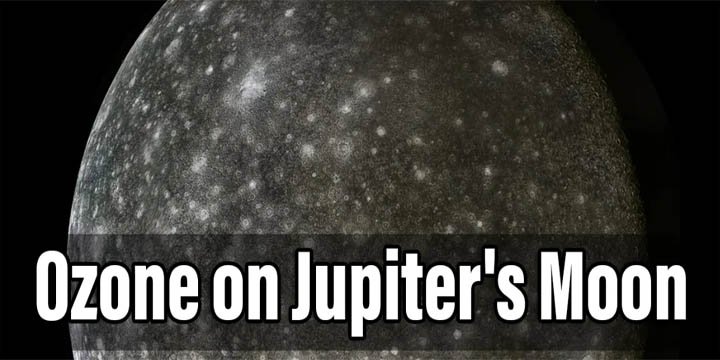
OZONE ON JUPITER’S MOON
An international team of scientists, including from India, has discovered strong evidence indicating the presence of ozone on Jupiter’s moon, Callisto, shedding light on the complex chemical processes taking place on icy celestial bodies in the Solar System.
WHAT WAS THE SOURCE OF THESE FINDINGS?
They corroborated their findings by comparing them with data from the Hubble Space Telescope to understand Callisto’s environment and the potential habitability of icy moons in the Solar System.
WHY LIFE EXISTS ON EARTH?
The earth has life not just because it found a way to originate here; it also has the resources to thrive, evolve, and diversify.
WHICH KIND OF RESOURCES?
These resources include
- Sunlight containing the “right” frequencies of radiation,
- Water,
- A stable atmosphere providing a stable supply of the requisite gases at the right temperature, and
- Various compounds required for the life-forms’ biochemical processes.
Scientists are currently studying various celestial bodies in the Solar System that show signs of ozone, suggesting the existence of stable atmospheric conditions and, by extension, the possibility of their being able to host life.
IMPORTANCE OF OZONE
Ultraviolet radiation in particular is harmful to many species (but also useful to some others). Two of its components, called ultraviolet-B (Wavelength 290–320 nanometres) and ultraviolet-C (wavelength 100-280 nanometres)
WHAT DAMAGE CAN BE CAUSED BY UV RADIATION?
- It can damage DNA, trigger mutations, and increase the risk of skin cancer and cataracts in humans.
- Ultraviolet light has also been known to inhibit plant growth and have detrimental effects on various organisms.
This is why the ozone layer is a crucial part of the earth’s atmosphere: it completely absorbs ultraviolet-B and ultraviolet-C radiation.
ABOUT CALLISTO
- Callisto is one of Jupiter’s largest moons and the third-largest moon in the Solar System After Ganymede and Titan.
- Callisto, despite its huge size, is distinguished by its composition.
- Despite being as big as the planet Mercury, it has less than half as much mass.
- Callisto is primarily composed of water ice, rocky materials, sulphur dioxide, and some organic compounds.
- These substances make the moon a potential candidate for supporting life in the solar system beyond the earth.
- Callisto’s surface is heavily cratered, indicating a long history of being struck by asteroids and comets. (It may have the oldest surface in the Solar System, in fact.)
- It also lacks the extensive seismic activity seen on some of Jupiter’s other moons, such as Io and Europa.
- Its surface is relatively stable devoid of any seismic activity.
Note: Connect with Vajirao & Reddy Institute to keep yourself updated with latest UPSC Current Affairs in English.
Note: We upload Current Affairs Except Sunday.